Stomatepia pindu
Last revised 2026Edit this page
On this page11 sections
Quick factsEdit
Difficulty3 of 8 measures
- Space
- medium tank
- Water
- needs a steady pH
- Temp
- needs a very steady temperature
- Diet
- unknown
- Temperament
- unknown
- Social
- unknown
- Compatibility
- unknown
Other demands
Each of these can raise the rating on its own, whatever the measures above say.
- Hardiness
- unknown
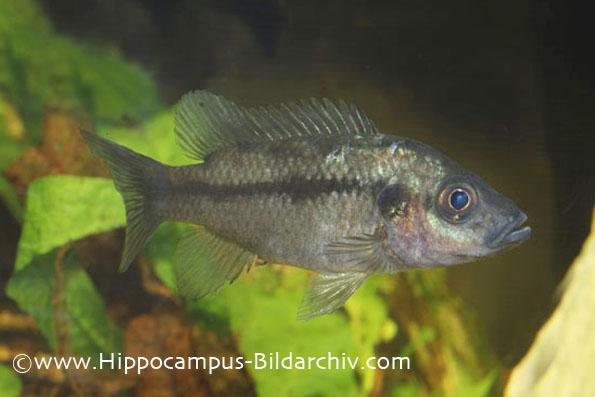
Stomatepia pindu is a cichlid endemic to Lake Barombi Mbo, a small volcanic crater lake in Cameroon. Its tiny range, water removal for the nearby town of Kumba, deforestation, introduced species and overfishing mean it is considered critically endangered, and it is correspondingly rare in the hobby. It can change colour rapidly, turning pure black when in good condition and particularly when spawning.
Distribution
EditCameroon. It is endemic to Lake Barombi Mbo, a volcanic crater lake with a diameter of just 3 miles.
Habitat
Write a noteEditUnknown.
Aquarium size
Write a noteEdit75 ∗ 30 ∗ 30 cm30 ∗ 12 ∗ 12 in - ~68 litres~18 US gal.
Maintenance
Write a noteEditNot much is written about the fishes' natural biotope. We suggest a sandy substrate with some piles of rockwork and/or driftwood arranged to form caves and hiding places.
Water conditions
EditTemperature: 25 – 27 °C77 – 81 °F
pH: 7.5-8.5
Hardness: 4-12°H
These recommendations come from this profile’s own figures. They contain affiliate links, so we may earn a commission.
Diet
Write a noteEditA micropredator in nature. Feed a diet composed mainly of live and frozen foods, supplemented with good quality pellets or flake.
Behaviour and compatibility
Write a noteEditIt is best kept in a species tank to allow the best possible chances of a successful spawn. The fish pay little attention to conspecifics, even when spawing, and can be maintained in a group.
Sexual dimorphism
Write a noteEditUnknown.
Reproduction
Write a noteEditHas been acieved in captivity but little published information exists. Maternal mouthbrooder. It appears that spawning is a very simple process, with a pair of fish leaving the main school and spawning directly onto the substrate. No particular spawing site is designated or constructed. The female lays the eggs, allows the male to fertilise them and then picks them up in her mouth. She retains them for 3-4 weeks. Once released, the fry can be fed on brine shrimp nauplii, microworm or powdered dried foods.
Notes
EditBecause of it's its tiny natural range, habitat destruction due to excess water removal (the nearby town of Kumba relies on the lake for it's water supply), deforestation, the introduction of non-native species and overfishing, it is considered to be critically endangered. All efforts at captive breeding are to be encouraged. However, it is correspondingly rare in the hobby. The area around Lake Barombi Mbo has been suggested to be designated a protected area, but as yet this has not occured.
Currently there are 2 other species of Stomatepia. These are also endemic to Lake Barombi Mbo and are similarly threatened.
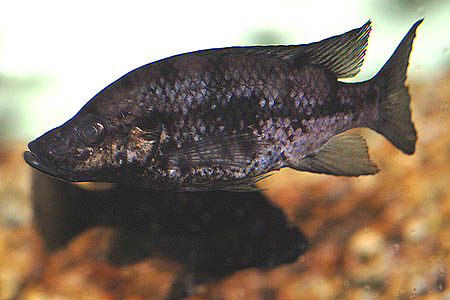
S. pindu can undergo rapid colour changes when threatened or excited. The most notable of these is a pure black colouration that the fish exhibit when in good condition, and particularly when spawning.
Species images · 2
These photographs are used with each photographer's permission.
Send a photograph