Results for “lateral”
Type a name: scientific, common, or one a species used to go by. Or narrow the catalogue with the filters.
Filters
Scleropages jardiniiAustralian Arowana
authority not recorded
Max length900mm SL35in SLTank180 × 60cm72 × 24inTemp24–29°C75–84°FpH6.8–7.5Although S. jardinii superficially resembles its Asian cousins, it is not considered as desirable an aquarium inhabitant, nor is it classed as being at risk in nature. It can be easily distinguished from the asian species by its much smaller scale size, greater lateral scale count (32-35 as opposed to 21-25 in the asian aros) and duller patterning. It differs from its Australian relative S. leichardtii by its more sloping head, downward-pointing barbels and patterned gill covers. The base colour...
Scleropages leichardtiSpotted Australian Arowana
authority not recorded
Max length900mm SL35in SLTank180 × 60cm72 × 24inTempnot recordedpH6.8–7.5Although S. leichardtii superficially resembles its Asian cousins, it is not considered as desirable an aquarium inhabitant, nor is it classed as being at risk in nature. It can be easily distinguished from the asian species by its much smaller scale size, greater lateral scale count (32-35 as opposed to 21-25 in the asian aros) and duller patterning. It differs from its Australian relative S. jardinii by its spotted scales, forward-pointing barbels, lack of sloping head and unpatterned gill cov...
Tanganicodus irsacae
authority not recorded
Max length70mm SL2.8in SLTank75 × 30cm30 × 12inTemp24–28°C75–82°FpH8.0–9.0This is one of the so-called Tanganyikan Goby Cichlids. They occur only in the upper few feet of water around rocky shores, also known as the surge zone, where they scrape algae from the rocks with their specialised teeth. This habitat is typified by breaking waves and strong currents. They have a few adaptations allowing them to inhabit such an environment. The swim bladder is rendered useless to reduce their buoyancy. They also have a longand a laterally compressed body shape to allow them to ...
Thayeria boehlkeiFalse Penguin Tetra
authority not recorded
Max length36mm SL1.4in SLTank60 × 38cm24 × 15inTemp22–28°C72–82°FpHnot recordedThere are only three species in the genus Thayeria, of which T. boehlkei is by far the most popular in the hobby. Of its congeners, it was the type species T. obliqua that was originally given the common name of "penguin" fish or tetra, although T. boehlkei is usually sold under the same name (we've also seen it on sale as "hockeystick" tetra). The two are easy to tell apart, as in T. boehlkei the thick black stripe extending from the lower lobe of the travels laterally ...
Trigonopoma gracile
Kottelat, 1991
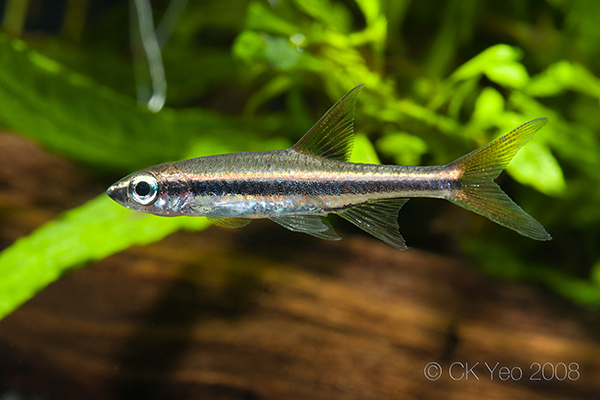
Max length55mm SL2.2in SLTank75 × 30cm30 × 12inTemp21–26°C70–79°FpH4.0–7.0This species occurs in several colour forms depending on collection locality with some exhibiting more intense pigmentation in the fins or an additional reddish lateral stripe, for example. It's sometimes said to closely resemble and occur sympatrically with Rasbora agilis, but that name is currently considered a junior synonym of the congener Trigonopoma pauciperforatum. R. agilis had previously been us...
Trigonopoma pauciperforatumGlowlight Rasbora
Weber & de Beaufort, 1916
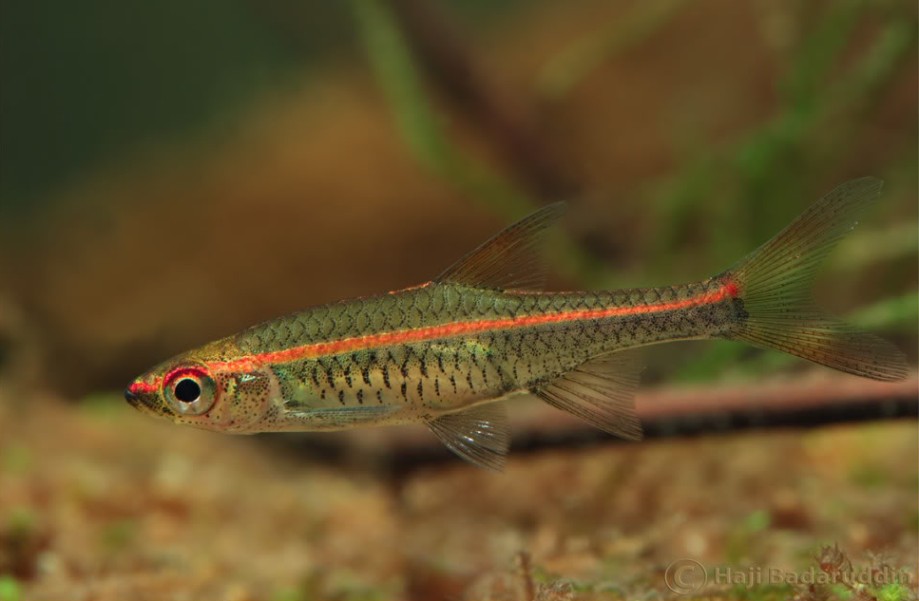
Max length60mm SL2.4in SLTank90 × 30cm36 × 12inTemp21–26°C70–79°FpH4.0–7.5This species is also sold as the 'redline' rasbora which is something of a misnomer as in reality the colour of the lateral stripe that gives rise to the name can vary from deep orange to golden depending upon the collection locality of the fish as well as diet, condition, and even mood. Some specimens also have a second, darkish stripe beneath the other which seems to vary in length and intensity depending on a similar array of factors. Older fish tend to possess a greater degree of black edging to the scales, especially in the ventral portion of the body.
Zoogoneticus tequilaTequila Splitfin
Webb & Miller, 1998
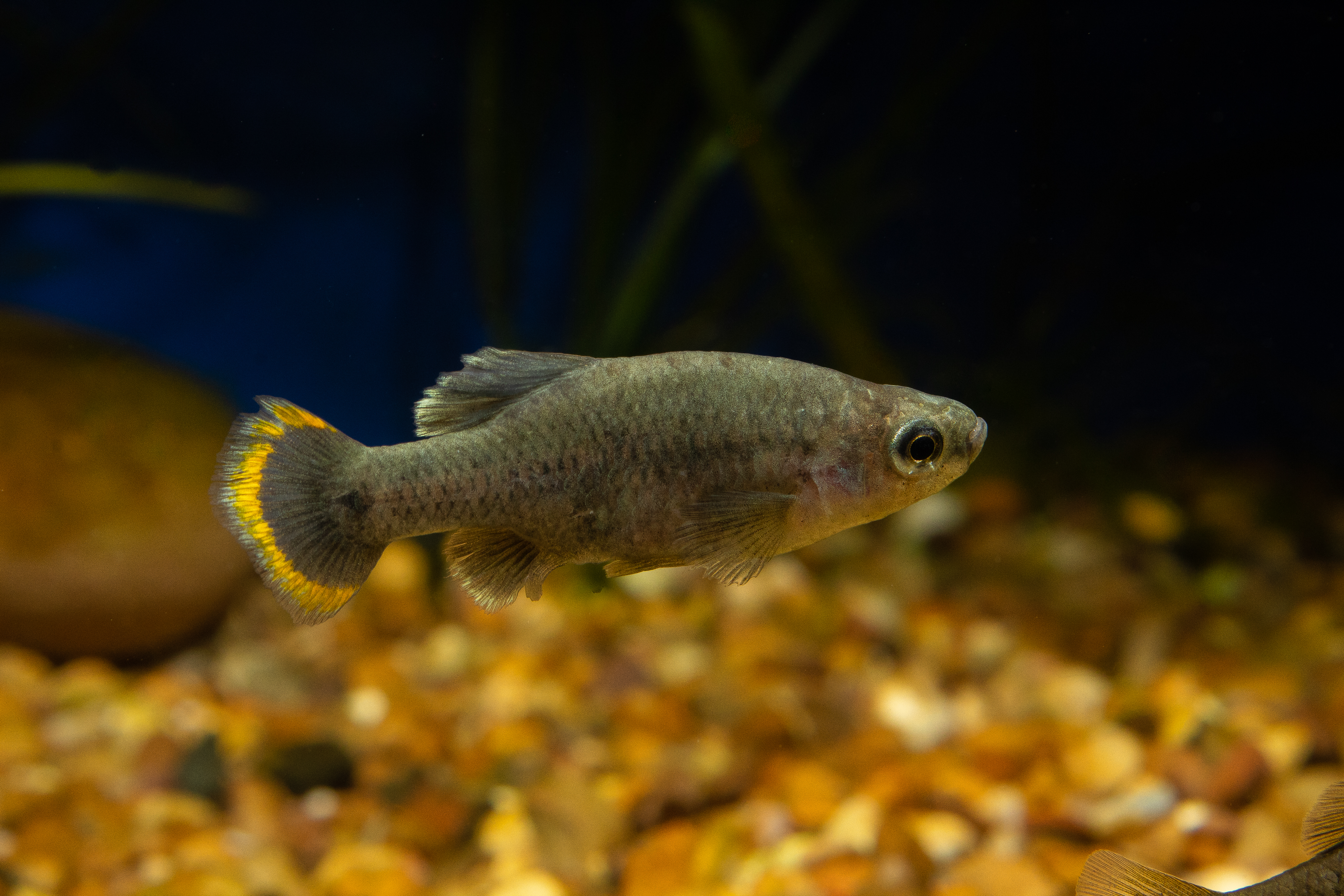
Max length♂ 30 · ♀ 50mm SL♂ 1.2 · ♀ 2.0in SLTank90 × 30cm36 × 12inTemp17–27°C63–81°FpH6.8–7.6A single male of the Tequila Splitfin was sampled in 1955 by Miller and Greenbank, but identified erroneously as Zoogoneticus quitzeoensis, with which species it was collected and found sympatrically . Many years later, the mistake was detected, the fish identified as a new species and finally, 43 years after the first capture, described by Webb and Miller. In 2001, a wild population of this species was rediscovered in a very small spring pool (3 x 4m in diameter). The population there was composed of only a handful of adult fish and a few tens of juveniles (De la Vega-Salazar et al., 2003). In 2007, N. W. Bailey et al showed, that the allelic richness of this population (though it was comparable in size to an aquatic stock) was higher than in any aquatic stock. In 2013 the loss of this population was reported (pers. comm. Domínguez), so there is not much hope that this species is still persisting in the wild.
Lepidocephalichthys guntea
Hamilton, 1822
Matched on Misgurnus lateralis, a name it was formerly known by
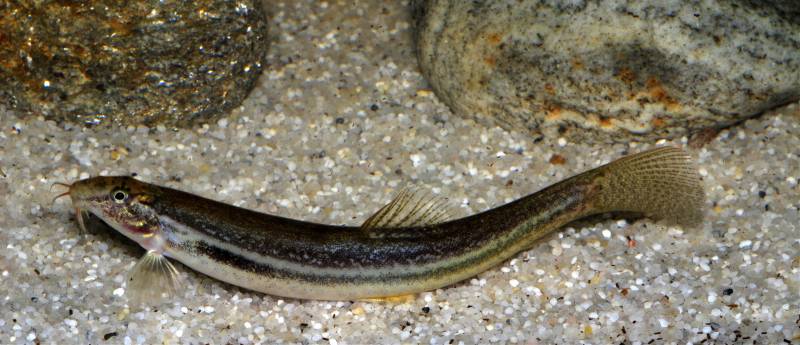
Max length150mm SL6in SLTank80 × 30cm31 × 12inTemp20–25°C68–77°FpH6.0–8.0This is one of the most frequently-traded members of the group and is an excellent choice for those new to keeping loaches. It's distinguishable from congeners by a combination of characters including: rounded/truncate caudal-fin; a scaleless patch on top of the head; relatively large adult size; flanks with spotted patterning in females and a solid...
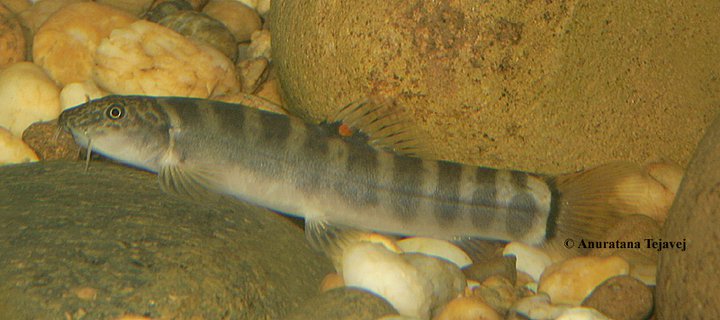
Schistura nicholsi
Smith, 1933
Matched on Schistura laterimaculata, a name it was formerly known by
Max length74mm SL2.9in SLTank120 × 30cm48 × 12inTemp20–26°C68–79°FpH6.0–7.5This species is sometimes traded for aquaria but its name also appears to have been widely misapplied to other fishes. It can be identified via the following combination of characters: presence of 8-10 quite regular dark bars...