Tanganicodus irsacae
Last revised 2026Edit this page
On this page12 sections
Quick factsEdit
Difficulty5 of 8 measures
- Space
- medium tank
- Water
- needs alkaline water, kept steady
- Temp
- needs a steady temperature
- Diet
- no meaty foods
- Temperament
- territorial
- Social
- unknown
- Compatibility
- unknown
Other demands
Each of these can raise the rating on its own, whatever the measures above say.
- Hardiness
- unknown
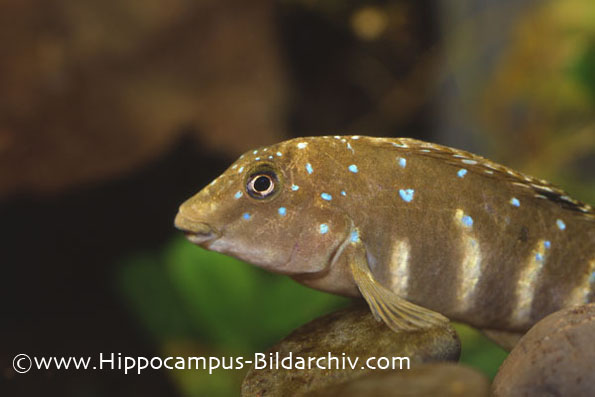
Tanganicodus irsacae is a goby cichlid endemic to the northern part of Lake Tanganyika, living among pebbles and rocks in water under 1 metre deep. In this surge zone it scrapes algae from the rocks. Quite delicate in aquaria, it needs the highest water quality, a higher pH than many Tanganyikans and a relatively specialised diet, and it is aggressive towards its own kind. A bi-parental mouthbrooder, it is difficult to breed.
Distribution
EditEndemic to Lake Tanganyika, in the northern part of the lake.
Habitat
Write a noteEditIt inhabits the direct shoreline in water of less than 1 metre in depth, usually being found amongst pebbles and rocks.
Aquarium size
Write a noteEdit75 ∗ 30 ∗ 30 cm30 ∗ 12 ∗ 12 in - ~68 litres~18 US gal.
Maintenance
Write a noteEditUse piles of rocks and pebbles to form caves and hiding places. A sandy substrate is best. Algal growth should be encouraged and strong lighting is recommended. The water must be very well-oxygenated with a relatively high pH, although the creation of strong currents is not necessary.
Water conditions
EditTemperature: 24 – 28 °C75 – 82 °F
pH: 8.0-9.0
Hardness: 8-25°H
These recommendations come from this profile’s own figures. They contain affiliate links, so we may earn a commission.
Diet
Write a noteEditVegetable matter such as blanched spinach or spirulina flake should form the basis of the diet. This can be supplemented with small live and frozen foods. It should not be fed high protein foods such as shellfish, meat (especially animal meat) or worms.
Behaviour and compatibility
Write a noteEditA territorial species but should not be kept with large or boisterous fish such as mbuna. Good tankmates are species inhabiting different areas of the aquarium to them, such as Cyprichromis, Paracyprichromis and shell-dwellers. It is best kept singly or as a pair as it is aggressive towards conspecifics. Once a pair has formed they will remain together for life. A suitably large aquarium is required if several are to be kept.
Sexual dimorphism
Write a noteEditDifficult to sex. Adult males tend to be larger than females, and sometimes also have slightly longer pelvic fins.
Reproduction
Write a noteEditDifficult. Bi-parental mouthbrooder. We suggest the purchase of a group of young fish and allowing these to pair off naturally. Once a pair forms, the other fish should be removed from the aquarium. Buying an adult male and female will not guarantee a pair and often results in the female being harassed to death. The aquarium itself should be at least 30" in length and set up as suggested above, along with the addition of some flat rocks to act as spawning sites. These should be placed at varying heights in the tank. The pH should be around 8.2-9.0 and the temperature 25 – 26.5 °C77 – 80 °F. Strong oxygenation is essential.
Spawning is initiated by the female. She will select one of the rocks as the spawning site and will proceed to clean the surface of it thoroughly. The pair then display to each other, eventually circling the spawning site, before the female lays a few eggs. The male then fertilises them before the female then picks them up in her mouth. This sequence is repeated until the female has laid all her eggs.
The female may carry the brood for over 2 weeks. She will not eat during this period and can be easily spotted by her distended mouth. When the eggs hatch, she then transfers the fry to the mouth of the male. This usually occurs back at the spawning site, with 1-2 fry being gently blown out by the female and picked up by the male at a time. The fry will still have their yolk sacs at this point. He then continues to incubate the fry for 5-10 days, before releasing them over a period of several hours in different areas around the pair's territory. There is no need to remove either adult fish or young (the adults ignore them for a time) but if you intend the pair to breed again, it is better to remove the fry to a separate raising tank.
The fry will accept brine shrimp nauplii and powdered spirulina flake from the first day. As with many Tanganyikan species growth is slow.
Notes
EditThis is one of the so-called Tanganyikan Goby Cichlids. They occur only in the upper few feet of water around rocky shores, also known as the surge zone, where they scrape algae from the rocks with their specialised teeth. This habitat is typified by breaking waves and strong currents. They have a few adaptations allowing them to inhabit such an environment. The swim bladder is rendered useless to reduce their buoyancy. They also have a long dorsal fin and a laterally compressed body shape to allow them to cope with the strong water movement. The dorsal is also very spiny to protect against predation by birds. The mouth of the fish is underslung, meaning the fish can remain in a flat position against the rocks whilst scraping them for algae.
Tanganicodus can be distinguished from other goby cichlids primarily by the shape of the mouth, which is more pointed and narrow than in the other genera.
They are quite delicate in aquaria, requiring the highest water quality, a higher minimum pH than many Tanganyikans (the pH in the natural habitat of these fish is often higher than in the rest of the lake due to the release of oxygen from the turbulent water) and a relatively specialised diet.
T. irsacae makes a superb addition to a well-maintained Tanganyikan tank and will always provide interest with its characteristic 'hopping' around the rocks. However, it is not recommended for beginners due to its sensitivity and specific requirements.
References
- Ad Konings (2019). Tanganyika Cichlids in their natural habitat, 4th edition Cichlid Press, 144-150
Species images · 3
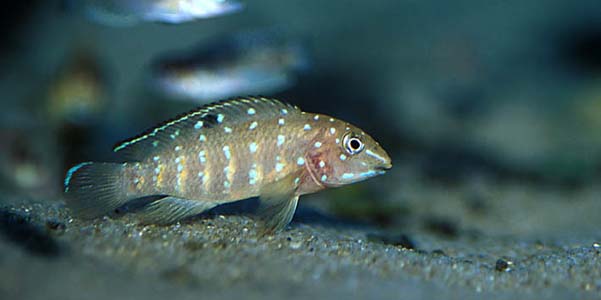
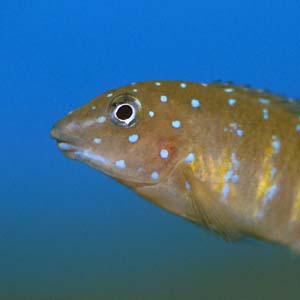
These photographs are used with each photographer’s permission.
Send a photographDistribution
Profile completeness20 of 24
83% complete
Also missing: a common name, etymology.
Contributors
Improved by
- CowPuppet59
The number beside each name is how many contributions that person has had accepted on Seriously Fish.
Community
Questions about Tanganicodus irsacae?
Ask on Discord