Results for “spot”
Type a name: scientific, common, or one a species used to go by. Or narrow the catalogue with the filters.
Filters
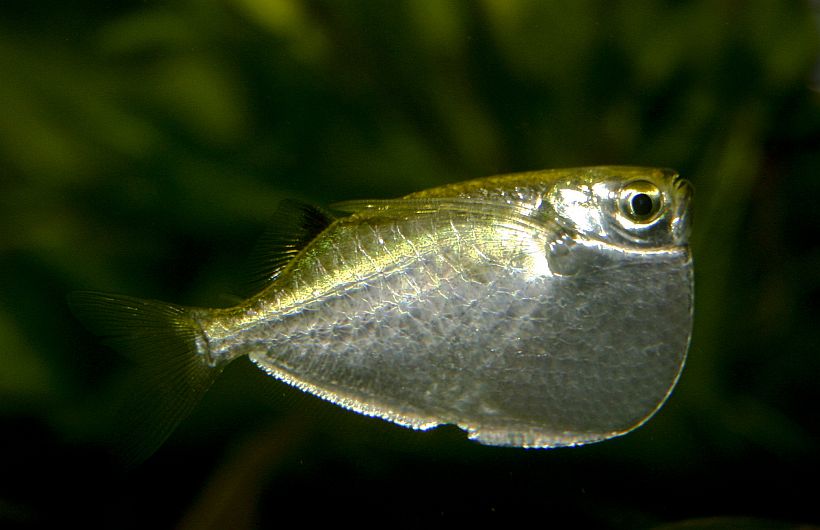
Thoracocharax stellatusSpotfin Hatchetfish
Kner, 1858
Matched on the common name Spotfin Hatchetfish
Max length70mm SL2.8in SLTank120 × 45cm48 × 18inTemp20–28°C68–82°FpH5.0–7.5T. stellatus is superficially similar to its only congener T. securis, but can immediately be identified by the presence (vs. absence) of a prominent dark spot in the dorsal-fin. It is sometimes traded as 'platinum hatchetfish'. The genus Thoracocharax was originally erected by Fowler in 1906 as a subgenus of Gasteropelecus, but was elevated to generic status by Weitzman (1960).
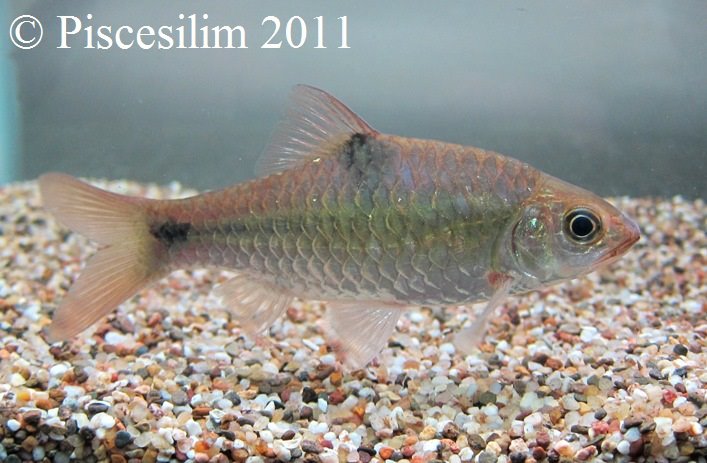
Barbodes binotatusSpotted Barb
Valenciennes, 1842
Matched on the common name Spotted Barb
Max length200mm SL8in SLTank120 × 45cm48 × 18inTemp18–30°C64–86°FpH6.0–7.5This species is so ubiquitous across its natural range that it's often referred to simply as 'common barb'. Basic adult colour pattern consists of a small, dark spot at the base of the dorsal-fin origin and another on the caudal peduncle but overall appearance varies somewhat depending on origin, with the anterior dark spot enlarged ventrally forming a bar or posterior spot extending into the caudal-fin, for example. The spots may also appear darker or lighter in some individuals.
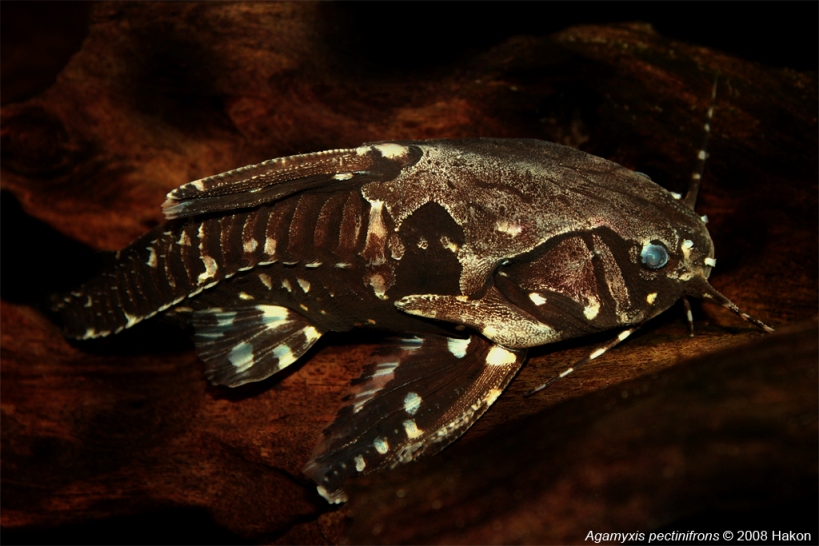
Agamyxis pectinifronsSpotted Talking Catfish
Cope, 1870
Matched on the common name Spotted Talking Catfish
Max length150mm SL6in SLTank120 × 30cm48 × 12inTemp22–26°C72–79°FpH5.5–7.5This species, which may also be referred to by the alternative vernacular names 'spotted raphael', 'white-spotted' or 'white-barred' catfish, is very common in the trade and despite its adult size is recommended to beginners and experienced aquarists alike since it is hardy, attractive and relatively-long-lived. The light body markings are highly variable in terms of exact placement and may be either white or pale to darkish yellow in colour. It is very similar i...
Mogurnda adspersaSouthern Purple Spotted Gudgeon
authority not recorded
Matched on the common name Southern Purple Spotted Gudgeon
Max length140mm SL6in SLTank120 × 30cm48 × 12inTemp16–24°C61–75°FpH7.0–7.5This species is considered endangered across its native range, but has recently begun to appear in the hobby a little more often as a result of commercial farming. It's still by no means common though. Superficially it looks very similar to the much commoner Northern purple spotted gudgeon (Mogurnda mogurnda), but can be distinguished by the presence of only 30-36 scales along its lateral line, (as opposed to 37-48 in M. mogurnda), and a higher degree of red spotting in the second dorsal fi...
Peckoltia sp.Big Spot Peckoltia
authority not recorded
Matched on the common name Big Spot Peckoltia
Max length110mm SL4in SLTank75 × 30cm30 × 12inTemp23–26°C73–79°FpH6.5–7.2Commonly known as the big spot peckoltia, there is ongoing argument that this species should be included in the genus Hemiancistrus. As things stand, there has not yet been any scientific confirmation of this and the species remains undescribed. It's also often confused with the very similar-looking L013, another undescribed fish. These two species can only easily be distinguished as they mature, as L163 retains its spotted patterning, while L013 tends to become somewhat duller. When b...
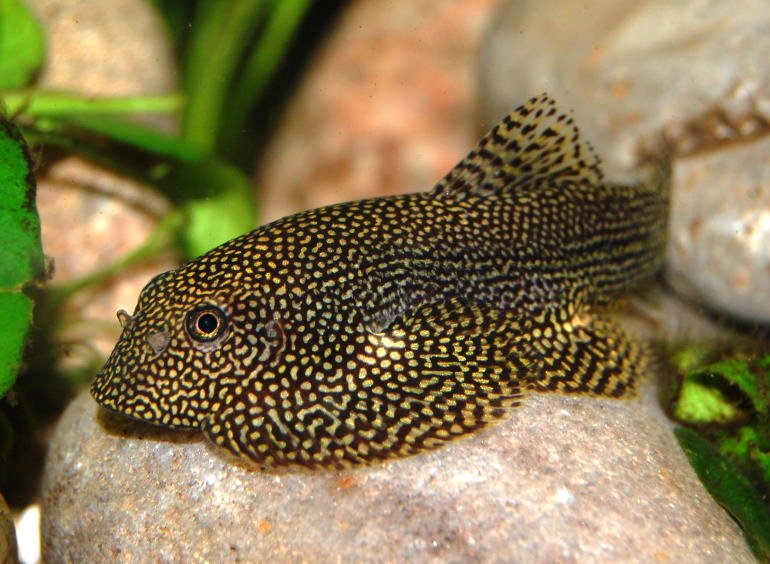
Sewellia sp. 'SEW01'Spotted Butterfly Loach
authority not recorded
Matched on the common name Spotted Butterfly Loach
Max length80mm SL3.1in SLTank90 × 30cm36 × 12inTemp20–24°C68–75°FpH6.0–7.5This is one of the more readily-available members of the genus and popularly referred to as S. sp. 'spotted' or S. sp. 'special'. It's superficially similar in appearance to S. albisuera but in that species body patterning consists of a network of irregular dark lines forming a complicated series of reticulations vs. many small, light spots on a dark background in S. sp. 'SEW01'. It's been suggested that these two may represent the same species but this...
Synodontis notataOne-spot Synodontis
authority not recorded
Matched on the common name One-spot Synodontis
Max length275mm SL11in SLTank120 × 30cm48 × 12inTemp22–25°C72–77°FpH6.5–7.5Also known as the Domino Synodontis or the One-spot Squeaker, several regional variants of S. notata are known, some of which have 3, 6 or 12 spots and others none at all. Some of these are seen for sale under the invalid name S. ocellata. It is also often imported with similar species such as S. nummifer or S.congica. These are usually then all sold as notata. S. notata is more active during the day than many Syno species and therefore makes a good addition to aquariums with more boisterous...
Chaetostoma sp.Spotted Bulldog Plec
authority not recorded
Matched on the common name Spotted Bulldog Plec
Max length120mm SL5in SLTanknot recordedTemp20–22.8°C68–73°FpH6.8–7.8Also known popularly as the rubbernose plecs, Chaetostoma species are seen for sale quite often these days. This is one of the more commonly seen, and provided its needs are adequately met, is a very hardy little fish. There's a bit of mystery surrounding its true identity, hence the species name, and it's sometimes misidentified in shops. The true L187 is currently known as Chaetostoma pearsei, and is a white-spotted fish. When buying Loricariids such as this always check the fish ...
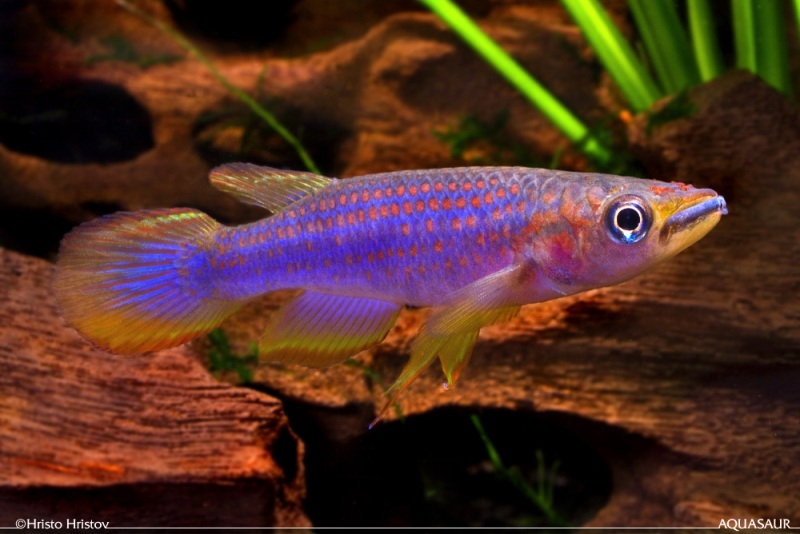
Epiplatys lamotteiRed-spotted Panchax
Daget, 1954
Matched on the common name Red-spotted Panchax
Max length60mm SL2.4in SLTank80 × 30cm31 × 12inTemp18–23°C64–73°FpH5.0–7.0Following the key of Romand (1992) this species can be told apart from congeners by the following combination of characters: adult size > 40 mm SL; large, dark, transverse bars and some reddish-brown pigmentation on flanks; longitudinal bands more-or-less defined; longitudinal bands composed of small red spots; caudal-fin subquadrangular caudal fin; 11-13 anal-fin rays; 16-17 dorsal-fin rays; 7-8 anal-fin rays located anterior to dorsal-fin origin.
Mogurnda mogurndaNorthern Purple Spotted Gudgeon
authority not recorded
Matched on the common name Northern Purple Spotted Gudgeon
Max length170mm SL7in SLTank120 × 30cm48 × 12inTemp24–26°C75–79°FpH6.0–8.0A good species of gudgeon for the beginner, being tolerant of a wide range of water conditions, hardy and easily bred. We've even seen them spawning in dealer's tanks on more than one occasion. It's easily confused with the similar looking, but rarer Southern purple spotted gudgeon, Mogurnda adspersa, a fish which is now being farmed for the trade despite being endangered in nature....
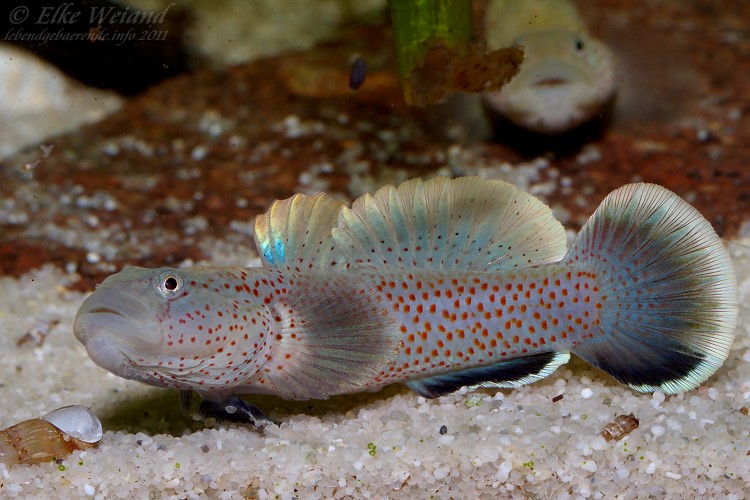
Rhinogobius rubromaculatusRed-spotted Goby
Lee & Chang, 1996
Matched on the common name Red-spotted Goby
Max length55mm SL2.2in SLTank60 × 30cm24 × 12inTemp18–24°C64–75°FpH6.0–8.0This species occurs in a couple of colour forms with fish from northern and central Taiwan possessing a greyish base body colour and those from the Linbian river, southern Taiwan having a dark marking in the anterior portion of the first dorsal fin and larger, more intense red spots on the body. The latter form is also smaller in size, lays smaller eggs, does not exhibit extreme sexual dimorphism and has been refe...
Scleropages leichardtiSpotted Australian Arowana
authority not recorded
Matched on the common name Spotted Australian Arowana
Max length900mm SL35in SLTank180 × 60cm72 × 24inTempnot recordedpH6.8–7.5Although S. leichardtii superficially resembles its Asian cousins, it is not considered as desirable an aquarium inhabitant, nor is it classed as being at risk in nature. It can be easily distinguished from the asian species by its much smaller scale size, greater lateral scale count (32-35 as opposed to 21-25 in the asian aros) and duller patterning. It differs from its Australian relative S. jardinii by its spotted scales, forward-pointing barbels, lack of sloping head and unpatterned gill cov...
Trichopodus trichopterusThree-spot Gourami
authority not recorded
Matched on the common name Three-spot Gourami
Max length150mm SL6in SLTank90 × 30cm36 × 12inTemp24–30°C75–86°FpH5.5–8.5This species is available in many different colour forms and varieties, all of which have been selectively bred for the aquarium trade. These are seen much more often than the natural form, which is the blue-grey three spotted fish. They include gold, opaline, cosby, marbled and silver forms. T. trichopterus is one of the hardiest fish commonly available in the trade and can adapt to many different water conditions. However it is recommended to the beginner with reservations regarding it's ...
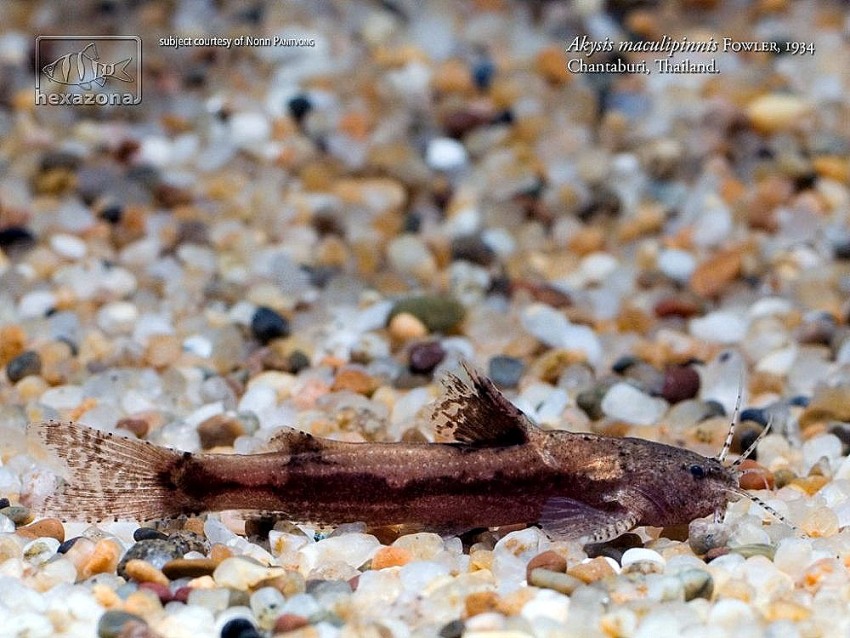
Akysis maculipinnisSpotfin Stream Catfish
Fowler, 1934
Matched on the common name Spotfin Stream Catfish
Max length35mm SL1.4in SLTank45 × 30cm18 × 12inTemp16.5–24°C62–75°FpH6.0–7.5This species has been exported for the aquarium hobby and ranks among the smaller members of the family. It can be differentiated from all other Akysis species by the following combination of characters: head length 22.0-28.6% of standard length (SL); caudal peduncle depth 8.8-10.7% of SL; anal-fin base length 15.2-19.1% of SL; eye diameter 12-16% of head length (HL); nasal barbel length 57 92% of HL; posession of 3-4 serrae on the posterior edge ofspine; body patterning mottled with indistinct ...
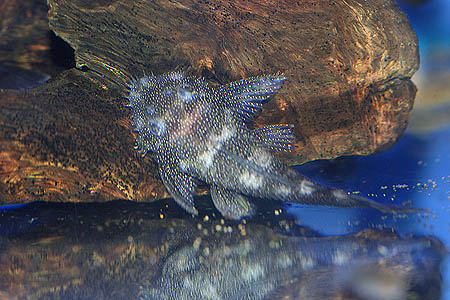
Ancistrus sp.L255
authority not recorded
Matched on the common name Spotted Medusa Plec
Max length130mm SL5in SLTank80 × 30cm31 × 12inTemp25–30°C77–86°FpH6.0–7.0A somewhat odd-looking species with a distinctive wide head and overall flattened profile. Unfortunately this fish is not the easiest fish to keep alive in the aquarium since it requires rather specialised conditions and is often in poor condition post-import.
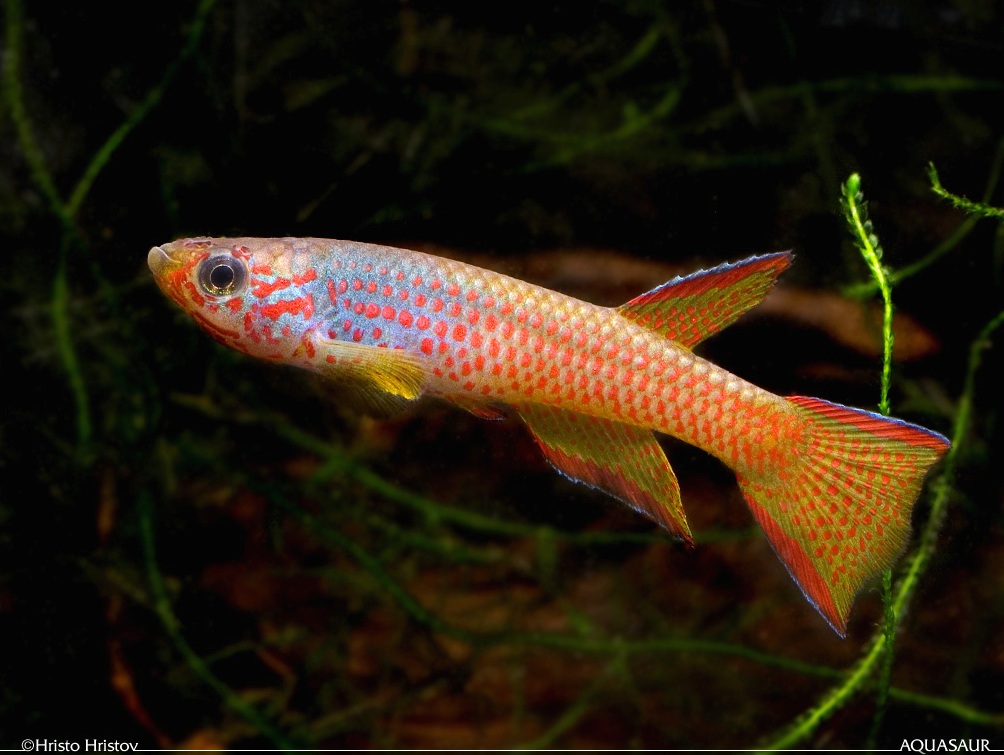
Aphyosemion cognatumRed-Spotted Lyretail
Meinken, 1951
Matched on the common name Red-Spotted Lyretail
Max length50mm SL2.0in SLTanknot recordedTempnot recordedpHnot recordedThe type material was derived from a commercial shipment of fishes from Leopoldville, now Kinshasa, Democratic Republic of Congo, and presumed to have been collected in the vicinity. The precise extent of its distribution unknown but appears extensive in the middle and lower Congo regions, with specimen collected from Lac Fwa (Sankuru River drainage, a Congo River tributary), many hundreds of kilometres west of Kinshasa, identified as belonging to this species.
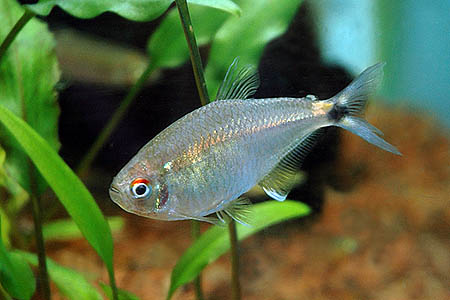
Astyanax bimaculatusTwo Spot Astyanax
Linnaeus, 1758
Matched on the common name Two Spot Astyanax
Max length150mm SL6in SLTank120 × 60cm48 × 24inTemp20–28°C68–82°FpH5.5–7.5A. bimaculatus is not a popular aquarium fish but is available on occasion exception, most often as a contaminant among shipments of other species. It's identity is also in question to an extent with the name currently applied to what is considered to represent a species complex comprising at least four taxa.
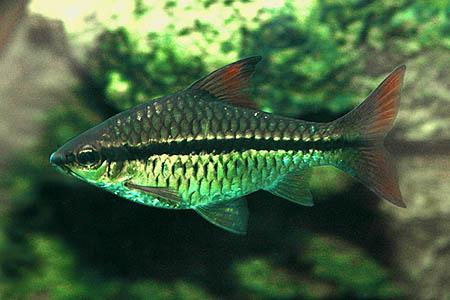
'Barbus' holotaeniaSpotscale Barb
Boulenger, 1904
Matched on the common name Spotscale Barb
Max length120mm SL5in SLTank120 × 45cm48 × 18inTemp24–30°C75–86°FpH6.0–7.0This species is native to Central West Africa where it is principally found in the great Ogooué and Congo River systems. It therefore has an extensive range and has been recorded at numerous localities right across the Democratic Republic of Congo (DRC) from the Ituri River in the far east of the country to the Luki River basin in the extreme west. The Congo River appears to represent the southernmost limit of its range as a...
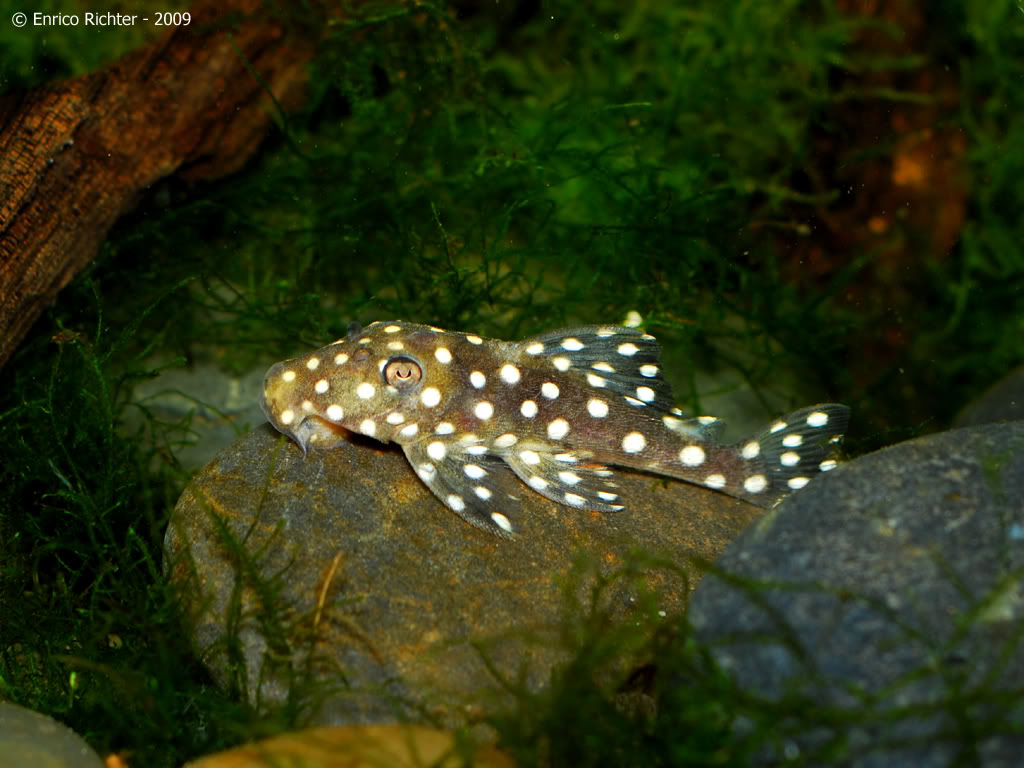
Baryancistrus sp. L142Big White Spot Pleco
authority not recorded
Matched on the common name Big White Spot Pleco
Max length250mm SL10in SLTank120 × 45cm48 × 18inTemp27–32°C81–90°FpH6.0–7.5The genus Baryancistrus can be distinguished from all other loricariids by possession of an enlarged membrane located posteriorly to the last branched dorsal-fin ray. This membrane may or may not reach the supporting structure of the adipose fin and in this way members can be told apart from the genera Oligancistrus, Parancistrus, and Spectracanthicus, in which the dorsal and adipose fins are completely connected, and Hemiancistrus...
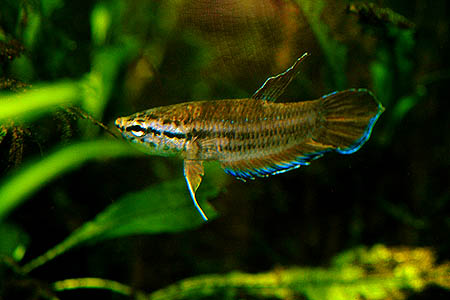
Betta pictaSpotted Betta
Valenciennes, 1846
Matched on the common name Spotted Betta
Max length50mm SL2.0in SLTank60 × 30cm24 × 12inTemp22–28°C72–82°FpH5.5–7.5This species lends its name to the Betta picta complex of closely-related species, an assemblage of which members share the following combination of characters: unpaired fins rounded (anal fin sometimes pointed): I-III, 18-24 anal-fin rays; anal and caudal fins with dark distal margins, most pronounced in mature males; pre- and post-orbital stripes present; chin bar present; opercle with iridescent blue, green, or gold scales.