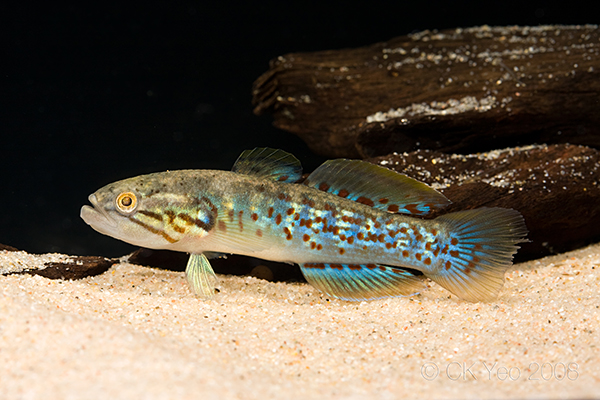
Mogurnda mogurnda
Northern Purple Spotted Gudgeon
On this page11 sections
Quick facts
Difficulty4 of 8 measures
More bars, more demanding. Hardiness is not averaged with the rest.
- Space
- large tank
- Water
- tap water
- Temp
- narrow band
- Diet
- unknown
- Temperament
- unknown
- Social
- unknown
- Compatibility
- unknown
Hardiness on its own can raise the rating, whatever the measures above say.
- Hardiness
- survives most mistakes
A good species of gudgeon for the beginner, being tolerant of a wide range of water conditions, hardy and easily bred. We've even seen them spawning in dealer's tanks on more than one occasion. It's easily confused with the similar looking, but rarer Southern purple spotted gudgeon, Mogurnda adspersa, a fish which is now being farmed for the trade despite being endangered in nature....
Distribution
Habitat
It can survive in conditions of low oxygen and therefore occurs in a wide range of biotopes, including forest streams, swamps, ponds and even desert boreholes.
Aquarium size
120 ∗ 30 ∗ 30 cm48 ∗ 12 ∗ 12 in - ~108 litres~29 US gal.
Maintenance
The decor itself is not essential but should contain plenty of potential hiding places for this shy species. A sand substrate with rocks and bogwood for cover works well, and plants can also be added as there is no need to add salt to the water, unlike with many other related species. Dim lighting will encourage the fish to be out and about more. These gudgeon do not like strong current, and water movement should therefore be kept to a minimum.
Water conditions
Temperature: 24 – 26 °C75 – 79 °F
pH: 6.0-8.0, depending on collection locality. Somewhere around neutral is probably best.
Hardness: Prefers medium to hard water of 10-20°H.
These recommendations come from this profile’s own figures. They contain affiliate links, so we may earn a commission.
Diet
This gudgeon is a very unfussy eater and will accept most foods offered. Try to include some frozen and live foods for the fish to be in the best condition. They will then reward you with some beautiful colouration.
Behaviour and compatibility
Sexual dimorphism
Not an easy species to sex, although when breeding the genital papillae of the male are clearly pointed. Adult male fish tend to be smaller than females.
Reproduction
Use a species tank for breeding purposes, set up as suggested above. The best chance of obtaining a breeding pair is by purchasing a group of young fish and allowing them to pair off naturally. Condition the group on a decent, varied diet and you should see signs of pairing before long, as the fish become sexually mature well before they attain maximum size.
Spawning is initiated by the male, who exhibits an increase in colouration before enticing a female to spawn with him by displaying with outstretched fins. The eggs are laid on a flat surface, although the fish are somewhat unfussy regarding this and will use the aquarium glass if nothing else is available. Once the female has laid her eggs (between 20-200, depending on the age of the fish), her job is done She is then chased away by the male. He now assumes responsibility for the brood and tends to them almost constantly, fanning the eggs with his fins and defending them against any intruders. If the tank is also to be used for raising the fry, any other inhabitants should now be removed. If you look closely, you'll be able to see that the eggs are attached to the spawning site by small adhesive threads, in a similar fashion to some marine species.
The eggs hatch in 5-7 days and parental care by the male ceases at this point. Unless fry or adults are removed, few young will survive predation. Once the fry have used up their yolk sacs, they require infusoria for the first few days, after which they can be offered brine shrimp nauplii. Keep a close eye on the fry as growth rates can vary wildly and predation can occur.
Notes
A good species of gudgeon for the beginner, being tolerant of a wide range of water conditions, hardy and easily bred. We've even seen them spawning in dealer's tanks on more than one occasion. It's easily confused with the similar looking, but rarer Southern purple spotted gudgeon, Mogurnda adspersa, a fish which is now being farmed for the trade despite being endangered in nature.
Species images · 1
Used with the photographer’s permission. Not licensed for reuse.
Profile completeness17 of 24
71% complete
Also missing: a recorded distribution, taxonomic authority, etymology.
Community
Questions about Mogurnda mogurnda?
Ask on Discord