Results for “swim bladder”
Type a name: scientific, common, or one a species used to go by. Or narrow the catalogue with the filters.
Filters
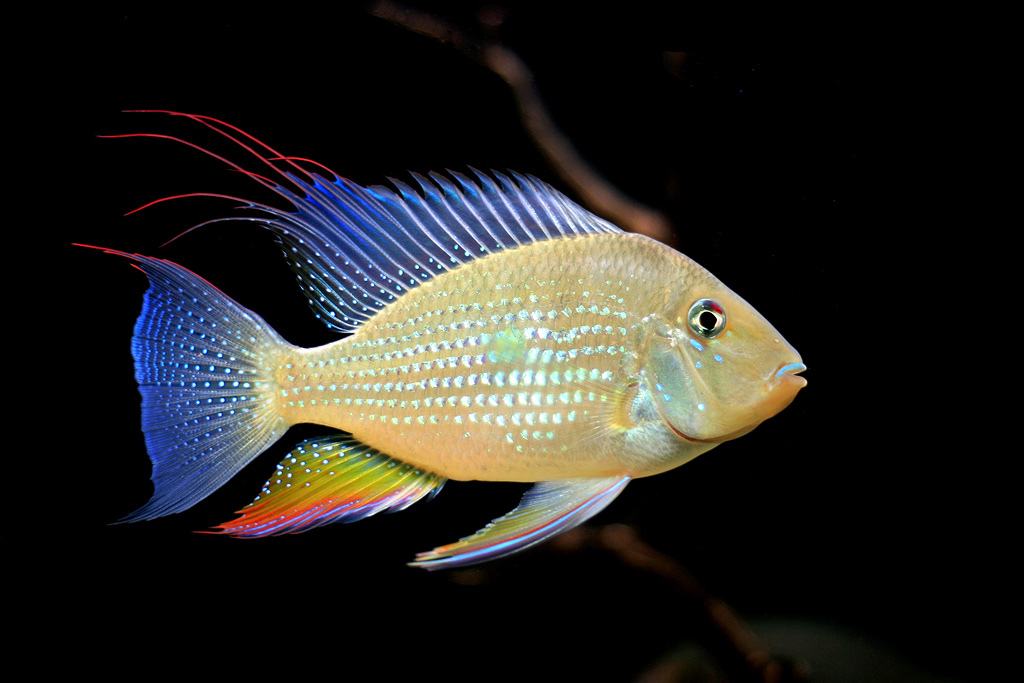
Acarichthys heckeliiThreadfin Acara
Müller & Troschel, 1849
Max length200mm SL8in SLTanknot recordedTemp24–30°C75–86°FpH6.0–8.0The genus Acarichthys remains monotypic and was resdescribed by Kullander (1986) who characterised it by the following: lack of epibranchial lobe; comparatively few (12-14)rays; pelvic fins with relatively broad tips (branches of the first ray are equal in length or the inner is slightly longer); possession of a single supraneural plus 14-15 vertebrae (these characters taken as a combination); no caudal extensions to swim bladder; no caudal ribs. Its current taxonomic position is based largel...
Caecomastacembelus albomaculatus
authority not recorded
Max length220mm SL9in SLTank120 × 30cm48 × 12inTemp23–27°C73–81°FpH8.0–9.5This is a great oddball species for the Tanganyikan community tank, although it is not as attractive as the closely related Aethiomastacembelus ellipsifer. It is rarely seen in the hobby. The species in the family Mastacembelidae are known as "spiny" eels because the dorsal rays are stiffened. Care must therefore be exercised when handling them to avoid injuries. Spiny eels also have no swim bladder, an adaptation to their benthic lifestyle....
Caecomastacembelus plagiostomus
authority not recorded
Max length300mm SL12in SLTank120 × 45cm48 × 18inTemp23–27°C73–81°FpH8.0–9.5Very rarely seen in the hobby, this species makes an interesting oddball addition to the Tanganyikan community tank. The species in the family Mastacembelidae are known as "spiny" eels because the dorsal rays are stiffened. Care must therefore be exercised when handling them to avoid injuries. Spiny eels also have no swim bladder, an adaptation to their benthic lifestyle.....
Eretmodus cyanostictusStriped Goby Cichlid
authority not recorded
Max length80mm SL3.1in SLTank90 × 30cm36 × 12inTemp24–28°C75–82°FpH8.0–9.0Also known as the Tanganyikan Clown, this is one of the so-called Tanganyikan goby cichlids. They occur only in the upper few feet of water around rocky shores, also known as the surge zone, where they scrape algae from the rocks with their specialised teeth. This habitat is typified by breaking waves and strong currents. They have a few adaptations allowing them to inhabit such an environment. The swim bladder is rendered useless to reduce their buoyancy. They also have a longand a laterally co...
Hoplerythrinus unitaeniatusGold Wolf Fish
authority not recorded
Max length400mm SL16in SLTanknot recordedTemp23–27°C73–81°FpH5.5–7.5Also known as the golden trahira, H. unitaeniatus is the only one of the three recognised species currently in the genus to appear in the trade with any regularity. It's really a fish suitable only for the specialist, and as with any predatory species, care must be taken when performing tank maintenance. It's a representative of an ancient group of fishes, and possesses a modified, highly vascularised swim bladder that acts as an accessory breathing organ, allowing the fish to survi...
Mastacembelus ellipsiferTanganyikan Spiny Eel
authority not recorded
Max length450mm SL18in SLTank120 × 45cm48 × 18inTemp23–27°C73–81°FpH8.0–9.5M. ellipsifer is a stunning eel that makes a nice 'alternative' species for the Tanganyikan community tank. The species in the family Mastacembelidae are known as "spiny" eels because the dorsal rays are very hard. Care must therefore be exercised when handling them to avoid injuries. The swim bladder in these eels has also disappeared completely, an adaptation to their bottom-dwelling lifestyle. The African species such as this one can be distinguished from their Asian relat...
Polypterus bichir bichirNile Bichir
authority not recorded
Max length720mm SL28in SLTank180 × 60cm72 × 24inTemp22–28°C72–82°FpH6.0–8.0An incredibly hardy, nocturnal species with very poor vision, P. delhezi relies on its excellent sense of smell to locate food. This species, along with others of its genus, is one of the last surviving relatives of very ancient species. Fossils of earlier relatives have been found that date back to the Triassic Period, which occured during the early development of the dinosaurs more than 200 million years ago. They have several interesting adaptations. The swim bladder is divided into 2 par...
Polypterus delheziArmoured Bichir
authority not recorded
Max length350mm SL14in SLTank120 × 45cm48 × 18inTemp24–30°C75–86°FpH6.0–8.0An incredibly hardy, nocturnal species with very poor vision, P. delhezi relies on its excellent sense of smell to locate food. This species, along with others of its genus, is one of the last surviving relatives of very ancient species. Fossils of earlier relatives have been found that date back to the Triassic Period, which occured during the early development of the dinosaurs more than 200 million years ago. They have several interesting adaptations. The swim bladder is divided into 2 par...
Polypterus endlicheri endlicheriSaddled Bichir
authority not recorded
Max length750mm SL30in SLTank210 × 120cm84 × 48inTemp22–27°C72–81°FpH6.0–8.0An incredibly hardy, nocturnal species with very poor vision, P. endlicheri endlicheri relies on its excellent sense of smell to locate food. This species, along with others of its genus, are some of the last surviving relatives of very ancient species. Fossils of earlier relatives have been found that date back to the Triassic Period, which occured during the early development of the dinosaurs more than 200 million years ago. They have several interesting adaptations. The swim bladder is div...
Polypterus ornatapinnisOrnate Bichir
authority not recorded
Max length600mm SL24in SLTank180 × 60cm72 × 24inTemp25–28°C77–82°FpH6.0–8.0An incredibly hardy, nocturnal species with very poor vision, []iP. ornatapinnis relies on its excellent sense of smell to locate food. This species along with others of its genus are some of the last surviving relatives of very ancient species. Fossils of earlier relatives have been found that date back to the Triassic Period, which occured during the early development of the dinosaurs more than 200 million years ago. They have several interesting adaptations. The swim bladder is divided int...
Polypterus palmas palmasMarbled Bichir
authority not recorded
Max length325mm SL13in SLTank120 × 45cm48 × 18inTemp25–28°C77–82°FpH6.0–7.0An incredibly hardy, nocturnal species with very poor vision, P. delhezi relies on its excellent sense of smell to locate food. This species, along with others of its genus, is one of the last surviving relatives of very ancient species. Fossils of earlier relatives have been found that date back to the Triassic Period, which occured during the early development of the dinosaurs more than 200 million years ago. They have several interesting adaptations. The swim bladder is divided into 2 par...
Polypterus senegalus senegalusSenegal Bichir
authority not recorded
Max length500mm SL20in SLTank150 × 60cm60 × 24inTemp24–28°C75–82°FpH6.2–7.8An incredibly hardy, nocturnal species with very poor vision, P. senegalus relies on its excellent sense of smell to locate food. This species, along with others of its genus, are some of the last surviving relatives of very ancient species. Fossils of earlier relatives have been found that date back to the Triassic Period, which occured during the early development of the dinosaurs more than 200 million years ago. They have several interesting adaptations. The swim bladder is divided into 2 ...
Polypterus teugelsi
authority not recorded
Max length400mm SL16in SLTank150 × 60cm60 × 24inTemp25–28°C77–82°FpH7.0–7.5An incredibly hardy, nocturnal species with very poor vision, P. teugseli relies on its excellent sense of smell to locate food. This species along with others of its genus are some of the last surviving relatives of very ancient species. Fossils of earlier relatives have been found that date back to the Triassic Period, which occured during the early development of the dinosaurs more than 200 million years ago. They have several interesting adaptations. The swim bladder is divided into 2 parts...
Tanganicodus irsacae
authority not recorded
Max length70mm SL2.8in SLTank75 × 30cm30 × 12inTemp24–28°C75–82°FpH8.0–9.0This is one of the so-called Tanganyikan Goby Cichlids. They occur only in the upper few feet of water around rocky shores, also known as the surge zone, where they scrape algae from the rocks with their specialised teeth. This habitat is typified by breaking waves and strong currents. They have a few adaptations allowing them to inhabit such an environment. The swim bladder is rendered useless to reduce their buoyancy. They also have a longand a laterally compressed body shape to allow them to ...
Xenomystus nigriAfrican Knifefish
authority not recorded
Max length300mm SL12in SLTank120 × 45cm48 × 18inTemp23–28°C73–82°FpH5.8–7.5Originally classified in the genus Notopterus and reclassified in 1984, this is now the only described species of Xenomystus and has several interesting characteristics. Its swim bladder is specially adapted to act as an accessory breathing organ in a similar fashion to Polypteriids. It must rise to the surface to take a gulp of air periodically, often emitting a bell-like sound as it does so. X. nigri is often confused with the similar looking but far more aggressive Asian knifefish, Notopt...