Caecomastacembelus albomaculatus
On this page11 sections
Quick facts
Difficulty4 of 8 measures
More bars, more demanding. Hardiness is not averaged with the rest.
- Space
- large tank
- Water
- mild adjustment
- Temp
- steady heat
- Diet
- unknown
- Temperament
- territorial
- Social
- unknown
- Compatibility
- unknown
Hardiness on its own can raise the rating, whatever the measures above say.
- Hardiness
- unknown
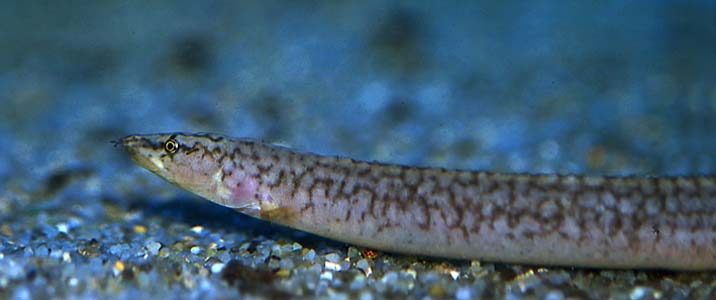
This is a great oddball species for the Tanganyikan community tank, although it is not as attractive as the closely related Aethiomastacembelus ellipsifer. It is rarely seen in the hobby. The species in the family Mastacembelidae are known as "spiny" eels because the dorsal rays are stiffened. Care must therefore be exercised when handling them to avoid injuries. Spiny eels also have no swim bladder, an adaptation to their benthic lifestyle....
Distribution
Endemic to Lake Tanganyika.
Habitat
It inhabits rocky areas around the shoreline of the lake.
Aquarium size
120 ∗ 30 ∗ 30 cm48 ∗ 12 ∗ 12 in - ~108 litres~29 US gal.
Maintenance
Use piles of rocks to form sheltered areas. It is essential that the tank bottom is covered in sand as the fish spends much of it's time burrowed into the substrate. Gravel is not recommended, as its sharp edges can damage the eel's skin. There should be no strong currents in the tank.
Water conditions
Temperature: 23 – 27 °C73 – 81 °F
pH: 8.0-9.5
Hardness: 8-25°H
These recommendations come from this profile’s own figures. They contain affiliate links, so we may earn a commission.
Diet
In nature, it preys on small fish but aquarium specimens readily accept dead alternatives. Prawn, cockle, mussel, earthworms and bloodworm can all be offered.
Behaviour and compatibility
It is peaceful with species it cannot fit into its mouth but is not suitable for most freshwater tanks, due to its hard, alkaline water requirements. It is best kept in a Tanganyikan community, where it can be combined with any species too large to be considered food. It tends to be somewhat territorial with conspecifics and a large tank is required if more than one is to be kept.
Sexual dimorphism
Unknown.
Reproduction
Not thought to have been bred in aquaria.
Notes
This is a great oddball species for the Tanganyikan community tank, although it is not as attractive as the closely related Aethiomastacembelus ellipsifer. It is rarely seen in the hobby. The species in the family Mastacembelidae are known as "spiny" eels because the dorsal rays are stiffened. Care must therefore be exercised when handling them to avoid injuries. Spiny eels also have no swim bladder, an adaptation to their benthic lifestyle.
Species images · 1
Used with the photographer’s permission. Not licensed for reuse.
Profile completeness17 of 24
71% complete
Also missing: a recorded distribution, taxonomic authority, a common name, etymology.
Community
Questions about Caecomastacembelus albomaculatus?
Ask on Discord