Paracyprichromis brieni
Last revised 2026Edit this page
On this page11 sections
Quick factsEdit
Difficulty5 of 8 measures
- Space
- large tank
- Water
- flexible
- Temp
- needs a steady temperature
- Diet
- unknown
- Temperament
- peaceful
- Social
- needs to be in a group
- Compatibility
- unknown
Other demands
Each of these can raise the rating on its own, whatever the measures above say.
- Hardiness
- unknown
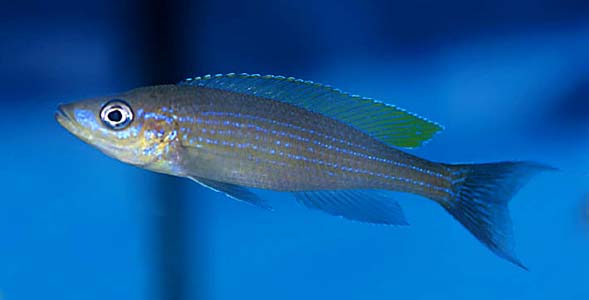
Paracyprichromis brieni is a deep-water cichlid endemic to Lake Tanganyika, where it is quite widespread. Males hold territories under rocky overhangs and are often seen hanging upside down beneath them, while females stay in open water above the rocks. It is easily confused with P. nigripinnis, its only congener, but has smaller eyes and a slimmer, more elongate body, and it quickly loses its best colouration under bright lighting or with boisterous tankmates.
Distribution
EditEndemic to Lake Tanganyika. It is quite widespread in the lake.
Habitat
Write a noteEditIt is found in relatively deep water, with females in open water just above areas of rocky substrates and males preferring to sit under rocky overhangs or in caves.
Aquarium size
Write a noteEdit120 ∗ 45 ∗ 38 cm48 ∗ 18 ∗ 15 in - ~205 litres~54 US gal is large enough for a small shoal.
Maintenance
Write a noteEditThis species will generally be found in the upper levels of the aquarium and swimming space is important. Most hobbyists like to keep it in a community with other species so a deep aquarium filled with piles of rock arranged to form caves with swimming space above is ideal. Some tall vertical rocks forming overhangs or large caves should be used to simulate the fishes' natural habitat. As it is a deep water fish it will show much better colouration under subdued lighting.
Water conditions
EditTemperature: 24 – 27 °C75 – 81 °F
pH: 7.5-9.0
Hardness: 8-25°H
These recommendations come from this profile’s own figures. They contain affiliate links, so we may earn a commission.
Diet
Write a noteEditP. brieni will accept most foods offered but live and frozen varieties should form the bulk of the diet. This fish has a small mouth and is a zooplankton feeder in the wild so ensure it is getting its fill.
Behaviour and compatibility
Write a noteEditVery peaceful and retiring. Do not keep with boisterous species such as mbuna or that inhabit similar areas in the tank like Cyprichromis. It is best kept in a species tank but possible tankmates include Julidochromis, Neolamprologus and Altolamprologus species. Should be kept in a shoal of at least 8 fish, but the more you can fit in the better.
Sexual dimorphism
Write a noteEditMale fish are more colourful than females and develop longer extensions to the caudal fin.
Reproduction
Write a noteEditPossible but rarely achieved in captivity. Polygamous maternal mouthbrooder. The breeding aquarium should be set up as suggested above. Large caves and vertical rock walls are highly recommended. A pH of 8.0-9.0 and a temperature of 24 – 25.5 °C75 – 78 °F are ideal. We recommend the purchase of a group of at least 8 fish and allowing things to develop naturally. Several females should be kept per male.
The males will form territories in caves and it is against the rocky walls of these that spawning occurs. When in condition, males will start to display to passing females. When a female is ready to spawn, she will enter the territory of the chosen male and adopt a head down position towards the base of a rock wall. The male will follow and sit just above the female. The female releases eggs one at a time, taking them into her mouth as they reach the substrate, whilst the male produces a continuous stream of sperm in the direction of the female, thus fertilising the eggs. The pair continue in this manner until the female has 5-25 eggs in her buccal cavity.
The female will carry the brood for around 3-4 weeks before releasing the free swimming fry. She will not eat during this period and can be easily spotted by her distended mouth. If a female is overly stressed she may spit out the brood prematurely or eat them, so care must be taken if you decide to move the fish. Once the fry are released broodcare by the female ceases.
The fry are quite large and will accept newly hatched brine shrimp from the day they are released.
Notes
EditAlthough P. brieni is better kept in a group, it tends to form much looser shoals than the similar Cyprichromis species. Male fish form territories under overhangs if they are available and can often be seen hanging upside down under these or vertically against rock walls. In the aquarium if it is not provided with such retreats, or if it is housed under bright lighting or with boisterous fish it will rapidly lose its best colouration.
It is quite easily confused with P. nigripinnis, it's only congener, but can be distinguished by it's smaller eyes and slimmer, more elongate body shape. Several colour morphs exist and these should not be mixed in aquaria, as they will hybridise.
P. brieni is not a particularly demanding species in terms of water quality, asking no more of the aquarist than other Tanganyikan species. However, due to it's specific requirements in other areas, it does not make a good beginner's fish and is not suitable for the general Tanganyikan community.
Species images · 1
These photographs are used with each photographer's permission.
Send a photographDistribution
Profile completeness19 of 24
79% complete
Also missing: taxonomic authority, a common name, etymology.
Community
Questions about Paracyprichromis brieni?
Ask on Discord