Basin
Coppename Rivier basin
Only species with a profile on Seriously Fish are counted.
- Species
- 4
- Rivers
- 1
- Photographed
- 4 of 4
- Difficulty rated
- 4 of 4
Rivers in this basinspecies recorded from each
Runs through

Apistogramma steindachneriSteindachner's Apisto
Cichlidae · Regan, 1908
Steindachner's apisto, Apistogramma steindachneri, is a dwarf cichlid from the Essequibo, Demerara and other river systems of Guyana and Suriname. It lives in slower-moving tributaries and streams with leaf litter and submerged wood. The form from the Demerara drainage carries the DATZ code A138, and a very similar fish from the Cuyuni basin in eastern Venezuela (A139) may or may not be conspecific.

Brachychalcinus orbicularisDiscus Tetra
Characidae · Valenciennes, 1850
The discus tetra, Brachychalcinus orbicularis, is a deep-bodied characid generally considered endemic to coastal watersheds of Guyana and Suriname. Recent records suggest it, or a similar congener, may also occur in the Orinoco and Negro drainages. The genus is often referred to collectively as 'silver dollar tetras', and although B. orbicularis is normally said to be the species in the trade, identification is challenging.
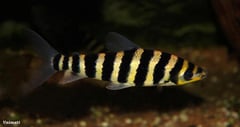
Leporinus fasciatusBanded Leporinus
Anostomidae · Bloch, 1794
The banded leporinus, Leporinus fasciatus, is an anostomid from the Amazon and Orinoco systems and coastal Guyana, Suriname and French Guiana. Young fish are often sold without warning of their size and requirements, and it is fairly ubiquitous in public aquarium displays. It is frequently confused with L. affinis, and its dark body bars multiply with age, from five in young fish to around ten in adults.
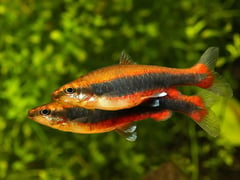
Nannostomus beckfordiGolden Pencilfish
Lebiasinidae · Günther, 1872
The golden pencilfish, Nannostomus beckfordi, is a lebiasinid widely distributed across Guyana, Suriname, French Guiana, Brazil and Venezuela. The type species of the genus and fairly ubiquitous in the trade, it is less demanding than most congeners and a good choice for a newcomer. Many fish on sale are farmed, and wild populations vary in colour pattern, several having been described as species now considered synonyms of N. beckfordi.