Basin
Demerara basin
Only species with a profile on Seriously Fish are counted.
- Species
- 14
- Rivers
- 1
- Photographed
- 14 of 14
- Difficulty rated
- 14 of 14
Rivers in this basinspecies recorded from each
Runs through
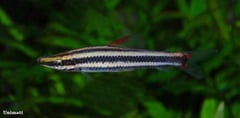
Anostomus anostomusStriped Headstander
Anostomidae · Linnaeus, 1758
The striped headstander, Anostomus anostomus, is an anostomid from the Amazon and Orinoco river systems in Peru, Brazil, Venezuela and Guyana. It lives along rocky shores of fast-flowing rivers, grazing algae and small invertebrates from the rocks. Although it shoals in nature, it is very quarrelsome with conspecifics when only a few are kept, so it is best kept singly or in a group of 6 or more in a larger tank.

Apistogramma steindachneriSteindachner's Apisto
Cichlidae · Regan, 1908
Steindachner's apisto, Apistogramma steindachneri, is a dwarf cichlid from the Essequibo, Demerara and other river systems of Guyana and Suriname. It lives in slower-moving tributaries and streams with leaf litter and submerged wood. The form from the Demerara drainage carries the DATZ code A138, and a very similar fish from the Cuyuni basin in eastern Venezuela (A139) may or may not be conspecific.

Brachychalcinus orbicularisDiscus Tetra
Characidae · Valenciennes, 1850
The discus tetra, Brachychalcinus orbicularis, is a deep-bodied characid generally considered endemic to coastal watersheds of Guyana and Suriname. Recent records suggest it, or a similar congener, may also occur in the Orinoco and Negro drainages. The genus is often referred to collectively as 'silver dollar tetras', and although B. orbicularis is normally said to be the species in the trade, identification is challenging.
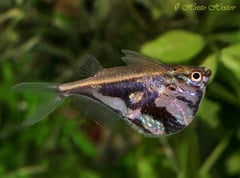
Carnegiella strigataMarbled Hatchetfish
Gasteropelecidae · Günther, 1864
The marbled hatchetfish, Carnegiella strigata, is a hatchetfish from the Amazon and Orinoco basins and coastal rivers of Guyana and Suriname. Popular in the hobby, it is collected for the trade mostly in the rio Negro basin in Brazil. Its larger size and dark, marbled pattern set it apart from congeners, though the pattern varies and the wide range may be open to question. It appears to live only in blackwater.
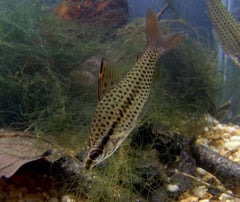
Chilodus punctatusSpotted Headstander
Chilodontidae · Müller & Troschel, 1844
The spotted headstander, Chilodus punctatus, is a headstander from much of the Amazon, the western Orinoco and coastal rivers of Guyana and Suriname. Also called the 'checkered headstander', it lives in slow-moving rivers, oxbows and floodplain lakes, and its colour pattern appears to vary with locality. Shy and peaceful, it is sensitive to dissolved organic wastes and should never be introduced to a biologically-immature aquarium.

Cleithracara maroniiKeyhole Cichlid
Cichlidae · Steindachner, 1881
The keyhole cichlid, Cleithracara maronii, is a small cichlid from French Guiana, Guyana, Suriname, the Orinoco delta in Venezuela and Trinidad. It is told apart from relatives by the keyhole-shaped marking on each side of the body, and is one of few fishes whose generic name derives from its aquarium common name. It inhabits slow-moving blackwater streams, is naturally shy and sensitive to deteriorating water quality, and most fish on sale are commercially farmed.
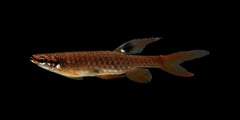
Copella arnoldiSplash Tetra
Lebiasinidae · Regan, 1912
The splash tetra, Copella arnoldi, is a lebiasinid from the lower Amazon basin in Brazil and coastal drainages of Guyana, Suriname and French Guiana. It spawns out of the water: a pair leap together onto overhanging vegetation and cling there while the eggs are laid. Zarske (2011) treats the Guianas populations as C. carsevennensis, restricting C. arnoldi sensu stricto to the lower Amazon, though Mol (2012) considers the two synonymous.
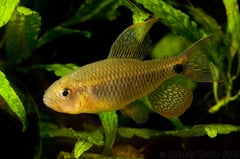
Crenuchus spilurusSailfin Characin
Crenuchidae · Günther, 1863
The sailfin characin, Crenuchus spilurus, is a crenuchid from much of the Amazon and Orinoco drainages and coastal rivers of the Guianas. The only described member of its genus, it varies considerably in colour pattern and morphology across that range. It lives in tea-stained forest streams, and its timid, predominantly benthic nature means it does not always make an ideal community fish. Males guard eggs laid on the roof of a small cave, often formed from leaf litter.

Geophagus brachybranchus
Cichlidae · Kullander & Nijssen, 1989
Geophagus brachybranchus is a cichlid from the Nickerie and Courantyne drainages of Suriname, also reported from Guyana and Venezuela. Generally rare in the aquarium hobby, it appears to be one of the commoner species in Australia, where it is often called the 'black-throated eartheater'. The largest wild specimen recorded measured 138 mm, but it is known to reach 180 to 200 mm in captivity.
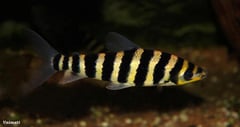
Leporinus fasciatusBanded Leporinus
Anostomidae · Bloch, 1794
The banded leporinus, Leporinus fasciatus, is an anostomid from the Amazon and Orinoco systems and coastal Guyana, Suriname and French Guiana. Young fish are often sold without warning of their size and requirements, and it is fairly ubiquitous in public aquarium displays. It is frequently confused with L. affinis, and its dark body bars multiply with age, from five in young fish to around ten in adults.
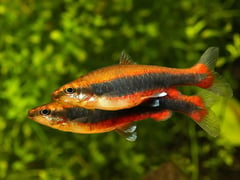
Nannostomus beckfordiGolden Pencilfish
Lebiasinidae · Günther, 1872
The golden pencilfish, Nannostomus beckfordi, is a lebiasinid widely distributed across Guyana, Suriname, French Guiana, Brazil and Venezuela. The type species of the genus and fairly ubiquitous in the trade, it is less demanding than most congeners and a good choice for a newcomer. Many fish on sale are farmed, and wild populations vary in colour pattern, several having been described as species now considered synonyms of N. beckfordi.
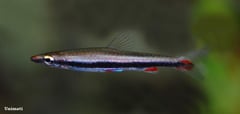
Nannostomus harrisoniBlackstripe Pencilfish
Lebiasinidae · Eigenmann, 1909
The blackstripe pencilfish, Nannostomus harrisoni, is a lebiasinid that appears endemic to the Demerara River basin in eastern Guyana. Quite rare in the hobby, it is more often exported as bycatch among shipments of N. eques than in numbers. It inhabits sluggish tributaries, swamps and flooded forest, and mature males show red in the pelvic, anal and caudal fins.
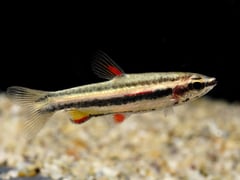
Nannostomus marginatusDwarf Pencilfish
Lebiasinidae · Eigenmann, 1909
The dwarf pencilfish, Nannostomus marginatus, is a lebiasinid of Guyana, Suriname and the middle-to-lower Amazon in Peru, Colombia and Brazil. Enduringly popular, it lacks the red body colour of males of the related N. mortenthaleri and N. rubrocaudatus, showing three dark lateral stripes with no red or purple between them. Colour varies between populations, and its small size and timid nature make it a poor community fish.

Satanoperca leucostictaWhitespot Eartheater
Cichlidae · Müller & Troschel, 1849
The whitespot eartheater, Satanoperca leucosticta, is a cichlid from the Guiana Shield in Guyana, Suriname, eastern Venezuela and northern Brazil. Farmed in several countries, it is frequently available in the ornamental trade. It is often confused with S. jurupari but is easily recognised by the prominent white spots or vermiform markings on the sides of the head. A larvophilous maternal mouthbrooder, it has been bred in aquaria.