Basin
Indragiri basin
Only species with a profile on Seriously Fish are counted.
- Species
- 20
- Rivers
- 1
- Photographed
- 20 of 20
- Difficulty rated
- 20 of 20
Rivers in this basinspecies recorded from each
Runs through
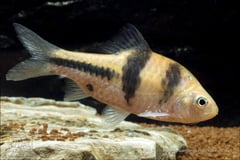
Barbodes lateristrigaSpanner Barb
Cyprinidae · Valenciennes, 1842
The spanner barb or 'T-barb', Barbodes lateristriga, is a cyprinid from peninsular Thailand, Peninsular Malaysia, Singapore, Sumatra and Java. Its colour pattern varies with locality, and the form most commonly seen in the trade corresponds most closely to fish from Johor. The species may prove to be a complex of closely-related taxa. Quite boisterous, it can intimidate more timid species with its size and activity, especially at feeding times.

Betta hipposideros
Osphronemidae · Ng & Kottelat, 1994
Betta hipposideros is a paternal mouthbrooding labyrinth fish from peat swamps in western Peninsular Malaysia and eastern Sumatra, Indonesia. A member of the B. waseri group, it is most easily told from its relatives by a black horse-shoe shaped marking on the throat. An obligate inhabitant of peat swamps and blackwater streams, where the pH can be as low as 3.0 or 4.0, it may have to survive for several weeks in moist leaf litter at certain times of year.

Betta raja
Osphronemidae · Tan & Ng, 2005
Betta raja is a mouthbrooding labyrinth fish endemic to Sumatra, Indonesia, found in the Batang Hari and Indragiri river basins. Before its description it was widely misidentified as Betta fusca. It lives in lowland forest swamps with both clear and black water, and mature males of this B. pugnax complex member have very long pelvic fins and black marginal bands on the anal and lower caudal fins. Populations from different localities should be labelled as such to preserve pure bloodlines.

Betta renata
Osphronemidae · Tan, 1998
Betta renata is a mouthbrooding labyrinth fish from forest peat swamps in Jambi, South Sumatra and Riau provinces on Sumatra, Indonesia. A member of the B. waseri group, it is most easily identified by a clearly-defined dark, kidney-shaped blotch on the throat that is always separate from the dark lower jaw. Its blackwater habitats can have a pH as low as 3.0 or 4.0, and at certain times of year the fish may be forced to survive in moist leaf litter for several weeks.

Betta simorum
Osphronemidae · Tan & Ng, 1996
Betta simorum is a slender bubble-nesting labyrinth fish from Sumatra and the Kapuas River system in West Kalimantan, Borneo, Indonesia. Growing to around 90 mm SL, it inhabits heavily-vegetated forest peat swamps and blackwater streams. It shares the B. bellica group with B. bellica, from which it differs in its slanted head with a concave profile behind the eye. Populations are often labelled by locality, such as Rantau Panjang or Sungai Bengkwan, to preserve pure bloodlines.
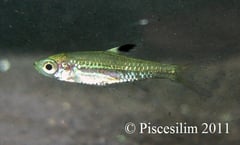
Brevibora cheeya
Cyprinidae · Liao & Tan, 2011
Brevibora cheeya is a small cyprinid from Peninsular Malaysia, Sumatra and the island of Bangka. The type locality is a slow-flowing, acidic stream in coastal heath forest over sand and peat. Very rare in the trade, it is normally imported only as bycatch among other fishes. A complete lateral line, more scales in the lateral row and a larger adult size separate it from the better-known B. dorsiocellata.
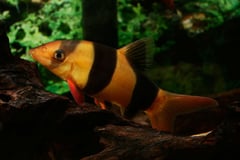
Chromobotia macracanthusClown Loach
Botiidae · Bleeker, 1852
The clown loach, Chromobotia macracanthus, is a large botiid loach native to river systems of Borneo and Sumatra in Indonesia. Widely sold, it is wholly unsuitable for smaller aquaria: a group needs a tank of at least 180 x 60 cm, and a properly kept fish can live for more than twenty years. Bornean and Sumatran populations differ slightly in pattern, and in the Batang Hari, Sumatra, drifting larvae are now collected and grown on for the trade.
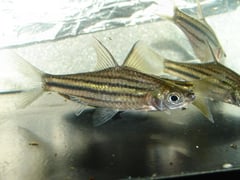
Desmopuntius gemellus
Cyprinidae · Kottelat, 1996
Desmopuntius gemellus is a rarely-traded cyprinid from eastern Sumatra and the island of Bangka, Indonesia. Like D. johorensis and D. trifasciatus, it is vertically barred as a juvenile and changes to a pattern of thin lateral stripes, a change that begins at around 20 mm SL and is normally complete by 30 to 40 mm. It inhabits peat swamp forests and associated black water streams.
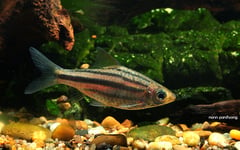
Desmopuntius johorensisStriped Barb
Cyprinidae · Duncker, 1904
The striped barb, Desmopuntius johorensis, is a cyprinid from southern Thailand, Peninsular Malaysia, Singapore, Sumatra and Borneo. Juveniles have 4 dark vertical bars and develop 5 or 6 broad lateral stripes as they grow, a pattern change shared with D. gemellus and D. trifasciatus. Before Kottelat (1992) it was referred to as Puntius eugrammus, while the name 'Puntius johorensis' was misapplied to D. hexazona. It lives mainly in peat swamps and black water streams.
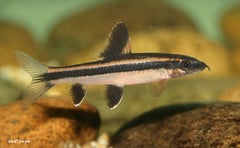
Epalzeorhynchos kalopterumFlying Fox
Cyprinidae · Bleeker, 1850
The flying fox, Epalzeorhynchos kalopterum, is a cyprinid from southern Thailand, Peninsular Malaysia and the Greater Sunda Islands. Fishes sold as 'false flying fox' or 'Siamese flying fox', such as Garra cambodgiensis and Gyrinocheilus aymonieri, are often confused with it, but it has white-edged red and black fins and two pairs of barbels. It grows increasingly territorial with age and can live for over 15 years.
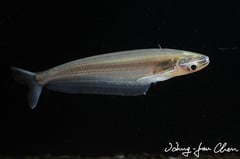
Kryptopterus cryptopterusBlue Sheatfish
Siluridae · Bleeker, 1851
The blue sheatfish, Kryptopterus cryptopterus, is a silurid catfish from the Malay Peninsula, Singapore, Sumatra, Borneo and Java. It inhabits flowing rivers and larger streams with turbid water, and is sometimes traded as 'smokey glass catfish'. Populations from Thailand, Cambodia, Laos and Vietnam once considered conspecific are now referred to K. geminus, its closest relative, from which it differs in having a wider head and a shorter snout and anal fin.

Labiobarbus leptocheilus
Cyprinidae · Valenciennes, 1842
Labiobarbus leptocheilus is a large cyprinid widespread in Southeast Asia, from the Mekong and Salween to the Greater Sunda Islands. Different populations vary somewhat in appearance, and it may turn out to represent a group of closely-related species. The Cambodian Mekong population has been considered a distinct species, Labiobarbus lineatus, and that name is widely used in the ornamental trade although it is currently a synonym. It grows to 260 mm SL and needs spotless, well-oxygenated water.
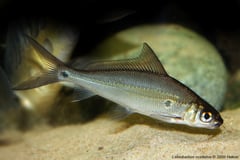
Labiobarbus ocellatus
Cyprinidae · Heckel, 1843
Labiobarbus ocellatus is a cyprinid from Peninsular Malaysia, Sumatra and Borneo, with a black spot on the shoulder and one on the caudal peduncle. It is occasionally available in the ornamental trade, typically under a name such as 'Bornean eye-spot silver shark' or the invalid scientific name Cirrhinus chinensis. A pelagic species of rivers and some lakes, it moves into seasonally inundated floodplains and forest during the wet season, and grows to 180 mm SL.
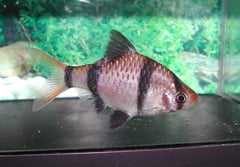
Puntigrus tetrazonaTiger Barb
Cyprinidae · Bleeker, 1855
The tiger barb, Puntigrus tetrazona, is a small cyprinid probably endemic to central and southern Sumatra, Indonesia. Among the most ubiquitous species in the aquarium trade, it is seen mostly as commercially-produced fish and ornamental strains, and wild examples are rarely traded. The identity of the 'aquarium' tiger barb is the subject of ongoing confusion, and many farmed fish are weak or deformed through inbreeding.
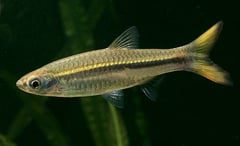
Rasbora dusonensis
Cyprinidae · Bleeker, 1850
Rasbora dusonensis is a cyprinid from Sumatra, Peninsular Malaysia and Borneo, found in larger river channels and peat swamp blackwaters. Its identity was unclear for decades before its redescription by Ng and Kottelat (2013). It is very similar to R. tornieri, which shares the Musi river with it, but has a bright yellow caudal fin with a broad dark margin, against carmine red in R. tornieri. One specimen measured 162 mm SL, although 95 to 105 mm is a more commonly reported adult size.
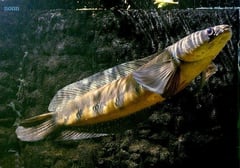
Channa marulioidesEmperor Snakehead
Channidae · Bleeker, 1851
The emperor snakehead, Channa marulioides, is a large snakehead from southern Thailand, Malaysia and Indonesia, including Borneo and Sumatra. Colour pattern varies with locality, and it is often confused with C. marulius and C. melanoptera, all three presenting taxonomic problems. Growing to 650 mm SL, it is pelagic, turns aggressive towards its own kind at sexual maturity and is suitable only for public installations or the very largest private aquaria.

Channa micropeltesGiant Snakehead
Channidae · Cuvier, 1831
The giant snakehead, Channa micropeltes, is a predatory fish from Southeast Asia that grows to well over a metre. Juveniles are sold as 'red' or 'redline' snakehead, but it is suitable only for public installations or the very largest private aquaria. Unlike most Channa species it is pelagic and needs plenty of room to swim, and adults become aggressive at sexual maturity.
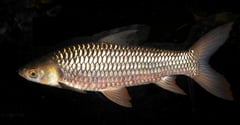
Leptobarbus hoeveniiMad Barb
Cyprinidae · Bleeker, 1851
The mad barb, Leptobarbus hoevenii, is a large pelagic cyprinid apparently native to Peninsular Malaysia, Borneo, Sumatra and Java. A popular sport fish growing to 800 to 1000 mm, it is wholly unsuitable for private aquaria but is readily available at 100 to 150 mm. The congener L. rubripinna was referred to as L. hoevenii for decades and both are traded under the same name. L. hoevenii lacks the broad dark midlateral stripe and has dark grey pelvic and anal fins.

Macrochirichthys macrochirusGiant Sword Minnow
Cyprinidae · Valenciennes, 1844
The giant sword minnow, Macrochirichthys macrochirus, is a large pelagic cyprinid widespread in Southeast Asia, from the Mekong to Borneo and Sumatra. Growing to 600 to 800 mm and becoming increasingly piscivorous as it grows, it is unsuitable for the majority of private aquaria, although juveniles are traded on occasion. It is thought to have been extirpated from the Chao Phraya, Mae Klong, Lake Songkhla and Java, and the Mekong populations have been drastically reduced.

Phalacronotus apogon
Siluridae · Bleeker, 1851
Phalacronotus apogon is a large silurid catfish from much of Southeast Asia, including Thailand, the Mekong basin and the Greater Sunda Islands. It reaches 700 mm and arguably should not be considered a home aquarium subject at all, but juveniles are sometimes sold as 'blue neon sheatfish' or 'metallic cheatfish' without adequate information on long-term care. It is an important food fish across much of its native range.