Basin
Kayan basin
Only species with a profile on Seriously Fish are counted.
- Species
- 9
- Rivers
- 1
- Photographed
- 9 of 9
- Difficulty rated
- 9 of 9
Rivers in this basinspecies recorded from each
Runs through
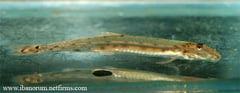
Acanthopsoides robertsi
Cobitidae · Siebert, 1991
Acanthopsoides robertsi is a dwarf horse-face loach from the Kapuas River basin in West Kalimantan, Indonesian Borneo. Unlike most of its congeners it is quite easily identified, being the only species with a dark, triangular marking in the caudal fin. Very similar fish have been collected further north in the Kayan and Sambas basins. Highly gregarious, it needs soft sand to bury in and is best kept in a group of six or more.
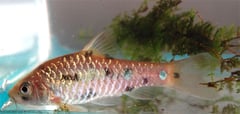
Barbodes everetti
Cyprinidae · Boulenger, 1894
Barbodes everetti is a cyprinid from Borneo, known from Sarawak and West Kalimantan, where it lives in clear forest streams in the foothills. Uncommon in the hobby, its name has been widely misapplied to the clown barb, B. dunckeri, from Peninsular Malaysia and Singapore. B. everetti is the less colourful of the two, with relatively small dark body markings, a dark blotch at the rear of the dorsal-fin base and 3½ scales above the lateral line.

Betta lehi
Osphronemidae · Tan & Ng, 2005
Betta lehi is a paternal mouthbrooding labyrinth fish endemic to Borneo, in southwestern Sarawak and the lower River Kapuas basin in West Kalimantan. A member of the B. pugnax complex, it has green iridescent scales on the opercle and body and a light blue iridescent band on the anal fin. It inhabits forest peat swamps, acidic clearwater swamps and associated streams, where the pH can be between 3.0 and 5.5.

Betta midas
Osphronemidae · Tan, 2009
Betta midas is a stout-bodied labyrinth fish from the lower Kapuas basin in West Kalimantan, Indonesian Borneo, and may also occur in western Sarawak. It has been traded as B. anabatoides in the past, and most images of it are labelled as such. It has gold iridescent scales on the opercle, belly and body. The paratype series came from a blackwater river in peat swamp forest with a pH of 4.1.

Betta unimaculata
Osphronemidae · Popta, 1905
Betta unimaculata is a large mouthbrooding labyrinth fish from the upper Kayan and Mahakam river drainages in East Kalimantan, Borneo, Indonesia. Growing to around 115 mm SL, it has been collected from clear, flowing streams, elevated headwater pools and more turbid forest streams. Populations differ in colour and pattern and will hybridise, so they are labelled by locality and should never be kept together. Fish from 'Tawau' once thought to be this species have been described as B. ocellata.

Channa luciusForest Snakehead
Channidae · Cuvier, 1831
The forest snakehead, Channa lucius, is a predatory snakehead from Indochina, Peninsular Malaysia and the Greater Sunda Islands. Also referred to as the 'splendid' or 'shiny' snakehead, it occurs on Sumatra, Borneo and Java, grows to 400 mm SL and favours forest swamps and tributaries. Like others in the genus it breathes atmospheric air, and it needs a dimly-lit tank with plenty of cover and a tightly-fitting lid, since Channa spp. are notorious for their ability to escape.

Parosphromenus allani
Osphronemidae · Brown, 1987
Parosphromenus allani is a liquorice gourami from Sarawak in Borneo, East Malaysia, to which it appears endemic. Its type description was a hobbyist-magazine announcement with limited diagnostic information, and fish from around Lundu with a different fin pattern, known to aquarists as P. sp. 'Stunggang' or P. sp. 'Lundu', may or may not be the same species. Much of its habitat has been lost and it is considered in grave danger of extinction.
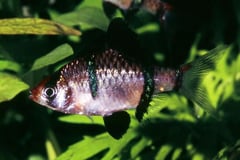
Puntigrus pulcher
Cyprinidae · Rendahl, 1922
Puntigrus pulcher is a small cyprinid endemic to the Indonesian part of eastern Borneo, with records from the Kayan and Mahakam rivers. Considered a synonym of P. anchisporus for decades following Alfred (1963), it was revalidated by Kottelat and Tan (2011). It has an incomplete lateral line, an entirely black dorsal fin and black pelvic fins, and occasionally appears in the hobby, though the trade relies largely on commercially-produced 'tiger barbs'.
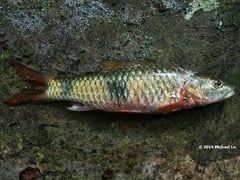
Hampala bimaculata
Cyprinidae · Popta, 1905
Hampala bimaculata is a large riverine cyprinid endemic to Borneo, recorded from Sarawak, Sabah, East Kalimantan and Brunei. Its adult size of up to 500 mm SL more-or-less precludes it as an aquarium fish, and it is poorly known in the ornamental trade. Of the Hampala species with two body blotches, it has saddle-shaped markings, with the anterior blotch beneath the posterior half of the dorsal-fin.