Basin
Sambas basin
Only species with a profile on Seriously Fish are counted.
- Species
- 11
- Rivers
- 1
- Photographed
- 11 of 11
- Difficulty rated
- 11 of 11
Rivers in this basinspecies recorded from each
Runs through
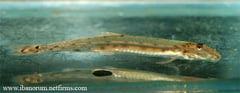
Acanthopsoides robertsi
Cobitidae · Siebert, 1991
Acanthopsoides robertsi is a dwarf horse-face loach from the Kapuas River basin in West Kalimantan, Indonesian Borneo. Unlike most of its congeners it is quite easily identified, being the only species with a dark, triangular marking in the caudal fin. Very similar fish have been collected further north in the Kayan and Sambas basins. Highly gregarious, it needs soft sand to bury in and is best kept in a group of six or more.

Betta lehi
Osphronemidae · Tan & Ng, 2005
Betta lehi is a paternal mouthbrooding labyrinth fish endemic to Borneo, in southwestern Sarawak and the lower River Kapuas basin in West Kalimantan. A member of the B. pugnax complex, it has green iridescent scales on the opercle and body and a light blue iridescent band on the anal fin. It inhabits forest peat swamps, acidic clearwater swamps and associated streams, where the pH can be between 3.0 and 5.5.

Betta midas
Osphronemidae · Tan, 2009
Betta midas is a stout-bodied labyrinth fish from the lower Kapuas basin in West Kalimantan, Indonesian Borneo, and may also occur in western Sarawak. It has been traded as B. anabatoides in the past, and most images of it are labelled as such. It has gold iridescent scales on the opercle, belly and body. The paratype series came from a blackwater river in peat swamp forest with a pH of 4.1.
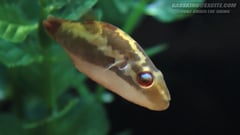
Carinotetraodon irrubescoRed-tailed Redeye Puffer
Tetraodontidae · Tan, 1999
The red-tailed redeye puffer, Carinotetraodon irrubesco, is a small freshwater puffer endemic to Indonesia, known from Sumatra and West Kalimantan. Males have a reddish caudal fin and lack the black spot at the dorsal-fin base seen in the other red-eyed puffers, and the eyes bulge clearly above the head. It has been collected only among submerged riparian vegetation of terrestrial origin, in murky brown water.

Datnioides polotaSilver Tiger Perch
Datnioididae · Hamilton, 1822
The silver tiger perch, Datnioides polota, is a tiger perch widely distributed in southeastern Asia, from India and Bangladesh east to Indonesia. Mostly found in brackish habitats such as estuaries, mangroves and coastal lagoons, it has a highly variable colour pattern with up to 7 dark bars. The name D. quadrifasciatus is sometimes applied to it, but that name is a junior homonym and polota takes precedence.
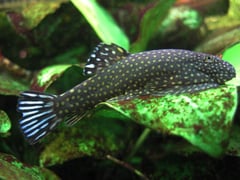
Gastromyzon ctenocephalus
Gastromyzontidae · Roberts, 1982
Gastromyzon ctenocephalus is a hillstream loach from western Borneo, known only from headwaters of the Sarawak and Sambas rivers. One of the more commonly traded members of the genus, it turns up in mixed shipments labelled 'Borneo sucker', 'Hong Kong pleco' or 'butterfly loach'. It is sometimes misidentified as G. punctulatus, which has yellow fins and a lighter, less intensely spotted body.
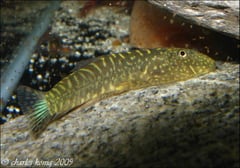
Gastromyzon zebrinus
Gastromyzontidae · Tan, 2006
Gastromyzon zebrinus is a hillstream loach known only from the upper Sambas River in West Kalimantan, Indonesian Borneo. Its black body carries 11-13 thin cream bars on the dorsal surface. It forms a pair of cryptospecies with G. stellatus, separated from it by an outcrop of the Müller range, and intermediate colour patterns mean the two are often confused. It is one of the more commonly-traded members of the genus.
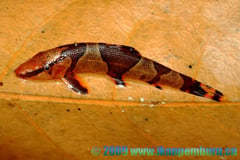
Homaloptera orthogoniataSaddle-back Loach
Balitoridae · Vaillant, 1902
The saddle-back loach, Homaloptera orthogoniata, is a 'lizard' loach endemic to Borneo, known from rivers in Sarawak and Kalimantan. It was historically said to occur across much of Indochina. It is rare in the hobby, and most images online and in the literature show H. confuzona or H. parclitella. It always has three large, saddle-shaped markings on the back, the third between the dorsal and caudal fins.
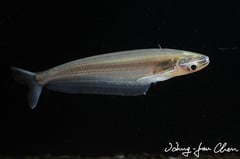
Kryptopterus cryptopterusBlue Sheatfish
Siluridae · Bleeker, 1851
The blue sheatfish, Kryptopterus cryptopterus, is a silurid catfish from the Malay Peninsula, Singapore, Sumatra, Borneo and Java. It inhabits flowing rivers and larger streams with turbid water, and is sometimes traded as 'smokey glass catfish'. Populations from Thailand, Cambodia, Laos and Vietnam once considered conspecific are now referred to K. geminus, its closest relative, from which it differs in having a wider head and a shorter snout and anal fin.
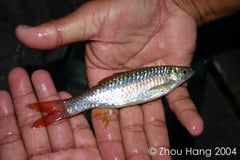
Rasbora tornieri
Cyprinidae · Ahl, 1922
Rasbora tornieri is a cyprinid from Sumatra, Borneo, Peninsular Malaysia and the Mekong drainage in Cambodia. Its identity was unclear for decades before its redescription by Ng and Kottelat (2013). It is very similar to R. dusonensis, which shares the Musi river with it, but its caudal fin is carmine red, against bright yellow in R. dusonensis. It lives in flowing streams and peat swamp blackwaters alike.

Channa micropeltesGiant Snakehead
Channidae · Cuvier, 1831
The giant snakehead, Channa micropeltes, is a predatory fish from Southeast Asia that grows to well over a metre. Juveniles are sold as 'red' or 'redline' snakehead, but it is suitable only for public installations or the very largest private aquaria. Unlike most Channa species it is pelagic and needs plenty of room to swim, and adults become aggressive at sexual maturity.