Basin
Tanintharyi basin
Only species with a profile on Seriously Fish are counted.
- Species
- 4
- Rivers
- 1
- Photographed
- 4 of 4
- Difficulty rated
- 4 of 4
Rivers in this basinspecies recorded from each
Runs through
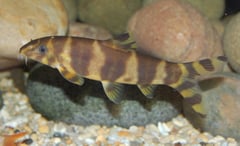
Botia udomritthirujiEmperor Botia
Botiidae · Ng, 2007
The emperor botia, Botia udomritthiruji, is a botiid loach known only from the Tanintharyi River drainage in southern Myanmar. Known since 1993, it was occasionally traded as B. sp. 'Tenasserim' before it was described. At first glance it is most easily confused with B. histrionica but keeps its wider vertical bars at all ages, while in B. histrionica the bars become irregular or break up completely as the fish mature.

Danio sp. 'hikari'Hikari Danio
Cyprinidae · authority not recorded
The hikari danio, Danio sp. 'hikari', is a probable undescribed cyprinid from the Tanintharyi River drainage in southern Myanmar. First available in 2002, males and females were sold as 'Danio sp. hikari yellow' and 'D. sp. hikari blue'. DNA testing showed them to be one species, distinct from the very similar D. kerri, in which the central body stripe ends at the caudal peduncle. Only one population of D. kerri was sampled, so it could still be a colourful form of that species.
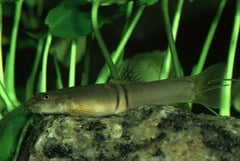
Schistura balteataSumo Loach
Nemacheilidae · Rendahl, 1948
The sumo loach, Schistura balteata, is a nemacheilid loach from the Tanintharyi river system in southern Myanmar, also recorded in western Thailand. Quite uncommon in the hobby, its name is sometimes used for the similar-looking, apparently undescribed S. cf. balteata, and both are traded as 'sumo loach'. The real S. balteata has two dark vertical bars below the dorsal-fin and no black bar at the caudal-fin base.

Garra notata
Cyprinidae · Blyth, 1860
Garra notata is a cyprinid known with certainty from the Salween basin in Myanmar, China and Thailand, and the Tenasserim drainage. Records from the Western Ghats of southern India are unlikely to be accurate, and a report from the upper Irrawaddy needs confirmation. It lacks both a transverse groove and a proboscis on the snout, and has dark spots at the base of the dorsal-fin rays.