Basin
Tenasserim basin
Only species with a profile on Seriously Fish are counted.
- Species
- 6
- Rivers
- 1
- Photographed
- 6 of 6
- Difficulty rated
- 6 of 6
Rivers in this basinspecies recorded from each
Runs through

Badis ruberBurmese Badis
Badidae · Schreitmüller, 1923
The Burmese badis, Badis ruber, is a badid common throughout much of lowland Myanmar, from the Ayeyarwady and Sittaung south to the Tenasserim. Among the better known Badis in the hobby, it is also traded as 'red badis' and appears in older literature as Badis badis burmicanus. It differs from B. khwae and B. siamensis in its rows of vertically arranged dark flank markings and relatively large caudal peduncle blotch. It tends to inhabit lentic biotopes such as roadside ditches and small, well-vegetated creeks.

Channa luciusForest Snakehead
Channidae · Cuvier, 1831
The forest snakehead, Channa lucius, is a predatory snakehead from Indochina, Peninsular Malaysia and the Greater Sunda Islands. Also referred to as the 'splendid' or 'shiny' snakehead, it occurs on Sumatra, Borneo and Java, grows to 400 mm SL and favours forest swamps and tributaries. Like others in the genus it breathes atmospheric air, and it needs a dimly-lit tank with plenty of cover and a tightly-fitting lid, since Channa spp. are notorious for their ability to escape.

Danio sp. 'hikari'Hikari Danio
Cyprinidae · authority not recorded
The hikari danio, Danio sp. 'hikari', is a probable undescribed cyprinid from the Tanintharyi River drainage in southern Myanmar. First available in 2002, males and females were sold as 'Danio sp. hikari yellow' and 'D. sp. hikari blue'. DNA testing showed them to be one species, distinct from the very similar D. kerri, in which the central body stripe ends at the caudal peduncle. Only one population of D. kerri was sampled, so it could still be a colourful form of that species.
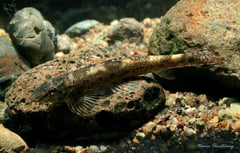
Homalopteroides modestus
Balitoridae · Vinciguerra, 1890
Homalopteroides modestus is a small hillstream loach from the Salween, Mae Klong and Tenasserim rivers of southern Myanmar and western Thailand. Randall and Page (2012) redescribed it from Mae Klong specimens that had previously been identified as the congener H. smithi. A specialised micropredator of swift, clear, oxygen-saturated streams, it needs clean, well-oxygenated water and regular meals of live or frozen food.

Garra notata
Cyprinidae · Blyth, 1860
Garra notata is a cyprinid known with certainty from the Salween basin in Myanmar, China and Thailand, and the Tenasserim drainage. Records from the Western Ghats of southern India are unlikely to be accurate, and a report from the upper Irrawaddy needs confirmation. It lacks both a transverse groove and a proboscis on the snout, and has dark spots at the base of the dorsal-fin rays.

Scleropages inscriptus
Osteoglossidae · Roberts, 2012
Scleropages inscriptus is an osteoglossid said to come from the Tenasserim river basin in Tananthayi Region, southern Myanmar. Its distribution is unclear, and the type specimens were obtained dead from an aquarium fish vendor. Distinctive angulated linear markings on the head and flanks separate it from other members of the genus. The largest of the type series measured 385 mm, but it can apparently attain about 600 mm.