Genus
Anatolichthys
- Species
- 6
- Photographed
- 6 of 6
- Difficulty rated
- 6 of 6
Where the name comes fromEdit
named for Anatolia, also referred to as Asia Minor, a geographical region comprising the majority of the Republic of Türkiye to which genus members are endemic, in combination with the Greek noun ichthys (Gr. ἰχθύς), meaning 'fish'.

Anatolichthys anatoliaeAnatolian Toothcarp
Leidenfrost, 1912
The Anatolian toothcarp, Anatolichthys anatoliae, is a small killifish from central and western Anatolia in Turkey. The most widely distributed of the Anatolian species, it lives in fresh and mildly saline waters, and around Lake Tuz several populations have disappeared through pollution and water extraction. It needs a cold winter period, and given its conservation status it is best kept on its own, in a group with two or three females to each male.
Anatolichthys danfordiiDanford's Toothcarp
Boulenger, 1890
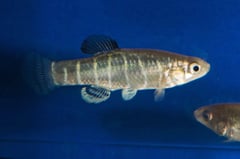
Danford's toothcarp, Anatolichthys danfordii, is endemic to Turkey, in the middle and lower Kızıl, lower Yeşil and upper Seyhan river systems. It has a confused history, having been treated as a synonym of both A. sophiae and A. fasciatus, and A. chantrei is now known to be a junior synonym of it. Colour and pattern vary with locality, and forms such as 'Soysallı' and 'Kırşehir' are labelled to preserve bloodlines.
Anatolichthys saldaeSalda Toothcarp
Akşiray, 1955
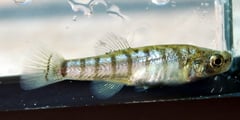
The Salda toothcarp, Anatolichthys saldae, is endemic to Lake Salda in the Turkish Lakes region of southwestern Anatolia, Turkey. Lake Salda is a highly alkaline, magnesium-rich soda lake. The fish has an elongated, slender body, an angular lower jaw and reduced scalation that varies between individuals. It has been considered Critically Endangered by the IUCN since 1996.
Anatolichthys sureyanusBurdur Toothcarp
Neu, 1937
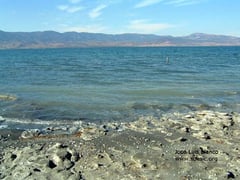
The Burdur toothcarp, Anatolichthys sureyanus, is endemic to Lake Burdur in the Turkish Lakes region of southwestern Anatolia, Turkey. The only fish in this extremely alkaline, saline lake, it has a slender body, an angular lower jaw and variable scalation. It has also gone by A. transgrediens, A. burdurensis and A. burduricus, and appears twice on the IUCN Red List as a result.
Anatolichthys transgrediensAcı Toothcarp
Ermin, 1946
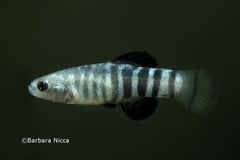
The Acı toothcarp, Anatolichthys transgrediens, is endemic to the Lake Acı basin in the Turkish Lakes region of southwestern Anatolia, Turkey. The lake's extreme chemistry and fluctuating level mean it is mostly found in fresh and slightly brackish springs around the margins. In scalation, body form and jaw it is intermediate between A. anatoliae and A. splendens/sureyanus. It has been considered critically endangered by the IUCN since 1996.
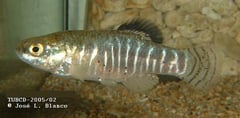
Anatolichthys villwockiSakarya Toothcarp
Hrbek & Wildekamp, 2003
The Sakarya toothcarp, Anatolichthys villwocki, is endemic to the Sakarya River basin, including Lake Çavuşçu, in western central Turkey. Formerly treated as a form of A. anatoliae, it has been shown to be the sister group to all other Anatolian Aphanius. It occupies habitats from clear, spring-fed freshwater to hypersaline Lake Çavuşçu, and colour and pattern vary with locality.