Genus
Apricaphanius
- Species
- 3
- Photographed
- 3 of 3
- Difficulty rated
- 3 of 3
Where the name comes fromEdit
from the Latin adjective apricus, meaning 'sunny' (given as "shining" by the authors), in reference to the many small white spots on the flanks of male individuals, in combination with the generic name Aphanius, within which genus members were formerly placed.
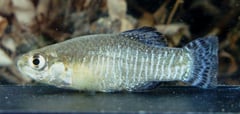
Apricaphanius baeticusBaetican Toothcarp
Doadrio, Carmona & Fernández-Delgado, 2002
The Baetican toothcarp, Apricaphanius baeticus, is endemic to a small part of southern Spain, mostly in the lower Guadalquivir River basin. It was considered a geographic variant of A. iberus until 2002, and differs in details such as thicker vertical bars in males and a few large dark markings in females. Only nine isolated populations remain, and it has been listed as endangered by the IUCN since 2006.
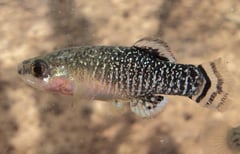
Apricaphanius iberusSpanish Toothcarp
Valenciennes, 1846
The Spanish toothcarp, or fartet, Apricaphanius iberus, is restricted to a few small areas of Spain's Mediterranean coast. These lie in Catalonia, Valencia and Murcia, and only 20 or so isolated populations remain, threatened by introduced Gambusia holbrooki and Fundulus heteroclitus, habitat degradation and pollution. Populations from the Atlantic coast and Algeria are now A. baeticus and A. saourensis.
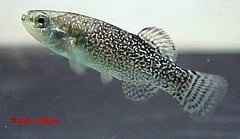
Apricaphanius saourensisSahara Toothcarp
Blanco, Hrbek & Doadrio, 2006
The Sahara toothcarp, Apricaphanius saourensis, is endemic to the Oued Saoura, an endorheic river basin in Algeria that drains into the Sahara. Described in 2006, it differs from A. iberus and A. baeticus in its mottled body patterning. In 2004 it was found only at Mazzer, and introduced Gambusia is thought to have extirpated it from its other localities. The describers suggest it should be considered critically endangered.