Genus
Badis
- Species
- 13
- Photographed
- 13 of 13
- Difficulty rated
- 13 of 13
Where the name comes fromEdit
probably derived from a Bangla (Bengali) name for the fish.

Badis assamensis
Ahl, 1937
Badis assamensis is a badid from the Brahmaputra River basin in Assam state, northeast India, and the largest species in its genus. Like most badids it is poorly documented. Its body patterning is almost identical to that of B. blosyrus, but it grows slightly larger, to 65 to 75 mm, and has a noticeably shorter jaw profile. The neotype was collected from a slow-moving forest stream in the Dibru River drainage, and it is a slow-moving, retiring fish that more boisterous tankmates can outcompete for food.

Badis badisBadis
Hamilton, 1822
The badis, Badis badis, is a small badid from the Ganges river system in India, Nepal and Bangladesh, with further records in Assam and the Mahanadi. Sometimes sold as the 'chameleon fish' for its ability to change colour rapidly, especially when breeding or stressed, it was one of only two badids popular in the hobby before 2002. Several congeners share its dark cleithral spot and can be hard to tell apart. It is sluggish and retiring, and rival males can be quite aggressive towards one another in confined spaces.

Badis blosyrus
Kullander & Britz, 2002
Badis blosyrus is a badid from western Assam and northern West Bengal in India, in the Brahmaputra drainage. Like most badids it is poorly documented. Its body patterning is almost identical to that of B. assamensis, but it is slightly smaller and has a noticeably elongated, better-developed jaw. In the Raidak River it was collected from cool, shallow, flowing water over small rocks and sand, with thick marginal vegetation.

Badis corycaeus
Kullander & Britz, 2002
Badis corycaeus is a badid known only from the upper Ayeyarwady River basin in northern Myanmar, including nearby Lake Indawgyi. Its closest relative is B. pyema, but it is much the deeper, darker-bodied fish. At the type locality it lives in running water towards the margins of a clear stream, alongside B. kyar and Dario hysginon, which occupy different niches. Rare in the hobby, it is best kept alone with the emphasis on captive reproduction, and rival males can be very aggressive.

Badis ferrarisi
Kullander & Britz, 2002
Badis ferrarisi is a badid endemic to the Ayeyarwady River drainage in Myanmar, although the full extent of its range remains unclear. It is difficult to confuse with any congener because of its body patterning of usually 11 short dark bars running along the flank from just behind the gill plate. Poorly documented and rare in the hobby, it is best kept alone with the emphasis on captive reproduction, and rival males can be aggressive towards one another.

Badis juergenschmidti
Schindler & Linke, 2010
Badis juergenschmidti is a badid known only from the Ka Dat Chaung river system in Mon State, south-eastern Myanmar, part of the Sittaung drainage. Discovered by German aquarist Horst Linke in early 2010, it was known as B. sp. East Myanmar before its description. It has no opercular or cleithral blotch, and adult males have a broad, solid bar at the caudal-fin base and white margins to the caudal fin. The type locality is a shallow, slow-flowing river over boulders, stones and sand.
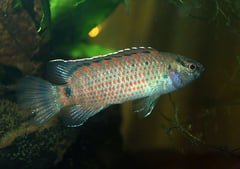
Badis khwae
Kullander & Britz, 2002
Badis khwae is a badid that appears to be endemic to the Khwae Noi River basin in western Thailand, close to the border with Myanmar. It is most easily confused with B. ruber and B. siamensis, but lacks the rows of dark spot-like markings both have on the flanks. Its restricted range means it is unlikely ever to be available in large numbers. It lives in small forest streams with sluggish to moderate flow, usually in marginal areas or still pools.

Badis kyar
Kullander & Britz, 2002
Badis kyar is a slender badid from the upper Ayeyarwady River basin in northern Myanmar, recorded near Myitkyina and in the lower Shweli River. It shares its body shape with B. pyema, but has solid, uniform dark bars on the flanks and a solid bar on the caudal peduncle where B. pyema has rows of irregular spots and a blotch. At the type locality it occupies the faster flow towards the centre of the stream, and it needs more current than most other Badis in the aquarium.

Badis pyema
Kullander & Britz, 2002
Badis pyema is a slender badid known only from the remote, mountainous Putao area of Kachin state, northern Myanmar, in the Ayeyarwady system. It resembles B. kyar in shape, but its flank 'bars' are rows of irregular dark spots and it has a dark blotch on each side of the caudal peduncle. The type series came from a narrow, shallow, fast-moving forest stream with clear water over rocks, gravel and sand, and it needs more flow than most other Badis in the aquarium.

Badis ruberBurmese Badis
Schreitmüller, 1923
The Burmese badis, Badis ruber, is a badid common throughout much of lowland Myanmar, from the Ayeyarwady and Sittaung south to the Tenasserim. Among the better known Badis in the hobby, it is also traded as 'red badis' and appears in older literature as Badis badis burmicanus. It differs from B. khwae and B. siamensis in its rows of vertically arranged dark flank markings and relatively large caudal peduncle blotch. It tends to inhabit lentic biotopes such as roadside ditches and small, well-vegetated creeks.

Badis siamensis
Klausewitz, 1957
Badis siamensis is a badid endemic to Peninsular Thailand, collected only from river systems draining the western coastline. It is most easily confused with B. khwae and B. ruber, but has rows of horizontally arranged dark markings on the flanks, and its caudal peduncle marking is reduced or missing. Poorly documented, it was known for a number of years as Badis badis siamensis and is labelled so in older literature. Its habitat is unconfirmed.

Badis sp. 'Buxar'
authority not recorded
Badis sp. 'Buxar' is an undescribed badid from India, named after the Buxa (often spelled 'Buxar') National Park in West Bengal. It has been in the hobby since 2006 and is also sold as B. sp. 'flame dot', after the red centres to the body scales of males. It appears to belong to the B. corycaeus group. Rival males can be very aggressive towards one another, especially in smaller tanks.

Badis tuivaiei
Vishwanath & Shanta, 2004
Badis tuivaiei is a badid from northeastern India, described from the Tuivai and Irang rivers in the Barak system of Manipur state. It has since been found in the Wahumiam River in Meghalaya, where fish collected in 2006 were first thought to be undescribed and called B. sp. 'Wahumiam River' or 'terracotta'. It is very similar to B. badis, B. chittagongis and B. kanabos and is separated from them by meristic counts. At the Wahumiam locality the water was clear, shallow and slow over boulders, pebbles and sand.