Genus
Bagarius
- Species
- 4
- Photographed
- 4 of 4
- Difficulty rated
- 4 of 4
Where the name comes fromEdit
from 'Vaghari', a local name in Calcutta (Kolkata).

Bagarius bagarius
Hamilton, 1822
Bagarius bagarius is a sisorid catfish with a wide but disjointed recorded range, from the Indus in Pakistan east to the Mekong and Malay Peninsula. Its identity is confused: the name has been widely applied to a small fish said to reach only 200 mm SL, but it may be the only Bagarius in the Indian subcontinent, in which case it can reach 2 metres. It is mostly collected from fast, turbulent rapids in larger rivers, where it shelters among boulders, and is best kept alone.
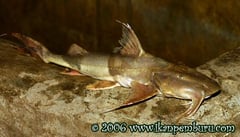
Bagarius rutilus
Ng & Kottelat, 2000
Bagarius rutilus is a sisorid catfish from the Red River and other drainages of northern Vietnam and Yunnan in southern China, possibly also Laos. Reaching 700 to 1000 mm SL, it is clearly unsuitable for the home aquarium, and small numbers are only occasionally exported. It has orange fins in life. Adults live in fast, turbulent rapids in large river channels and perform spawning migrations when rivers swell between March and June.

Bagarius suchusCrocodile Catfish
Roberts, 1983
The crocodile catfish, Bagarius suchus, is a sisorid catfish from the Mekong system in Thailand, Laos and Cambodia and the Chao Phraya in Thailand. Reaching 650 to 700 mm SL, it is clearly unsuitable for the home aquarium. An exposed, rugose cranium, sharp ridges on the predorsal plate and a row of prominent humps along the back separate it from congeners. It is mostly collected from turbulent rapids in larger rivers, where it shelters among boulders and large rocks.

Bagarius yarrelliGoonch
Sykes, 1839
The goonch, Bagarius yarrelli, is a very large sisorid catfish recorded from the Indus in Pakistan east through Indochina to Sumatra and Borneo. Also known as the 'giant devil catfish' and 'sand shark', it reaches 1300 to 2000 mm and is fished for food across much of its range. That wide distribution appears doubtful, and Indian and Southeast Asian populations may prove not to be conspecific. It lives among boulders in the fast, turbulent rapids of large rivers.