Genus
Barbodes
- Species
- 8
- Photographed
- 8 of 8
- Difficulty rated
- 8 of 8
Where the name comes fromEdit
from the Latin barbus, meaning 'barbel', and Ancient Greek εἶδος (-oides), meaning 'form, likeness'.

Barbodes aurotaeniatus
Tirant, 1885
Barbodes aurotaeniatus is a small cyprinid from the middle and lower Mekong basin in Laos, Vietnam, Cambodia and Thailand. Uncommon in the aquarium trade, it has a single pair of maxillary barbels, lacking the rostral barbels of other Barbodes, and usually four small vertical black markings on the flanks. It inhabits streams, irrigation canals and ditches, and is apparently very peaceful, best kept in a mixed-sex group of 6 to 10.
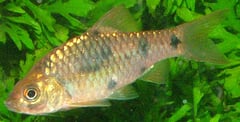
Barbodes banksi
Herre, 1940
Barbodes banksi is a cyprinid from Peninsular Malaysia, Singapore and western Borneo, plus the Anambas and Natuna islands of Indonesia. It is tentatively considered distinct from the closely related B. binotatus, differing in a dark, wedge-shaped marking below the dorsal fin in place of a midlateral spot, though the two may be colour forms of a single species. Occasionally exported as bycatch, it lives in habitats from fast hill streams to canals and floodplain ponds.

Barbodes binotatusSpotted Barb
Valenciennes, 1842
The spotted barb, Barbodes binotatus, is a cyprinid ranging from Myanmar and Thailand through the Greater Sunda Islands to the Philippines. So ubiquitous across its range that it's often called simply 'common barb', it occurs from sea level to at least 2000 m in habitats from fast-flowing hill streams to irrigation canals and floodplain ponds. The basic pattern of a dark spot at the dorsal-fin origin and another on the caudal peduncle varies with origin.
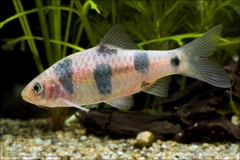
Barbodes dunckeriClown Barb
Ahl, 1929
The clown barb, Barbodes dunckeri, is a cyprinid from Peninsular Malaysia, described from Singapore, where it may now be extirpated. It has been widely misidentified as B. everetti, a distinct species from Borneo, and appears under that name in most aquarium literature. B. dunckeri has much larger dark body markings, no blotch at the rear of the dorsal-fin base and 4½ scales above the lateral line. Fish entering the ornamental trade appear to be farm-raised.
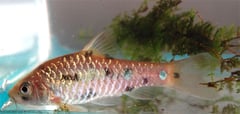
Barbodes everetti
Boulenger, 1894
Barbodes everetti is a cyprinid from Borneo, known from Sarawak and West Kalimantan, where it lives in clear forest streams in the foothills. Uncommon in the hobby, its name has been widely misapplied to the clown barb, B. dunckeri, from Peninsular Malaysia and Singapore. B. everetti is the less colourful of the two, with relatively small dark body markings, a dark blotch at the rear of the dorsal-fin base and 3½ scales above the lateral line.
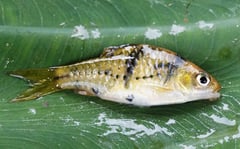
Barbodes kuchingensisFalse Spanner Barb
Herre, 1940
The false spanner barb, Barbodes kuchingensis, is a cyprinid apparently endemic to western Borneo, from Sarawak into the Kapuas system. It lives mainly in shallow, clear forest streams and is rarely exported, while subadult B. everetti and some populations of B. lateristriga are regularly traded under its name. B. kuchingensis sensu stricto has a prominent row of dark spots along the lateral line and a short streak extending from the upper part of the operculum.
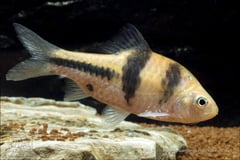
Barbodes lateristrigaSpanner Barb
Valenciennes, 1842
The spanner barb or 'T-barb', Barbodes lateristriga, is a cyprinid from peninsular Thailand, Peninsular Malaysia, Singapore, Sumatra and Java. Its colour pattern varies with locality, and the form most commonly seen in the trade corresponds most closely to fish from Johor. The species may prove to be a complex of closely-related taxa. Quite boisterous, it can intimidate more timid species with its size and activity, especially at feeding times.
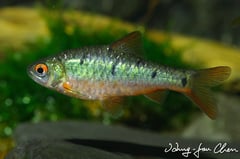
Barbodes semifasciolatusGolden Barb*
Günther, 1868
Barbodes semifasciolatus, the green or Chinese barb, is a cyprinid from Vietnam, Taiwan, southwestern China and northern Laos. The natural green form is an infrequent find in the trade, but the selectively-bred golden variant, first produced in the 1960s, is farmed in huge numbers. Commercial fish are largely inbred, with reduced fins and other deformities not uncommon. The name 'Puntius schuberti' often given to the golden form is not an official scientific name.