Genus
Baryancistrus
- Species
- 5
- Photographed
- 5 of 5
- Difficulty rated
- 5 of 5
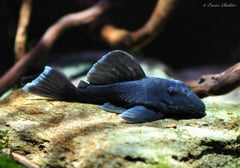
Baryancistrus begginiL239
Lujan, Arce & Armbruster, 2009
Known as L239 before description, Baryancistrus beggini is a small loricariid from the Orinoco and lower río Guaviare in Venezuela and Colombia. Its body and fins are uniformly black to brownish with a turquoise to bluish sheen. Placement in Baryancistrus is tentative. Territorial with conspecifics but somewhat delicate, it is not recommended for the general community aquarium.
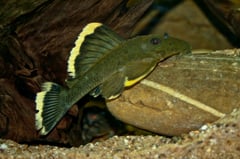
Baryancistrus chrysolomusMango Pleco
Rapp Py-Daniel, Zuanon & Ribeiro de Oliveira, 2011
The mango pleco, Baryancistrus chrysolomus, traded as L047, is a loricariid endemic to the rio Xingu basin in Pará state, Brazil. A broad, usually yellowish band along the edges of the dorsal and caudal fins throughout life separates it from B. xanthellus, whose bands shrink to tips in adults. It grows to around 220 mm SL, and males in particular become highly intolerant of conspecifics as they age.
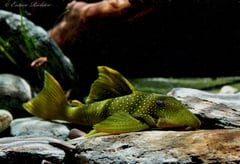
Baryancistrus demantoidesGreen Phantom Pleco
Werneke, Sabaj Pérez, Lujan & Armbruster, 2005
The green phantom pleco, Baryancistrus demantoides, is a suckermouth catfish known only from where the río Ventuari meets the Orinoco in Venezuela. It closely resembles Hemiancistrus subviridis, which lives alongside it, and both have been marketed as L200. B. demantoides is the less common and more expensive of the two, sometimes sold as 'L200 high-fin' or 'L200a' for its longer dorsal-fin spine. Males become increasingly intolerant of conspecifics as they age.
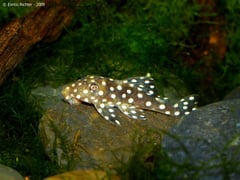
Baryancistrus sp. L142Big White Spot Pleco
authority not recorded
The big white spot pleco, Baryancistrus sp. L142, is an undescribed suckermouth catfish from the rio Tapajós in Pará state, Brazil. It appears restricted to a short stretch of the river between Itaituba and Pimenta, in shallow, fast-flowing, warm water. The species is also traded as 'snowball pleco', a name first applied to Hypancistrus inspector and now used for several similar white- or yellow-spotted fishes. Males become highly intolerant of conspecifics as they age.
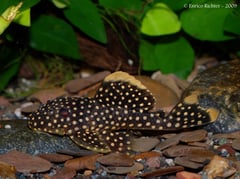
Baryancistrus xanthellusGold Nugget Pleco
Rapp Py-Daniel, Zuanon & Ribeiro de Oliveira, 2011
The gold nugget pleco, Baryancistrus xanthellus, is a suckermouth catfish endemic to the rio Xingu basin in Pará state, Brazil. It lives in whitewater rapids in the Volta Grande do rio Xingu, between Belo Monte falls and the mouth of the rio Iriri. Before its description it was traded as L018, L085, L177 and LDA060, and L081 is the same fish. Males become highly intolerant of conspecifics as they age.