Genus
Boraras
- Species
- 6
- Photographed
- 6 of 6
- Difficulty rated
- 6 of 6
Where the name comes fromEdit
anagram of the generic name Rasbora, in reference to the reversed ratio of abdominal and caudal vertebrae in this genus.
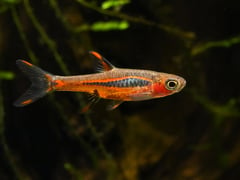
Boraras brigittaeMosquito Rasbora
Vogt, 1978
The mosquito rasbora, Boraras brigittae, is a miniature cyprinid that appears to be endemic to southwestern Borneo. It inhabits blackwater streams and pools associated with forest peat swamps, where the water is very soft and acidic. The congener B. urophthalmoides is often traded under its name, but B. brigittae is larger, lacks a distinct dark blotch at the caudal peduncle and has brighter, more uniformly red patterning. Striped males of B. merah have led to speculation that the two are the same species.
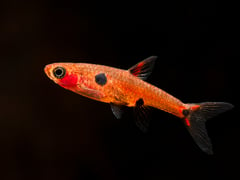
Boraras maculatusDwarf Rasbora
Duncker, 1904
The dwarf rasbora, Boraras maculatus, is a miniature cyprinid from Peninsular Malaysia, southern Thailand, eastern Sumatra, Singapore and Bintan. It inhabits blackwater streams and rivers associated with forest peat swamps, where the water is very soft and acidic. Colour pattern varies between populations, some forms showing more intense red than others. It is most similar to B. naevus, in which the red body colouration does not extend into the head.
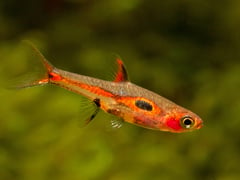
Boraras merah
Kottelat, 1991
Boraras merah is a miniature cyprinid from southern Borneo, described from the Jelai Bila river basin near Sukamara in Central Kalimantan, Indonesia. Sometimes sold as the 'phoenix rasbora', it lacks colour in much of the body, with the red pigmentation concentrated around dark markings that tend to form spots or blotches. Fully-striped males have led to speculation that it is the same species as B. brigittae, though Kottelat (2013) argued for two species.

Boraras micros
Kottelat & Vidthayanon, 1993
Boraras micros is a tiny cyprinid from the Mekong basin in northeastern Thailand, recorded in Nong Khai, Udon Thani and Sakon Nakhon provinces. Growing to only 13 mm SL, it inhabits shallow, clear, densely vegetated swamps, marshes, floodplains and rice paddies. Poorly documented and rarely seen in the trade, it has a rather plain pattern, and fish sold as B. micros var. 'red' or 'strawberry rasbora' are always B. maculatus, B. brigittae or B. naevus.
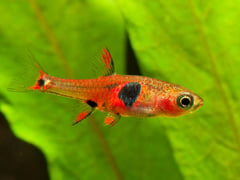
Boraras naevus
Conway & Kottelat, 2011
Boraras naevus is a miniature cyprinid known only from the lower Tapi river drainage in Surat Thani province, southern (peninsular) Thailand. Before its description it was traded as B. sp. 'micros', 'red micros', 'Petch Noi' and 'strawberry rasbora', and it is exported only sporadically. It lives in shallow, clear swamps and marshes. Males have an anterior flank blotch much larger than that of females, a feature unique to this species within the genus.
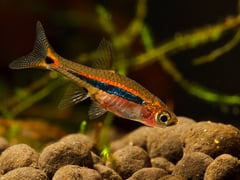
Boraras urophthalmoides
Kottelat, 1991
Boraras urophthalmoides is a miniature cyprinid from southern and central Thailand, Cambodia and Vietnam, including the moats of Angkor Wat. It inhabits shallow, clear, vegetated swamps, marshes, floodplains and rice paddies. Some populations develop an orange-red stripe that leads to confusion with B. brigittae, but B. urophthalmoides is smaller, with a distinct round, dark blotch on the caudal peduncle and a long, unbroken lateral stripe. It is sometimes sold as the 'exclamation-point rasbora'.