Genus
Botia
- Species
- 7
- Photographed
- 7 of 7
- Difficulty rated
- 7 of 7
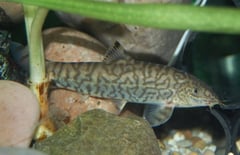
Botia almorhaeYo-Yo Loach
Gray, 1831
The yo-yo loach, Botia almorhae, is a botiid loach from parts of the Ganges River drainage in northern India and possibly Nepal. It is often called the 'Pakistani' loach, but that name is a misnomer. B. almorhae sensu stricto appears to belong to a group of closely-related species and has possibly never been seen in the aquarium trade, where the most commonly available members seem to be B. lohachata, B. sp. 'Kosi' and B. sp. 'Teesta', plus assorted hybrids.
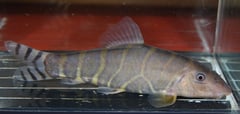
Botia darioBengal Loach
(Hamilton, 1822)
The Bengal loach, Botia dario, is a botiid loach from the middle to lower Ganges and Brahmaputra drainages in northern India, Bangladesh and Bhutan. Its yellow to golden body carries 7-9 dark bars with thinner, lighter bars between, and its particularly curved head makes it among the most easily recognisable in the genus. Botia macrolineata, described from aquarium fish shipped via Bombay, represents the same species. It is among the botiids produced commercially using hormones.
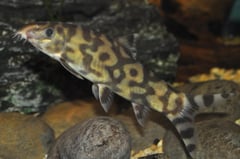
Botia histrionica
Blyth, 1860
Known in the trade as the 'Burmese loach', Botia histrionica is a botiid loach from Myanmar, Manipur in India and Yunnan, China. Young fish all carry five solid dark bars on each flank and are often confused with B. kubotai, but in B. histrionica the bars stay solid for longer and the central bar usually forms a 'y' shape. Adult patterning varies considerably between the Ayeyarwady, Salween, Manipur and Ataran forms, and there has been speculation that some represent distinct species.
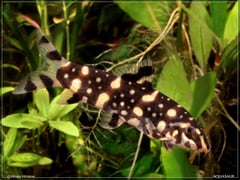
Botia kubotaiPolka-Dot Loach
Kottelat, 2004
The polka-dot loach, Botia kubotai, is a botiid loach that appears to be endemic to headwaters of the Salween basin in Myanmar and Thailand. It was traded before it was described and is still sold as 'angelicus', 'Burmese border loach' and 'marbled loach', among other names. Juveniles are often confused with B. histrionica, but the dark bars in B. kubotai split at a young age.
Botia rostrata
Günther, 1868
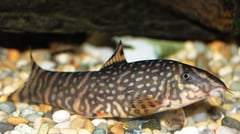
Botia rostrata is a botiid loach from the lower Ganges and middle to lower Brahmaputra basins in northern India and Bangladesh. Traded as the 'Gangetic loach', 'twin-banded loach' or 'ladder loach', almost all fish sold under the name are B. sp. 'upper Brahmaputra', and B. rostrata sensu stricto is rarely, if ever, available. Juveniles carry 9-10 dark body bars, usually in pairs, which break up to differing extents as the fish grow.
Botia striataZebra Loach
Narayan Rao, 1920
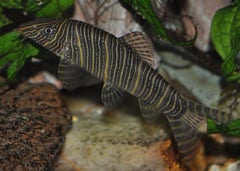
The zebra loach, Botia striata, is a botiid loach from the Krishna River system in southern India, described from the Tunga River in Karnataka. Its yellow to golden body with blue, green, grey or black bars and typically red mouthparts make it one of the most easily recognised in the genus, although the bars break up entirely in some specimens. Given its adult size and peaceable nature it is perhaps the best choice of Botia for the general community.
Botia udomritthirujiEmperor Botia
Ng, 2007
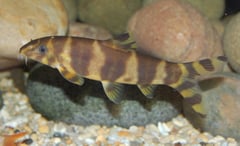
The emperor botia, Botia udomritthiruji, is a botiid loach known only from the Tanintharyi River drainage in southern Myanmar. Known since 1993, it was occasionally traded as B. sp. 'Tenasserim' before it was described. At first glance it is most easily confused with B. histrionica but keeps its wider vertical bars at all ages, while in B. histrionica the bars become irregular or break up completely as the fish mature.