Genus
Brachyplatystoma
- Species
- 7
- Photographed
- 7 of 7
- Difficulty rated
- 7 of 7
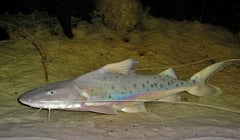
Brachyplatystoma capapretum
Lundberg & Akama, 2005
Brachyplatystoma capapretum is a large, piscivorous pimelodid catfish found throughout much of the Amazon basin, from near Belém to Iquitos in Peru. The largest recorded specimen measured 880 mm, and it is suitable only for public aquaria and a very small minority of private aquarists. It is very similar to B. filamentosum but smaller, with shorter maxillary barbels, a moderately forked caudal-fin with lobes of equal size, and adults very dark above.

Brachyplatystoma filamentosumPiraíba
(Lichtenstein, 1819)
The piraíba, Brachyplatystoma filamentosum, is the largest catfish of the Amazon basin, also found in the Orinoco and river systems of the Guianas. Adults typically measure 2 to 2.5 m and weigh over 150 kg. In the Amazon only fish over around 160 cm are called 'Piraíba', and smaller ones 'filhote'. It is suitable only for public aquaria and a very small minority of private aquarists.
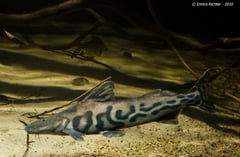
Brachyplatystoma juruenseGold Zebra Catfish
(Boulenger, 1898)
The gold zebra catfish, Brachyplatystoma juruense, is a large pimelodid from the middle Amazon and Orinoco basins, described from the rio Juruá. Adults have broad dark vertical, oblique or branching bands on a pale yellowish body and grow to at least 600 mm. It is sometimes confused with B. tigrinum, especially when young, but has a much less defined pattern, a deeper body and shorter barbels. It suits only public aquaria and a very small minority of private aquarists.

Brachyplatystoma platynemumSlobbering Catfish
Boulenger, 1898
The slobbering catfish, Brachyplatystoma platynemum, is a large migratory pimelodid catfish from the Amazon and Orinoco basins. The name refers to its relatively thick barbels, which give the impression that the fish is drooling. It travels considerable distances along deeper, flowing channels, and sexually mature adults have been observed in the upper rio Madeira basin, some 3000 km from the estuary. It grows to 1000 mm SL.

Brachyplatystoma rousseauxiiDourada
(Castelnau, 1855)
The dourada, Brachyplatystoma rousseauxii, is a large migratory pimelodid catfish from the Amazon and Orinoco drainages and rivers of the Guianas. Juveniles feed in the Amazon delta, while sexually mature adults are found only in the western Amazon. Some populations cover as much as 5500 km during migration from the delta, the longest known in any freshwater fish, and it is heavily fished during its upstream movement. It grows to 1900 mm SL.
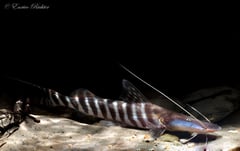
Brachyplatystoma tigrinumZebra Shovelnose
(Britski, 1981)
The zebra shovelnose, Brachyplatystoma tigrinum, is a pimelodid catfish from the upper Amazon basin in Brazil, Colombia and Peru. Adults appear to be obligate inhabitants of main river channels with strong flow, often around cataracts and rapids, and most aquarium fish are juveniles collected around Iquitos in Peru. It is sometimes confused with B. juruense, especially when young, but has a more well-defined colour pattern, a slenderer body and longer barbels.
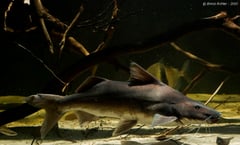
Brachyplatystoma vaillantiiPiramutaba
(Valenciennes, 1840)
The piramutaba, Brachyplatystoma vaillantii, is a large migratory pimelodid catfish from the Amazon and Orinoco watersheds and rivers of the Guianas. Juveniles feed in the Amazon delta before migrating upstream in massive numbers, when they are subject to intensive capture by commercial and artisanal fisheries. Sexually mature adults have been observed in the rio Caquetá basin, some 3500 km from the estuary. It grows to 1050 mm SL.