Genus
Brochis
- Species
- 27
- Photographed
- 25 of 27
- Difficulty rated
- 27 of 27
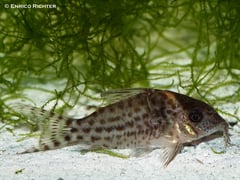
Brochis agassiziiSpotted Cory
(Steindachner, 1876)
The spotted cory, Brochis agassizii, long known as Corydoras agassizii, is an armoured catfish from the Amazon around the border of Brazil and Peru, described from near Tabatinga. Its name is commonly misapplied to similar-looking fishes, and it can be hard to identify even when the collection locality is known. It is most often confused with C. ambiacus, and fish matching that species appear far more common in the trade.
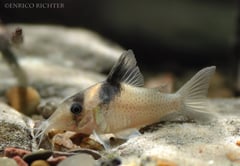
Brochis amandajanea
(Sands, 1995)
Brochis amandajanea, long known as Corydoras amandajanea, is an armoured catfish from the Rio Miuã system of streams off the upper Rio Negro in Brazil. It is rare in the aquarium trade and appears to be variable in colour pattern, some individuals having larger dark spots on the body. Little has been written about it since its description, and the congener C. crypticus was described from the same locality.
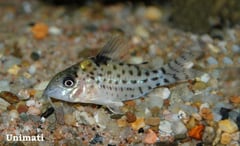
Brochis ambiacus
(Cope, 1872)
Brochis ambiacus, long known as Corydoras ambiacus, is an armoured catfish from the upper Amazon tributaries of Peru, Brazil, Colombia and Ecuador, described from the Río Ampiyacu. Its name is commonly misapplied to similar-looking fishes, particularly C. agassizii, and the colour pattern is variable. Cope described a large black spot covering the front half of the dorsal fin, and fish matching this are far more common in the trade than those matching C. agassizii.
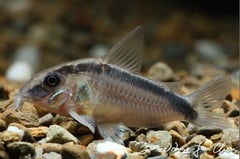
Brochis arcuataSkunk Cory; C020
(Elwin, 1938)
The skunk cory, Brochis arcuata, long known as Corydoras arcuatus, is an armoured catfish from the upper Amazon region in Brazil, Peru, Ecuador and Colombia. It is among the more popular Corydoras in the hobby and is also known as the 'arched cory' or C020. Several similar-looking congeners exist, particularly C. urucu, in which the black body stripe ends behind the eye, and the larger C. narcissus from the rio Purus.
Brochis britskiiGiant Brochis
Nijssen & Isbrücker, 1983
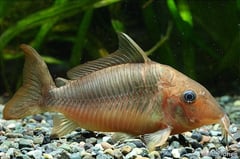
The giant brochis, Brochis britskii, long known as Corydoras britskii, is an armoured catfish restricted to the upper rio Paraguay in Mato Grosso state, Brazil. Formerly classified in Brochis, it grows to around 90 mm SL and can be told from other ex-Brochis species by its 15 to 18 dorsal-fin rays. It forms aggregations in smaller tributaries and still waters such as backwaters, oxbows and marginal lakes.
Brochis condiscipulus
(Nijssen & Isbrücker, 1980)
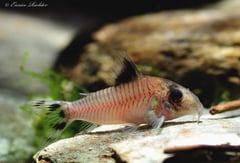
Brochis condiscipulus, long known as Corydoras condiscipulus, is an armoured catfish native to the Oyapock (Oiapoque) river system in French Guiana and Amapá state, Brazil. It often occurs alongside the similar-looking C. oiapoquensis, from which it differs in its larger adult size, narrower body, shorter pectoral spine and longer snout.
Brochis delphax
(Nijssen & Isbrücker, 1983)
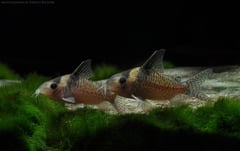
Brochis delphax, long known as Corydoras delphax, is an armoured catfish from the Río Inírida and other parts of the upper Orinoco basin in Colombia. The name is used often in the trade, sometimes for misidentified congeners, while C. delphax itself is often traded as C. punctatus. A relatively elongated snout, body spots that fade in adults and spots in the caudal fin are said to separate it from C. agassizii, C. brevirostris and others.
Brochis ephippiferaSaddle Cory
(Nijssen, 1972)
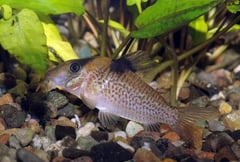
The saddle cory, Brochis ephippifera, long known as Corydoras ephippifer, is an armoured catfish native to Amapá state in northeastern Brazil. It resembles several congeners, including C. agassizii, C. brevirostris, C. delphax and C. melanistius, but seems unique among them in having all fins except the dorsal transparent and unmarked. Detailed observations from the wild are scarce.
Brochis geryi
authority not recorded
Brochis geryi, long known as Corydoras geryi, is an armoured catfish from the Río Mamoré basin in Bolivia. Not commonly seen, it is one of the larger corys in the hobby at around 7 cm.
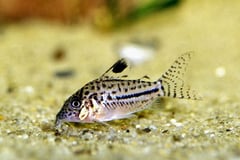
Brochis gomezi
(Castro, 1986)
Brochis gomezi, long known as Corydoras gomezi, is an armoured catfish from the western Amazon basin in Colombia and Peru, including the 'Tres Fronteras' region. Collection records are scarce and its range is unclear. It resembles C. leopardus, C. orphnopterus, C018 and C131, but has separate, distinct spots on the upper body, six bands on the caudal fin and a relatively slender body.
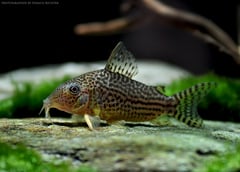
Brochis haraldschultziMosaic Cory
(Knaack, 1962)
The mosaic cory, Brochis haraldschultzi, long known as Corydoras haraldschultzi, is an armoured catfish endemic to the rio Guaporé (Río Iténez) in northeastern Bolivia and western Brazil. It resembles C. sterbai but has a more extended snout and grows larger, to 85 mm SL. Its head carries dark vermiculations and spots on a light background, where C. sterbai has light markings on dark. The type locality was once modified to the rio Tocantins, well over 1000 km away, but the original Guaporé locality appears to be correct.
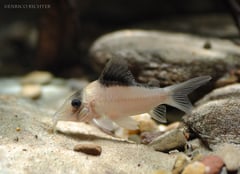
Brochis imitatorImitator Cory
(Nijssen & Isbrücker, 1983)
The imitator cory, Brochis imitator, long known as Corydoras imitator, is an armoured catfish endemic to the upper rio Negro basin in northern Brazil and southern Venezuela. It is one of several rio Negro congeners with an oblique dark bar along the dorsal surface of the body, a group that includes C. adolfoi, C. burgessi and C. duplicareus. It inhabits pristine blackwater tributaries and flooded forest with tea-coloured water, very little hardness and a pH of 4.0-6.0.
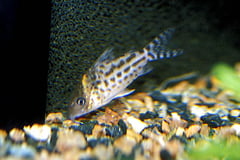
Brochis incolicanaC001
(Burgess, 1993)
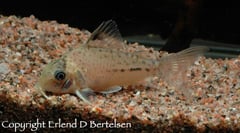
Brochis incolicana (C001), long known as Corydoras incolicana, is an armoured catfish from the rio Içana in the upper rio Negro basin, northern Brazil. It presumably also occurs in eastern Colombia, where the Içana forms the border. The first fish to receive a 'C' number, in 1993, it was described the same year in a hobbyist magazine and is difficult to identify accurately. The colour pattern is said to be extremely variable, but the dark bar through the eye and the dark marking at the dorsal-fin base are apparently consistent.
Brochis lambertiC009
(Nijssen & Isbrücker, 1986)
Brochis lamberti (C009), long known as Corydoras lamberti, is an armoured catfish known only from the lower Río Pastaza, a tributary of the Río Marañón in Loreto, northern Peru. Similar-looking fish are known from tributaries close to Iquitos, and it is unclear whether these, 'C009' and C. lamberti are the same species. It is rare in the hobby and difficult to identify without collection details, so it may have been traded under other names.
Brochis leopardusLeopard Cory
(Myers, 1933)
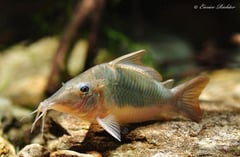
The leopard cory, Brochis leopardus, long known as Corydoras leopardus, is a spotted armoured catfish from the western Amazon basin in Peru, Ecuador, Bolivia and Brazil. It looks very like C. julii and C. trilineatus, but has a longer, more pointed snout and grows larger. Dias et al. (2024) moved it to the genus Brochis and put the two lookalikes in Hoplisoma, so the resemblance does not reflect a close relationship. The type specimens were aquarium imports.
Brochis multiradiataHognose 'Brochis'
(Orcés V., 1960)
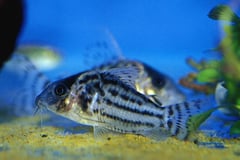
Known in the hobby as the hognose 'Brochis', Brochis multiradiata, long known as Corydoras multiradiatus, is an armoured catfish from the northwestern Amazon basin in Ecuador and Peru. Formerly placed in Brochis, it has an extended snout and 17-18 dorsal-fin rays, against 6-8 in other Corydoras. Little is known of its habitat, but it is likely to live in smaller tributaries and still waters such as backwaters and oxbows, as closely related species do.
Brochis ornata
authority not recorded
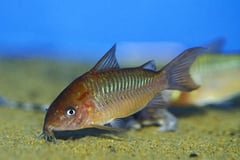
Brochis ornata, long known as Corydoras ornatus, is a larger armoured catfish from the lower Rio Tapajós basin in Brazil, growing to around 70 mm SL. Its habitat is not recorded and no captive breeding information is available. Very peaceful, it should be kept in a group over fine sand, with plenty of cover and well-oxygenated water.
Brochis pantanalensis
authority not recorded
Brochis pantanalensis, long known as Corydoras pantanalensis, is an armoured catfish from the Bolivian part of the Pantanal wetland, also referred to by its C-number, C005. Its habitat is typified by crystal clear waters and an abundance of aquatic vegetation. Like other corys it is sensitive to dirty substrates and can lose its barbels in substandard conditions, and it should be kept in a group of at least six.
Brochis pinheiroi
authority not recorded
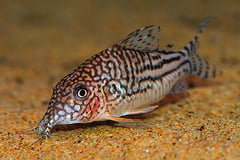
Brochis pinheiroi, long known as Corydoras pinheiroi, is an armoured catfish from Rondônia, Brazil, with a pattern similar to that of C. sterbai. It lacks the orange pectoral spines of that species and is rare in the hobby. Like other corys it is peaceful, should be kept in a group of at least six, and needs well-oxygenated water and a clean substrate.
Brochis reticulataReticulated Cory
authority not recorded
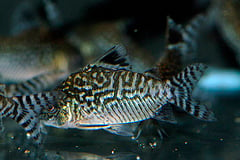
The reticulated cory, Brochis reticulata, long known as Corydoras reticulatus, is an armoured catfish from the lower Amazon basin in Brazil, also known as the network cory. One of the commoner species seen in dealers' tanks, it is a good cory for the beginner. Very peaceful, it should be kept in a group of at least six, and like other corys it is sensitive to dirty substrates.
Brochis robineaeFlagtail Cory
authority not recorded
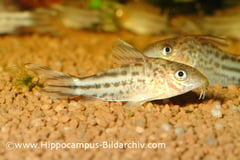
The flagtail cory, Brochis robineae, long known as Corydoras robineae, is an armoured catfish from the upper Rio Negro in Brazil, also known as the bannertail cory. It is found in the main river and its tributaries. Not the easiest Corydoras to induce to spawn, it can still be bred in a similar way to many other species in the genus. Very peaceful, it should be kept in a group of at least six.
Brochis robustaRobust Cory
authority not recorded
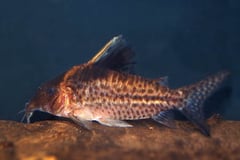
One of the largest species in the genus, Brochis robusta, long known as Corydoras robustus, is an armoured catfish endemic to the Rio Purus drainage in Brazil. It grows to around 95 mm SL, and as they mature males in particular develop an extended first dorsal-fin ray. It is not seen all that often in the trade, and in nature it inhabits small tributaries, creeks, areas of flooded forest and sand banks.
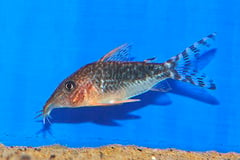
Brochis seussi
authority not recorded
Brochis seussi, long known as Corydoras seussi, is an armoured catfish from the Rio Mamoré basin and Rio Poranga in Brazil, also referred to by its C-number, C027. Very similar in appearance to C. gossei, it can be distinguished by its less rounded snout. Very peaceful, it should be kept in a group of at least six.
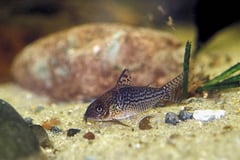
Brochis sodalisFalse Network Cory
authority not recorded
The false network cory, Brochis sodalis, long known as Corydoras sodalis, is an armoured catfish from the upper Amazon in Loreto, Peru, and Amazonas state, Brazil. It inhabits small tributaries, creeks, pools and areas of flooded forest. Very peaceful, it is best kept in a group of at least six, and it can be spawned in a similar way to other Corydoras.
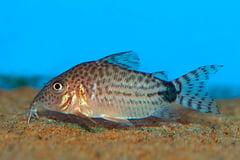
Brochis spectabilisMillenium Cory
authority not recorded
The millennium cory, Brochis spectabilis, long known as Corydoras spectabilis, is an armoured catfish from the Guaporé River basin in Brazil. The name comes from its being the first catfish species described in 2000, although the description appeared in late 1999 in a journal dated January 2000. C. guapore, C. ourastigma, C. similis and C. caudimaculatus can be confused with it, but C. spectabilis has spotted patterning on the body and a caudal spot with a well-defined edge.
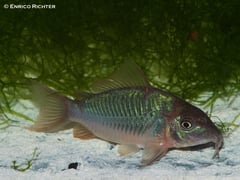
Brochis splendensEmerald 'Brochis'
(Castelnau, 1855)
The emerald 'brochis', Brochis splendens, long known as Corydoras splendens, is an armoured catfish recorded throughout much of the Amazon basin in Brazil, Peru, Ecuador and Colombia. Formerly placed in Brochis, it is sometimes called the 'common brochis', and juveniles are sometimes traded as 'hi-fin cory' for their enlarged dorsal fin. Its 10 to 12 dorsal-fin rays separate it from the other ex-Brochis species, and certain populations are thought likely to represent distinct species.
Brochis virginiaeMiguelito Cory
(Burgess, 1993)
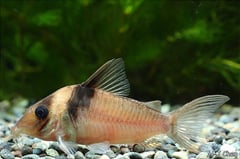
The Miguelito cory, Brochis virginiae, long known as Corydoras virginiae, is an armoured catfish considered endemic to the río Ucayali drainage in Peru. It is sometimes referred to as 'Virginia's catfish', Corydoras sp. 'Sangama' or 'Zangama', and prior to description it was misidentified as both Corydoras bicolor and C. delphax. Peaceful and gregarious, it should be kept in a group of at least four to six.