Genus
Carnegiella
- Species
- 3
- Photographed
- 3 of 3
- Difficulty rated
- 3 of 3
Where the name comes fromEdit
erected in 1909 by C.H. Eigenmann for the type species C. strigata (which was at that time named Gasteropelecus strigatus); the name honours Miss Margaret Carnegie and was chosen to represent the gracefulness of these fish.
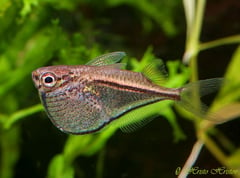
Carnegiella marthaeBlackwing Hatchetfish
Myers, 1927
The blackwing hatchetfish, Carnegiella marthae, is a small freshwater hatchetfish from the upper Orinoco in Venezuela and the rio Negro in Brazil. It appears to be a stenotypic inhabitant of blackwater, found in igapó and igarapé habitats with overhanging vegetation and leaf litter. Very peaceful but small and timid, it is best kept in a group of 10 or more with similarly sized, peaceful fishes.
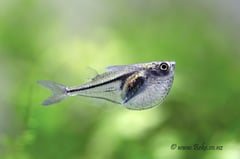
Carnegiella myersiPygmy Hatchetfish
Fernandez-Yepes, 1950
The pygmy hatchetfish, Carnegiella myersi, is a tiny freshwater hatchetfish from the Peruvian Amazon basin, with a second population in Bolivia. The smallest and most delicate of the nominal hatchetfishes, it has a shallower, rounded keel that gives it an elongate profile. It lives in small, shaded, shallow forest streams and must be kept in a group of at least six, away from active tankmates.
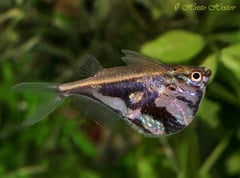
Carnegiella strigataMarbled Hatchetfish
Günther, 1864
The marbled hatchetfish, Carnegiella strigata, is a hatchetfish from the Amazon and Orinoco basins and coastal rivers of Guyana and Suriname. Popular in the hobby, it is collected for the trade mostly in the rio Negro basin in Brazil. Its larger size and dark, marbled pattern set it apart from congeners, though the pattern varies and the wide range may be open to question. It appears to live only in blackwater.