Genus
Colomesus
- Species
- 3
- Photographed
- 3 of 3
- Difficulty rated
- 3 of 3
Where the name comes fromEdit
from the Ancient Greek χωλóς (cholós), meaning 'physically defective, crippled', and μέσος (mésos), meaning 'middle', presumably in reference to the frontal bones being narrowed, not connected to the orbit, and with the elongated postfrontals connected to the prefrontals (see Gill 1884, also note misspelling of χωλóς as Κολoς).

Colomesus asellusAmazon Puffer
Müller & Troschel, 1849
The Amazon puffer, Colomesus asellus, is a freshwater puffer found throughout much of the Amazon basin, with records north to Guyana and Venezuela. Also traded as the South American puffer or 'SAP', it is told from congeners by a transverse row of dermal flaps across the chin. It lives mostly in well-oxygenated river habitats, is intolerant of organic waste, and forms loose aggregations, so a group of 6 or more is best, away from the general community.
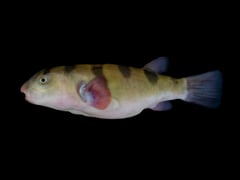
Colomesus psittacusBanded Puffer
Bloch & Schneider, 1801
The banded puffer, Colomesus psittacus, is a large puffer of coastal waters from Colombia and Venezuela through the Guianas to northeastern Brazil. It also occurs in Trinidad and Tobago and the Caribbean islands, and inhabits mangrove swamps, estuaries and the lower reaches of rivers. Growing to 290 mm SL, it is the largest of its genus and has six dark bands across the back. Likely to prove aggressive in all but the largest systems, it is not a popular aquarium fish.
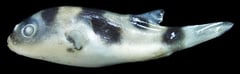
Colomesus tocantinensis
Amaral, Brito, Silva & Carvalho, 2013
Colomesus tocantinensis is a small freshwater pufferfish from Brazil, known only from the Tocantins River near Porto Nacional in Tocantins state. The type series measured up to 34.9 mm, though it should grow larger. It is distinguished from C. asellus and C. psittacus by fewer anal and dorsal-fin rays, a ventrally notched opercle, no dermal flaps on the chin, and a pale yellow back with five dark bands.