Genus
Copella
- Species
- 6
- Photographed
- 6 of 6
- Difficulty rated
- 6 of 6
Where the name comes fromEdit
a diminutive of the generic name Copeina which was named for naturalist Edward Drinker Cope (1840-1897).
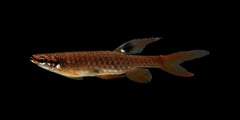
Copella arnoldiSplash Tetra
Regan, 1912
The splash tetra, Copella arnoldi, is a lebiasinid from the lower Amazon basin in Brazil and coastal drainages of Guyana, Suriname and French Guiana. It spawns out of the water: a pair leap together onto overhanging vegetation and cling there while the eggs are laid. Zarske (2011) treats the Guianas populations as C. carsevennensis, restricting C. arnoldi sensu stricto to the lower Amazon, though Mol (2012) considers the two synonymous.
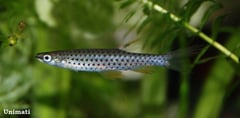
Copella callolepis
Regan, 1912
Copella callolepis is a small lebiasinid from the central Amazon region of Brazil, where all recent records come from. It is quite common in the aquarium trade but normally misidentified as C. nattereri or the very similar C. meinkeni. It lacks the dark lateral stripe of C. nattereri, and differs from C. meinkeni in a black triangular marking in the lower caudal-fin lobe and blue-black to dark brownish-red spots.
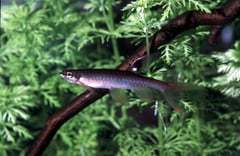
Copella carsevennensis
Regan, 1912
Copella carsevennensis is a small lebiasinid from coastal river systems in Guyana, Suriname, French Guiana and Amapá state, Brazil. It appears in the trade from time to time among wild-caught fishes from the Guianas. Zarske (2011) separated it from C. arnoldi, partly because it lays its eggs among submerged vegetation and not out of the water, though Mol (2012) considers the two synonymous.
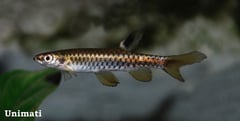
Copella eigenmanni
Regan, 1912
Copella eigenmanni is a small lebiasinid from the Orinoco system in the llanos of Colombia and Venezuela, including the Meta, Caroní and Apure. It turns up in the trade from time to time among wild-caught fishes from the Orinoco basin. Colombian populations were formerly called C. metae until Zarske (2011) synonymised the two. A broad dark stripe runs from the snout to the eye, and the eggs are laid among vegetation and guarded by the male.
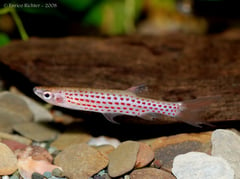
Copella meinkeniSpotted Splashing Tetra
Zarske & Géry, 2006
The spotted splashing tetra, Copella meinkeni, is a small lebiasinid from the central Amazon region, with most records from the rio Negro and Orinoco. It has been widely referred to as C. nattereri in aquarium literature, but lacks that species' dark lateral stripe and has 5-6 rows of bright red spots on the body. The similar C. callolepis is also traded. It inhabits forest streams with tea-coloured water and lays its eggs among vegetation.
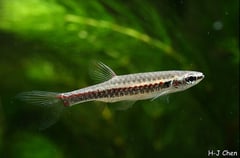
Copella nattereri
Steindachner, 1876
Copella nattereri is a small lebiasinid widespread in the middle and upper Amazon drainage in Peru and Brazil. It is sometimes traded as C. sp. 'red line', 'spotted tetra' or C. nigrofasciata, and its name was long applied to C. callolepis and C. meinkeni. Of the three it alone has a dark lateral stripe, and it has no more than three rows of red spots on the flanks. It inhabits forest streams and flooded forest.