Genus
Datnioides
- Species
- 5
- Photographed
- 5 of 5
- Difficulty rated
- 5 of 5
Where the name comes fromEdit
from the genus name Datnia and Ancient Greek εἶδος (eîdos), meaning 'form, likeness'.
Datnioides campbelliNew Guinea Tiger Perch
Whitley, 1939
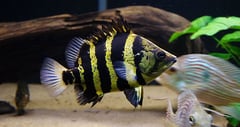
The New Guinea tiger perch, Datnioides campbelli, is a large tiger perch from southern New Guinea, recorded mostly from the lower Fly River basin. A golden yellow base colour with 4 to 6 wide, diffuse dark bars separates it from its congeners. The species is euryhaline, found in brackish tidal creeks as well as in tributaries and swamps at least 900 km from the sea, and it grows to 350 mm SL.
Datnioides microlepisIndonesian Tiger Perch
Bleeker, 1854
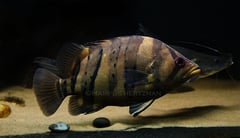
The Indonesian tiger perch, Datnioides microlepis, is a large tiger perch from Peninsular Malaysia, Sumatra and Indonesian Borneo. It has 6 to 7 wide dark bars and small body scales, lives only in large, deep lowland rivers, and grows to 500 mm SL. Juveniles may form groups, but adults are not gregarious and respond aggressively to conspecifics and similarly-shaped fishes.

Datnioides polotaSilver Tiger Perch
(Hamilton, 1822)
The silver tiger perch, Datnioides polota, is a tiger perch widely distributed in southeastern Asia, from India and Bangladesh east to Indonesia. Mostly found in brackish habitats such as estuaries, mangroves and coastal lagoons, it has a highly variable colour pattern with up to 7 dark bars. The name D. quadrifasciatus is sometimes applied to it, but that name is a junior homonym and polota takes precedence.

Datnioides pulcherSiamese Tiger Perch
(Kottelat, 1998)
The Siamese tiger perch, Datnioides pulcher, is a large tiger perch from the Mae Klong, Chao Phraya, Mekong and Dong Nai river systems. Wild populations are hypothesised to have declined by more than 90% since the mid-1980s, and it has been locally extinct in Thailand since the 1990s. Highly sought after by aquarists, it usually has 4 broad dark bars, and D. microlepis is sometimes sold as D. pulcher to raise prices.

Datnioides undecimradiatusMekong Tiger Perch
(Roberts & Kottelat, 1994)
The Mekong tiger perch, Datnioides undecimradiatus, is known only from the middle and lower Mekong basin in Thailand, Laos, Cambodia and Vietnam. An efficient, largely piscivorous predator of large, deep lowland rivers, it is marked with 4 relatively thin dark bars. The names 'Siamese tiger fish' and 'gold datnoid' are sometimes applied to it, but more typically belong to D. pulcher.