Genus
Devario
- Species
- 19
- Photographed
- 19 of 19
- Difficulty rated
- 19 of 19
Where the name comes fromEdit
appears to be derived from a local vernacular name for the type species of the genus Cyprinus (now Devario) devario Hamilton, 1822.

Devario acrostomus
(Fang & Kottelat, 1999)
Devario acrostomus is a devario from the Nam Leuk drainage in Vientiane Province, Laos, and has also been recorded in northeastern Thailand. It first appeared in the hobby in early 2011. It looks like D. aequipinnatus and allies at first glance, but has a sharp, upwardly-pointing mouth, a snout longer than the eye diameter, long rostral barbels and strongly pigmented body patterning. Above Tad Leuk falls its habitats have clear water under forest cover.

Devario acuticephala
(Hora, 1921)
Devario acuticephalus is a small devario from Manipur state in northeastern India, also known from neighbouring Nagaland. It is rare in the hobby but traded on occasion. D. apogon from Yunnan, China, is very similar but has dark vertical bars on the front of the flanks. During a 2010 IUCN assessment it was recorded from only a handful of localities, and it is likely restricted to small hill streams.

Devario aequipinnatus
(McClelland, 1839)
Devario aequipinnatus is a striped devario from hill streams in northeastern India, Bangladesh and Nepal. It is recognised by three straight dark stripes along each side, of which the middle one is widest. The name was long applied to almost any striped Devario, including the commercially bred giant danio, which is covered here under D. malabaricus.

Devario affinis
(Blyth, 1860)
Devario affinis is a poorly-known devario described from 'Tenasserim', the part of Myanmar south and east of the Irrawaddy delta. It was considered a synonym of D. aequipinnatus for a period and was revalidated by Fang in 2001. Little diagnostic detail exists beyond Blyth's description of 1860. It is likely restricted to hill streams and upper parts of small rivers with clear, well-oxygenated water.
Devario apogon
(Chu, 1981)
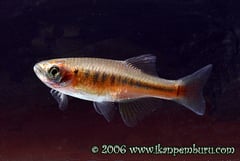
Devario apogon is a small devario from southwestern Yunnan, China, where all known localities lie in the Daying river watershed. Narrow, indistinct vertical bars on the front of the flank, a wide, tapering P stripe behind them, and no barbels or lateral line separate it from similar congeners. It is apparently abundant in rivers, streams and even ditches, in clear or turbid water.

Devario assamensis
(Barman, 1984)
Devario assamensis is a deep-bodied devario from Assam and West Bengal in northeastern India, in tributaries of the lower Brahmaputra. It has been traded as Devario sp. 'Mirik red', D. sp. 'redline' and D. sp. 'blood stripe', but is very rare in the hobby. If the distribution records are correct, it occurs from around 250 m AMSL in Darrang to 1767 m at Mirik, and possibly higher in Bhutan.

Devario chrysotaeniatus
(Chu, 1981)
Devario chrysotaeniatus is a devario from the upper Mekong watershed in Yunnan, southwestern China, northern Laos and northern Thailand. It first appeared in the hobby in 2005 and is rarely seen, probably because its natural waters lie outside the range of most commercial collectors. Its flank pattern is indistinct: a few short, thin horizontal stripes, a dark stripe along the back and a spot behind the gill opening.

Devario devarioBengal Danio
(Hamilton, 1822)
The Bengal danio, Devario devario, is a devario from the Ganges and Brahmaputra river systems in northern India, Nepal and Bangladesh. Also known as the 'Sind danio', it is told apart from congeners by a single, interrupted lateral stripe on each flank. It is relatively common in the trade and produced commercially, with an albino form and a short-bodied variant sometimes sold as D. sp. 'mini Putao'.

Devario interruptus
(Day, 1870)
Devario interruptus is a devario from the Hotha valley and nearby areas of southwestern Yunnan, China, close to the border with Myanmar. Short, wide vertical bars on the flanks and a P stripe made of contiguous dark blotches separate it from the similar D. maetaengensis and D. shanensis. It has mostly been collected from small, clear, moderate to swiftly-flowing streams over sand, gravel and rocks with no aquatic vegetation.

Devario laoensis
(Pellegrin & Fang, 1940)
Devario laoensis is a devario from the upper Mekong watershed in northwestern Laos and northern Thailand. Its dark P stripe starts faint around mid-body and becomes thicker and darker towards the caudal-fin base. Among congeners it is most similar to D. chrysotaeniatus, in which the P stripe extends to the end of the caudal-fin rays. Its habitats lie at relatively high altitude and are likely to be hill streams and small rivers.

Devario malabaricusGiant 'Danio'
(Jerdon, 1849)
The giant 'danio', Devario malabaricus, is a deep-bodied devario from peninsular India, living in hill streams and upper parts of small rivers. Most older aquarium literature labels it D. aequipinnatus, but genetic and morphological data have shown the traded fish to be D. malabaricus. It has a blue-and-yellow colour pattern and a P stripe extending to the fork of the caudal-fin. Its true range is uncertain and may be confined to western-flowing drainages of India.

Devario neilgherriensisPeninsular 'Danio'
(Day, 1867)
The peninsular 'danio', Devario neilgherriensis, appears endemic to tributaries of the Bhavani river system in the Nilgiri Hills, southern India. It is almost unheard of in the trade and little is known about it. Day described it with silvery flanks and a broad, indistinct steel-blue stripe bounded above and below by a narrow bright yellow band. Several of its hill-stream habitats lie around 2000 m AMSL.

Devario pathiranaBarred 'Danio'
(Kottelat & Pethiyagoda, 1990)
The barred 'danio', Devario pathirana, is a devario known only from a few small streams in the Nilwala River watershed of southwestern Sri Lanka. It has 7 to 11 dark blue, irregular vertical bars on the front of each flank and a short horizontal stripe on the caudal peduncle. Although endangered in nature, it is bred commercially in limited numbers and is sometimes sold as the 'tiger' or 'Ceylon' danio.
Devario reginaQueen 'Danio'
(Fowler, 1934)
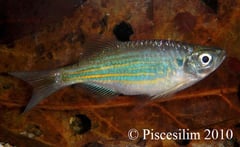
The queen 'danio', Devario regina, is a deep-bodied devario probably restricted to western and southern Thailand and northern Peninsular Malaysia. It belongs to a group of similar-looking congeners with a blue-and-yellow colour pattern. Most commonly it inhabits submontane hill streams and upper parts of small rivers with clear, well-oxygenated water.

Devario shanensis
(Hora, 1928)
Sometimes called the 'Hora danio' or 'Salween danio', Inlecypris shanensis is a small cyprinid from Shan state, Myanmar. Known from the Duthawadi and Salween river systems, it is most easily confused with 'I.' maetaengensis and Devario interruptus, and differs in having a P stripe that is not broken into a series of blotches. It has been collected from fast-flowing streams with clear water and substrates of rocks, pebbles and sand.

Devario sondhiiFireline Devario
(Hora & Mukerji, 1934)
The fireline devario, Devario sondhii, is a small devario from southern Shan State, Myanmar, described from a spring near Hopong. It first appeared in the trade in the mid-2000s and was initially confused with the sympatric Microrasbora cf. rubescens and with D. acuticephalus, but a dark cleithral spot behind the gill opening separates it from both. The habitat near Hopong is shallow, permanently-flooded grassland at around 1,040 metres AMSL with dense aquatic plants.

Devario sp. 'giraffe'
authority not recorded
Devario sp. 'giraffe' is an unidentified devario from Myanmar, first collected in 2007, about which very little is known. Its name refers to a giraffe-like colour pattern, with the stripes broken up towards the front of the body into spots, rings and vertical bars. It has a deep, bulky body.
Devario sp. 'purple cypris'
authority not recorded
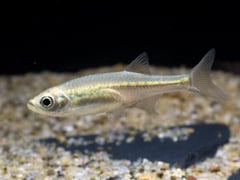
Devario sp. 'purple cypris' is a small, unidentified devario that has appeared in the aquarium trade only on a handful of occasions. It has been widely misidentified as Inlecypris jayarami, but has 9 or 10 lateral bars that increase in size towards the tail, 12 anal-fin rays and a blunter head.

Devario xyropsBlue Moon 'Danio'
Fang & Kullander, 2009
The blue moon 'danio', Devario xyrops, is a devario known only from small streams draining the western slope of the Rakhine Yoma in western Myanmar. Before its description it was sometimes called D. sp. 'broken line'. A dark blotch of 4 or 5 short vertical bars on the front of the flank and a wide dark P stripe behind it are shared only with D. anomalus, which has a shallower body and more lateral line scales.