Genus
Enteromius
- Species
- 7
- Photographed
- 7 of 7
- Difficulty rated
- 7 of 7
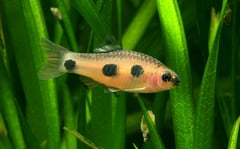
Enteromius candens
(Nichols & Griscom, 1917)
Enteromius candens is a small African barb from the Congo basin in northern and central DR Congo, mainly between Lisala and Kisangani. It lives in slow-moving, shady rainforest streams and swamps with soft, acidic, brown-stained water. Rare in the trade and sporadically collected, it can be told from the better-known E. hulstaerti, which has a bluer body, larger dark markings and yellow fins in males. Its shy nature suits it to a tank of similarly small, peaceful species.
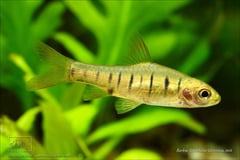
Enteromius fasciolatusAfrican Banded Barb
(Günther, 1868)
The African banded barb, Enteromius fasciolatus, is a small cyprinid widely distributed in Central Southern Africa, from Angola to Zimbabwe. For many years it was imported as Barbus/Barbodes barilioides, now a junior synonym, and it is also called the blue banded or Angola barb. It has 10 to 15 blue-black vertical bars and lives in slow-flowing, heavily vegetated lake shallows, floodplain lagoons and rainforest streams.
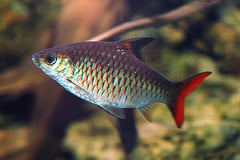
Enteromius guiraliAfrican Blackfin Barb
(Thominot, 1886)
The African blackfin barb, Enteromius guirali, is a cyprinid recorded only from Cameroon and Gabon, including the Sanaga and Ogooué basins. Primarily a river fish, it also enters affluent streams and tributaries. It is rare in the hobby and little is known of its captive care, though one lone fish kept by a forum member behaved well, and a batch of what appeared to be a different species has been imported under the same name.
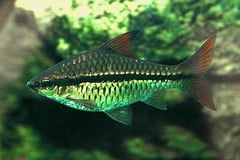
Enteromius holotaeniaSpotscale Barb
(Boulenger, 1904)
The spotscale barb, 'Barbus' holotaenia, is a cyprinid from Central West Africa, found principally in the Ogooué and Congo river systems. It has been recorded right across DR Congo and appears to be primarily riverine. Rare in the hobby, it has been suggested as the closest surface-dwelling relative of the Congo blind barb, Caecobarbus geertsii, a claim the profile considers questionable.
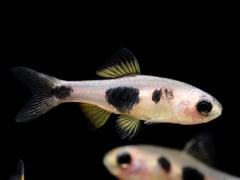
Enteromius hulstaertiAfrican Butterfly Barb
(Poll, 1945)
The African butterfly barb, Enteromius hulstaerti, is a cyprinid endemic to DR Congo, in rainforest south and east of the main Congo River channel. It reappeared in the trade in 2006 after an absence of 25 years. It lives in slow-moving, shady rainforest streams and swamps with very soft, acidic, brown-stained water, and its shy, retiring nature makes it unsuitable for most community tanks.
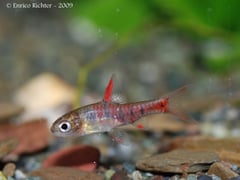
Enteromius jae
(Boulenger, 1903)
Enteromius jae is a small, delicate African barb from Cameroon, Equatorial Guinea, Gabon and the two Congos, sometimes sold as 'jae' or 'charcoal' barb. Populations vary in colour and pattern with locality, and the forms should never be mixed in the aquarium, to avoid crossbreeding. It lives in shady rainforest streams and swamps with soft, acidic, brown-stained water, and its shy nature makes it unsuitable for most community aquaria.
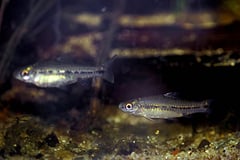
Enteromius sublineatus
(Daget, 1954)
Enteromius sublineatus is a widespread West African barb found in river basins from Senegal east to Cameroon, including the Niger and Volta. It is very variable in patterning and can be difficult to identify: Upper Niger fish show three elongate midlateral markings, Middle Niger fish a continuous band and Volta fish four spots. It may prove to be a complex of closely-related species. Little is known of its captive care.