Genus
Epalzeorhynchos
- Species
- 4
- Photographed
- 4 of 4
- Difficulty rated
- 4 of 4
Where the name comes fromEdit
From Epalzeo-, which has an unconfirmed derivation and meaning but is often reported incorrectly to denote 'curative' (it may actually mean 'horn' in reference to a cone-shaped protuberance on the snout of Epalzeorhynchos spp.), and the Ancient Greek ρυνχος (rhynchos), meaning 'snout, beak'.
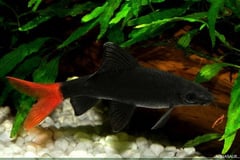
Epalzeorhynchos bicolorRed-Tailed Black Shark
Smith, 1931
The red-tailed black shark, Epalzeorhynchos bicolor, is a cyprinid native to central and western Thailand, in the Mae Klong and Chao Phraya basins. Declared extinct in 1996, it was found again in 2011 and 2014 and is considered critically endangered, while all fish in the trade are commercially produced. It becomes increasingly territorial as it grows, especially towards similar-looking species, and can live for over 15 years.

Epalzeorhynchos frenatumRainbow Shark
Fowler, 1934
The rainbow shark, Epalzeorhynchos frenatum, is a cyprinid reportedly native to Thailand, Laos and Cambodia. Recorded from the Mae Klong, Chao Phraya and Mekong basins, many of its wild populations have dwindled or vanished, and large numbers are farmed for the trade, including an albino and an anerythristic form sometimes misidentified as E. munense. It becomes increasingly territorial as it grows and can live for over 15 years.
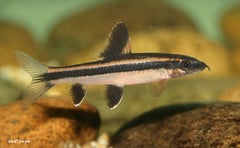
Epalzeorhynchos kalopterumFlying Fox
Bleeker, 1850
The flying fox, Epalzeorhynchos kalopterum, is a cyprinid from southern Thailand, Peninsular Malaysia and the Greater Sunda Islands. Fishes sold as 'false flying fox' or 'Siamese flying fox', such as Garra cambodgiensis and Gyrinocheilus aymonieri, are often confused with it, but it has white-edged red and black fins and two pairs of barbels. It grows increasingly territorial with age and can live for over 15 years.

Epalzeorhynchos munense
Smith, 1934
Epalzeorhynchos munense is a cyprinid from the Mun river and other tributaries of the middle Mekong in Thailand and Laos. It resembles E. bicolor and E. frenatum but has a black head, body and anal fin, red caudal and dorsal fins, and black margins on the pelvic and pectoral fins. A record from the Tonlé Sap system may refer to E. frenatum.