Genus
Esmaeilius
- Species
- 3
- Photographed
- 3 of 3
- Difficulty rated
- 3 of 3
Where the name comes fromEdit
named for Iranian ichthyologist Hamid Reza Esmaeili "for his extensive contribution to the understanding of diversity within this genus", in combination with the Latin suffix -ius, indicating 'belonging to'.
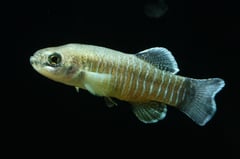
Esmaeilius arakensisArak Toothcarp
Teimori, Esmaeili, Gholami, Zarei, & Reichenbacher, 2012
The Arak toothcarp, Esmaeilius arakensis, appears to be endemic to a handful of natural springs near Arak in the Namak Lake basin, northern Iran. It was in the hobby for several years before its description, as Aphanius sp. 'Namak' or 'Namak River'. Externally it looks very similar to its closest relatives A. farsicus and A. sophiae. Aggressive spawning behaviour and its water requirements make it a poor choice for the community aquarium.
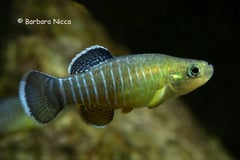
Esmaeilius persicusFarsi Toothcarp
Jenkins, 1910
The Farsi toothcarp, Esmaeilius persicus, is endemic to the Lake Maharlu basin near Shiraz in Fars Province, southern Iran. The hypersaline lake supports no fish, so it lives in the surrounding springs, pools, lagoons and marshes of fresh to brackish water. Males look very like those of its close relative E. sophiae, but females have stripes on the flanks where E. sophiae has spots. Most fish in the hobby come from Barm-e-shur spring.
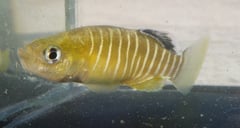
Esmaeilius vladykoviZagros Toothcarp
Coad, 1988
The Zagros toothcarp, Esmaeilius vladykovi, is restricted to a small area of the Zagros mountains in Chahārmahāl o Bakhtiyārī province, Iran. It lives over 2000 m above sea level in slow freshwater streams, pools and marshes of the upper Karun River basin. The dark dorsal fin of males separates it from its closest relative A. sophiae. Males are relatively peaceful towards one another, and it swims in large schools in nature.