Genus
Garra
- Species
- 27
- Photographed
- 27 of 27
- Difficulty rated
- 26 of 27
Where the name comes fromEdit
vernacular Gangetic name for a particular species of “sand-digger,” which Francis Buchanan-Hamilton applied as a generic name for bottom-dwelling cyprinids “with no affinity to another genus”.

Garra arupi
Nebeshwar, Vishwanath & Das, 2009
Garra arupi is a cyprinid from the upper Brahmaputra River basin in Arunachal Pradesh, northern India. It is sympatric with the congeners G. kempi and G. lissorynchus, and is told apart from them by scale and fin-ray counts, a transverse band of tubercles on the snout tip, and other characters. It grows to around 75 mm SL.

Garra bicornutaRhino Garra
Narayan Rao, 1920
The rhino garra, Garra bicornuta, is a cyprinid from the Tunga River in the upper Krishna drainage, Karnataka, southern India. No other Garra is known to have a pair of rostral processes, which males develop and hold erect when sparring. A blue opercular spot ringed with gold blotches also identifies it. It is traded as 'Tunga garra' or 'lionhead garra', and can be territorial, especially at feeding time.

Garra bispinosa
Zhang, 2005
Garra bispinosa is a cyprinid known only from its type locality, the Daying Jiang in the Irrawaddy basin, Yunnan Province, China. It is distinguished from other Garra in Southeast Asia and China by a quadrate proboscis on the snout, each lobe tipped with a single large tubercle. Nothing specific is recorded of its habitat.
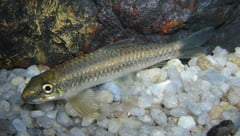
Garra borneensis
Vaillant, 1902
Garra borneensis is a cyprinid endemic to northern and western Borneo, in Kalimantan, Brunei, Sabah and Sarawak. No other member of the genus is known from the island. An obligate dweller of swiftly-flowing streams and headwaters, it lives in clear, oxygen-saturated water over gravel, rocks and bedrock carpeted with biofilm.

Garra cambodgiensisFalse SAE
Tirant, 1883
The false SAE, Garra cambodgiensis, is a cyprinid from the Mekong, Chao Phraya and Mae Klong basins and northern Peninsular Malaysia. It is still traded as Garra taeniata and is often confused with the Crossocheilus species sold as 'Siamese algae eater'. In this species the dark lateral stripe ends at the caudal peduncle, and a sucker formed by the lower lip is present. It inhabits swiftly-flowing headwaters and tributaries.

Garra dampaensis
Laironunga, Lainuntluanga & Lairamliana, 2013
Garra dampaensis is a cyprinid known only from the Seling River in the Dampa tiger reserve, Mizoram, northeastern India. The Seling belongs to the Karnaphuli drainage. It has been collected from clear, shallow, moderately fast-flowing streams with rocky substrates, and is recognised among Indian Garra partly by a W-shaped black band across the middle of the caudal fin.

Garra fasciacauda
Fowler, 1937
Garra fasciacauda is a cyprinid native to the Mekong river system in Thailand, Laos, Vietnam and Cambodia, including the Tonlé Sap basin. It has a black submarginal stripe on both caudal lobes and a plain dorsal fin. It inhabits swiftly-flowing water and migrates seasonally, with many fish moving from the Tonlé Sap system to the Khone Falls in the dry season.

Garra flavatraPanda Garra
Kullander & Fang, 2004
The panda garra (Garra flavatra) is a stream-dwelling cyprinid endemic to the Rakhine Yoma, or Arakan, mountain range in western Myanmar. It reached the hobby in 2005 and is traded as the 'panda', 'clown', 'banded butterfly' or 'rainbow' garra, sometimes incorrectly as a loach. Colour pattern varies considerably between individuals. It has been bred commercially in Myanmar since 2008.

Garra fuliginosa
Fowler, 1934
Garra fuliginosa is a cyprinid from the Mekong basin in Thailand, Laos, Vietnam and Cambodia, and the Chao Phraya and Mae Klong in Thailand. It tends to inhabit swiftly-flowing headwaters and tributaries with clear, oxygen-saturated water. Like other Garra it has a lower lip modified to form a mental adhesive disc for clinging to surfaces. The body is dark with random lighter scales.

Garra hughiCardamom Garra
Silas, 1955
The Cardamom garra (Garra hughi) is a cyprinid from the Anamalai, Cardamom, Palani and Ashambu Hills of the Western Ghats, southern India. It appears occasionally in the ornamental trade, where it may be labelled 'chocolate algae eater'. The flanks are grey and the belly yellowish-white, with a conspicuous dark lateral band running to the caudal-fin base. It inhabits swiftly-flowing headwaters and tributaries.

Garra imberba
Garman, 1912
Garra imberba is a cyprinid without barbels from the upper Yangtze, Mekong and Red River basins in southern China, and the upper Red in Vietnam. Records from the Salween system result from confusion with the similarly-named G. imberbis. With G. micropulvinus it is placed in the Semilabeoina, for which the name Ageneiogarra has been suggested. It tends to inhabit swiftly-flowing headwaters and tributaries.

Garra kalpangi
Nebeshwar, Bagra & Das, 2012
Garra kalpangi is a small cyprinid known only from the Kalpangi River, a Brahmaputra tributary in the Himalayan foothills of Arunachal Pradesh, India. It grows to around 75 mm SL and has two pairs of barbels and a weakly developed proboscis on the snout, a feature it shares with G. gravelyi, G. rotundinasus and G. elongata. Like other Garra it has a lower lip modified to form an adhesive disc.

Garra mirofrontis
Chu & Cui, 1987
Garra mirofrontis is a cyprinid native to the upper Mekong (Lancangjiang) basin in Yunnan province, China. It is characterised by a transverse groove on the snout directly in front of the eyes, and a bifurcate proboscis with a conical keratinised tubercle at each tip. A typical habitat is a strongly-flowing river about 25 m across with a predominantly rocky substrate.

Garra mullya
Sykes, 1839
Garra mullya is a cyprinid endemic to and widespread within peninsular India, in rivers including the Tapti, Narmada, Godavari, Krishna and Cauvery. It has been recorded from flowing headwater streams to low altitude main river channels, including polluted stretches, and at least some populations migrate upstream to breed. Wild fish feed on algae, diatoms and organic detritus.

Garra nambulica
Vishwanath & Joyshree, 2005
Garra nambulica is a small cyprinid known only from tributary streams of the Nambul River, in the Chindwin basin of Manipur state, northeastern India. It has a squarish head, no proboscis or transverse groove on the snout, and a W-shaped blue-black band on the caudal fin. It grows to around 65 mm SL.

Garra notata
Blyth, 1860
Garra notata is a cyprinid known with certainty from the Salween basin in Myanmar, China and Thailand, and the Tenasserim drainage. Records from the Western Ghats of southern India are unlikely to be accurate, and a report from the upper Irrawaddy needs confirmation. It lacks both a transverse groove and a proboscis on the snout, and has dark spots at the base of the dorsal-fin rays.
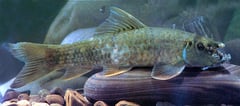
Garra orientalis
Nichols, 1925
Garra orientalis is a cyprinid widely distributed in southern China, with records from the Pearl River (Zhu Jiang) and Min Jiang watersheds. Earlier records from the Salween and upper Irrawaddy are now known to represent other species. It shares a forward-projecting, trilobed proboscis with G. salweenica and G. fuliginosa but lacks their dark blotch on the caudal peduncle. It tends to inhabit rocky, swiftly-flowing headwaters.

Garra poecilura
Kullander & Fang, 2004
Garra poecilura is a small cyprinid known only from a minor Irrawaddy tributary draining the eastern Rakhine Yoma, western Myanmar. The largest specimen in the type series measured 44.5 mm. The type locality is a clear stream 1-2 metres wide in bamboo forest, flowing over rocks and gravel. It has a weakly-defined dark band or series of blotches on the flank and two vertical rows of black spots on the caudal fin.
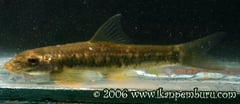
Garra qiaojiensis
Wu & Yao, 1977
Garra qiaojiensis is a cyprinid known only from a handful of localities in the upper Irrawaddy (Yiluowadi Jiang) basin in Yunnan province, China. It may also occur in northern Myanmar, and was collected from clear, flowing mountain streams over rock and gravel. It is similar to G. rotundinasus but has a quadrate, heavily tuberculated proboscis, a longer head and a deeper body. It grows to around 175 mm SL.

Garra rakhinica
Kullander & Fang, 2004
Garra rakhinica is a small cyprinid known only from its type locality, a minor stream on the western slope of the Rakhine Yoma, western Myanmar. In March 1998 that stream was reduced to a series of interconnected pools of clear water over gravel and rocks, with no aquatic vegetation. The body is almost uniform greyish, with a dark spot behind the upper edge of the opercle and white tips to the caudal-fin lobes.
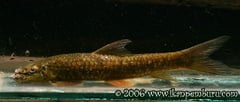
Garra rotundinasus
Zhang, 2006
Garra rotundinasus is a cyprinid native to the Yiluowadi Jiang, the upper Irrawaddy river system, in Yunnan province, southern China. Before its description it was confused with a congener now accepted to occur only in the Salween and Manipur basins. Both have a weakly-developed proboscis, but G. rotundinasus has a broadly rounded snout and more lateral line scales. It grows to around 185 mm SL.
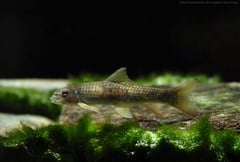
Garra rufaDoctor Fish
Heckel, 1843
The doctor fish (Garra rufa) is a cyprinid from the eastern Mediterranean and Middle East, from Turkey and Israel to the Tigris-Euphrates in Iran. Fish sold as G. rufa are marketed worldwide for their questionable ability to remove dead skin, but the species likely represents a complex of closely-related taxa and it is unclear which the traded fish are. Strictly not a tropical species, it is kept at 14-20 °C.

Garra salweenica
Hora & Mukerji, 1934
Garra salweenica is a cyprinid found throughout the Salween River system in Yunnan province, China, Myanmar and western Thailand. It has a brownish body with longitudinal stripes on the rear half, a trilobed proboscis on the blunt snout, and a dark marking at the tip of the upper caudal-fin lobe. It tends to inhabit swiftly-flowing headwaters and tributaries, and grows to around 175 mm SL.

Garra sp. 'redtail'Burmese Red-tailed Garra
authority not recorded
The Burmese red-tailed garra, Garra sp. 'redtail', is a cyprinid from headwaters of the Salween basin around the border between Myanmar and Thailand. A putatively undescribed species, it is often sold as G. sp. 'burmanicus' and first appeared in the trade in 2005. A flexible, proboscis-like rostral process between the eyes becomes erect during territorial conflicts or courtship. It inhabits shady, fast-flowing stretches and riffles.

Garra spilota
Kullander & Fang, 2004
Garra spilota is a small cyprinid probably endemic to the Rakhine Yoma, or Arakan, mountains in western Myanmar, and occasionally seen in the trade. It has reddish fins, a series of dark blotches on the flanks and an unusual upper lip lined with unculi, and differs from the similar G. flavatra in some meristic counts. It is less territorial with conspecifics than some Garra, and a group of 3-4 is the minimum.

Garra surendranathanii
Shaji, Arun & Easa, 1996
Garra surendranathanii is a cyprinid known only from the Chalakkudy, Periyar and Pamba river basins in Kerala, southwestern India. It has appeared in the aquarium trade on a handful of occasions, marketed as 'green algae-eater'. The body is elongate and shallow, with black-edged scales and a black spot at the upper extremity of the opercle. It grows to around 150 mm SL.

Garra theunensis
Kottelat, 1998
Garra theunensis is a large cyprinid from the Nam Theun and Nam Gnouang systems of the Mekong watershed in Laos, and the Nan River in Thailand. It grows to 300 mm SL and has a plain brown body and fins, sometimes with 6-8 faint longitudinal stripes. It tends to inhabit swiftly-flowing headwaters and tributaries with clear, oxygen-saturated water.