Genus
Gastromyzon
- Species
- 17
- Photographed
- 17 of 17
- Difficulty rated
- 17 of 17
Where the name comes fromEdit
from the Greek gaster, meaning 'stomach' and myzo, meaning 'to suckle'.
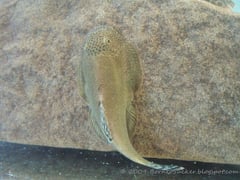
Gastromyzon aeroides
Tan & Sulaiman, 2006
Gastromyzon aeroides is a hillstream loach endemic to northern Borneo, recorded from western Sabah in Malaysia and the Temburong basin in Brunei. The dorsal, caudal and anal fins are blue in life, and the plain brown body separates it from the other two species in the G. punctulatus group. Like its congeners it needs swift, clean, well-oxygenated water.
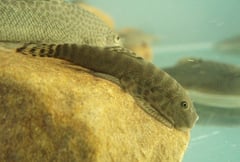
Gastromyzon cornusaccus
Tan, 2006
Gastromyzon cornusaccus is a small hillstream loach known only from the Sungai Kinarom, a river draining Mount Kinabalu in Sabah, Malaysian Borneo. Before its description it was often misidentified as G. danumensis because of its small adult size and secondary rostrum. Juveniles have thick cream bars and blotches, while adults are uniformly coloured. Like its congeners it needs swift, clean, well-oxygenated water.
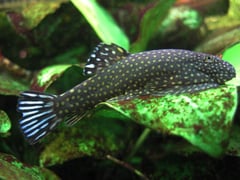
Gastromyzon ctenocephalus
Roberts, 1982
Gastromyzon ctenocephalus is a hillstream loach from western Borneo, known only from headwaters of the Sarawak and Sambas rivers. One of the more commonly traded members of the genus, it turns up in mixed shipments labelled 'Borneo sucker', 'Hong Kong pleco' or 'butterfly loach'. It is sometimes misidentified as G. punctulatus, which has yellow fins and a lighter, less intensely spotted body.

Gastromyzon extrorsus
Tan, 2006
Gastromyzon extrorsus is a hillstream loach from the Kimanis and Petagas basins, draining the western Crocker Range in Sabah, Malaysian Borneo. The brown body carries up to nine thin gold stripes and the head a gold reticulate pattern. Growing to around 80 mm SL, it lives in swift, shallow streams with clear, oxygen-saturated water, and in aquaria needs clean, well-oxygenated water with strong turnover.
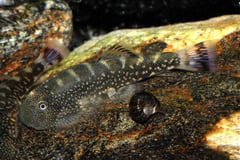
Gastromyzon farragus
Tan & Leh, 2006
Gastromyzon farragus is a small gastromyzontid loach from swift hill streams in the Sadong River basin of southern Sarawak, Malaysian Borneo. It is dark brown with thin cream bars across the back and a red caudal fin, and is very close to G. ocellatus. One of the more commonly traded members of the genus, it often arrives in mixed shipments labelled 'Borneo sucker' or 'Hong Kong pleco', and needs clean, well-oxygenated water with strong flow.
Gastromyzon introrsus
Tan, 2006
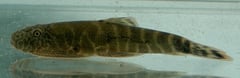
Gastromyzon introrsus is a hillstream loach known only from the Padas and Labuk basins, draining the eastern Crocker Range in Sabah, Malaysian Borneo. The brown body has up to 12 cream vertical bars, and it grows to around 95 mm SL. It lives in swift, shallow streams with clear, oxygen-saturated water, and in aquaria needs clean, well-oxygenated water with strong turnover.
Gastromyzon lepidogaster
Roberts, 1982
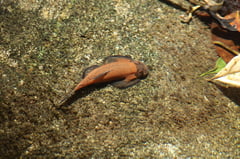
Gastromyzon lepidogaster is a hillstream loach from northern Borneo and the most widely-distributed member of the genus. It occurs in Sabah, Brunei and East Kalimantan. Colour is variable: large adults may be bright green, orange or barred, and can apparently change from barred to plain in a few seconds. It is occasionally available in the trade, where the orange form is particularly sought after.
Gastromyzon monticola
Vaillant, 1889
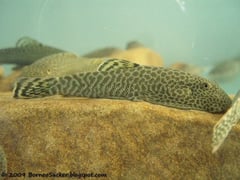
Gastromyzon monticola is a hillstream loach from streams draining Mount Kinabalu into Marudu Bay, and the Wariu basin, in Sabah, Malaysian Borneo. It has a spotted back with wavy bars on the flanks and grows to around 85 mm SL. German aquarist Philipp Dickmann attempted to spawn it and published his observations in 2001. Like its congeners it needs swift, clean, well-oxygenated water.
Gastromyzon ocellatus
Tan & Ng, 2004
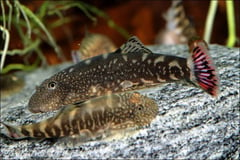
Gastromyzon ocellatus is a small hillstream loach known only from the Sarawak River drainage in southern Sarawak, Malaysian Borneo. One of the more commonly traded members of the genus, it turns up in mixed shipments labelled 'Borneo sucker', 'Hong Kong pleco' or 'butterfly loach'. The dark brown body has cream bars that break up into an ocellus pattern on the flanks, and the caudal fin is red in life.
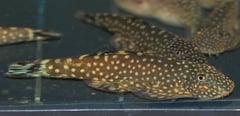
Gastromyzon scitulus
Tan & Leh, 2006
Gastromyzon scitulus is a hillstream loach endemic to tributaries of the Sungai Sadong basin in southern Sarawak, Malaysian Borneo. One of the more commonly-traded members of the genus, it usually arrives in mixed shipments labelled 'Borneo sucker' or 'Hong Kong pleco' regardless of species. It forms a pair of cryptospecies with the very similar G. ctenocephalus, and intermediate forms of both mean identification can sometimes be tricky.
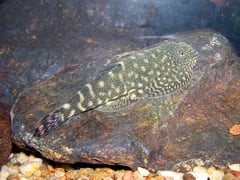
Gastromyzon sp. 'SK01'
authority not recorded
Gastromyzon sp. 'SK01' is an undescribed hillstream loach known only from the Sungai Jorong in South Kalimantan, Indonesian Borneo. The Jorong is part of the upper Barito drainage. The 'SK' code refers to South Kalimantan, home to several unidentified members of the genus. Based on colour pattern it appears similar to members of the G. ridens group. It has occasionally been maintained by private collectors, and like its congeners it lives in swift, shallow streams with clear, oxygen-saturated water.
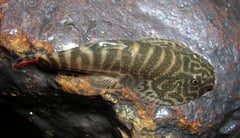
Gastromyzon sp. 'SK02'
authority not recorded
Gastromyzon sp. 'SK02' is an undescribed hillstream loach from the Sungai Amandit headwaters in South Kalimantan, Indonesian Borneo. The Amandit is a tributary of the Barito basin in the Meratus mountain range. Based on colour pattern this species appears similar to members of the G. ridens group, and it has occasionally been maintained by private collectors. Like its congeners it needs clean, well-oxygenated water with strong flow.
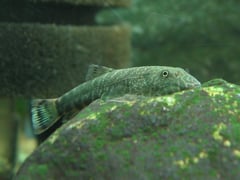
Gastromyzon sp. 'SK03'
authority not recorded
Gastromyzon sp. 'SK03' is an undescribed hillstream loach from a tributary of the Sungai Riam Kiwa in South Kalimantan, Indonesian Borneo. The Riam Kiwa feeds the Martapura, a major tributary of the Barito. The 'SK' code refers to South Kalimantan, home to several unidentified members of the genus. Based on colour pattern it appears similar to members of the G. ridens group, and it has occasionally been maintained by private collectors.
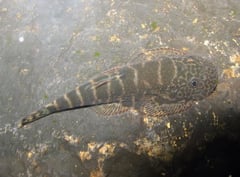
Gastromyzon sp. 'SK04'
authority not recorded
Gastromyzon sp. 'SK04' is an undescribed hillstream loach from South Kalimantan province, Indonesian Borneo. Based on colour pattern it appears similar to members of the G. lepidogaster group, which also includes G. psiloetron. It has occasionally been maintained by private collectors, and like its congeners it needs clean, well-oxygenated water with strong flow.
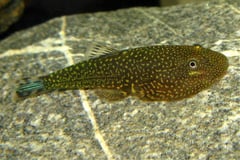
Gastromyzon stellatus
Tan, 2006
Gastromyzon stellatus is a hillstream loach from the Sarawak, Sadong and Lupar River drainages in southern Sarawak, Malaysian Borneo. Its dark brown head and body carry many small yellow spots. It forms a pair of cryptospecies with G. zebrinus and is often confused with it, since both show intermediate colour patterns. One of the more commonly-traded members of the genus, it usually arrives in mixed shipments labelled 'Borneo sucker' or 'Hong Kong pleco'.
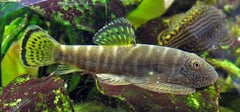
Gastromyzon viriosus
Tan, 2006
Gastromyzon viriosus is a hillstream loach known only from the Tatau River drainage in central Sarawak, Malaysian Borneo. A dark brown body with 8-10 complete vertical cream bars and a thin, cream, reticulated pattern on the head identify it. It is occasionally seen in the trade, most often in mixed shipments labelled 'Borneo sucker', 'Hong Kong pleco' or 'butterfly loach' regardless of species.
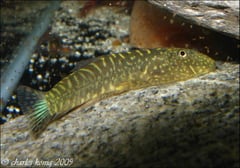
Gastromyzon zebrinus
Tan, 2006
Gastromyzon zebrinus is a hillstream loach known only from the upper Sambas River in West Kalimantan, Indonesian Borneo. Its black body carries 11-13 thin cream bars on the dorsal surface. It forms a pair of cryptospecies with G. stellatus, separated from it by an outcrop of the Müller range, and intermediate colour patterns mean the two are often confused. It is one of the more commonly-traded members of the genus.