Genus
Hampala
- Species
- 5
- Photographed
- 5 of 5
- Difficulty rated
- 5 of 5
Where the name comes fromEdit
from a Javanese vernacular name for this genus.
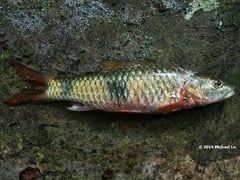
Hampala bimaculata
Popta, 1905
Hampala bimaculata is a large riverine cyprinid endemic to Borneo, recorded from Sarawak, Sabah, East Kalimantan and Brunei. Its adult size of up to 500 mm SL more-or-less precludes it as an aquarium fish, and it is poorly known in the ornamental trade. Of the Hampala species with two body blotches, it has saddle-shaped markings, with the anterior blotch beneath the posterior half of the dorsal-fin.

Hampala disparSpotted Hampala Barb
Smith, 1934
The spotted hampala barb, Hampala dispar, is a cyprinid endemic to the Mekong basin in northern Laos, Thailand and Cambodia. It needs plenty of space but, at up to 350 mm SL, makes a more suitable aquarium fish than the larger and more commonly traded H. macrolepidota. It has a single dark blotch on the body and less well-defined marginal stripes on the caudal lobes, although juveniles of the two can appear very similar.

Hampala macrolepidotaHampala Barb
Kuhl & van Hasselt, 1823
The hampala barb, Hampala macrolepidota, is a cyprinid ranging from Myanmar through Thailand to the Mekong, and south to Borneo, Sumatra and Java. Also known as 'jungle perch' or 'sidebar barb', it can grow to over 2 feet and 5 kg and is a powerful, pelagic predator and not an aquarium subject in all but the most extreme circumstances. Prized as a food and sport fish, it has been introduced to numerous water bodies.
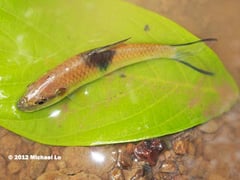
Hampala sabana
Inger & Chin, 1962
Hampala sabana is a large riverine cyprinid endemic to the Malaysian state of Sabah in northern Borneo. It inhabits clear, well-oxygenated running water and apparently favours deeper, slower-moving stretches. It has a single body marking and a higher count of circumpeduncular scales than its congeners. Growing to 410 mm SL, it is poorly known in the ornamental trade, and its size more-or-less precludes it as an aquarium fish.

Hampala salweenensis
Doi & Taki, 1994
Hampala salweenensis is a riverine cyprinid endemic to the Salween basin in northwestern Thailand and Myanmar. It has two roundish dark blotches on each flank, one beneath the dorsal-fin origin and one on the caudal peduncle, and a black marginal band on both caudal-fin lobes. It is poorly known in the aquarium hobby, and the full extent of its distribution within the watershed is unclear.