Genus
Hemibagrus
- Species
- 9
- Photographed
- 9 of 9
- Difficulty rated
- 9 of 9

Hemibagrus filamentus
Fang & Chaux, 1949
Hemibagrus filamentus is a bagrid catfish from the middle and lower Mekong river system in Laos, Cambodia and Thailand. It appears to be unknown in the aquarium trade but is a valued food fish within its native range, growing to 420 mm SL. It inhabits slowly-flowing or standing waters, including main river channels and lakes, and riverine populations typically migrate into flooded forest during the wet season.
Hemibagrus macropterus
Bleeker, 1870
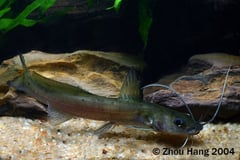
Hemibagrus macropterus is a bagrid catfish from the Zhujiang (Pearl River), Changjiang (Yangtze) and Qiantang Jiang in central and southern China. It inhabits swiftly-flowing rivers and tributaries with rocky substrates and grows to 408 mm SL. Virtually unknown in the aquarium trade, it is fished for food, and dam construction and pollution have affected it in parts of its range, where it may be locally extirpated.

Hemibagrus microphthalmus
Day, 1877
Hemibagrus microphthalmus is a very large bagrid catfish from the Salween, Irrawaddy and Sittaung systems of Myanmar and western Thailand. It also occurs in the Manipur River drainage in northeastern India. Known to reach 1500 mm SL and to live for several decades, it cannot be considered a suitable home aquarium subject, and it is likely to prove aggressively territorial.

Hemibagrus peguensis
Boulenger, 1894
Hemibagrus peguensis is a bagrid catfish from the Irrawaddy, Bago and Sittaung drainages of Myanmar and the Chindwin basin in northeastern India. Sometimes referred to as 'Sittang mystus', it has been widely confused with H. menoda in the past and seems virtually unknown in the aquarium hobby. It grows to 286 mm SL and can be told from H. menoda by its almost truncate snout.
Hemibagrus planiceps
Valenciennes, 1840
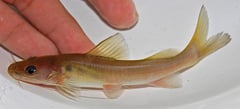
Hemibagrus planiceps is a bagrid catfish endemic to western Java, known only from seven river systems including the Citarum and Ciliwung. It occurs in the upper parts of river basins, in clear, fast-flowing water over rock or sand. It has been confused in the past with H. gracilis, H. velox and H. bongan, and the population once thought to inhabit northwestern Peninsular Malaysia has been described as H. divaricatus.

Hemibagrus punctatusPorthole Bagrid
Jerdon, 1849
The porthole bagrid, Hemibagrus punctatus, is a catfish known only from the Cauvery (Kaveri) river system in southern India. The IUCN lists it as Critically Endangered (possibly extinct), and at its confirmed localities in the Kabini, Bhadra and Moyar systems it was last collected in 1998 or earlier. It has been available only very occasionally in the aquarium trade, and its flanks carry dark spots arranged in vertical columns.

Hemibagrus spilopterus
Ng & Rainboth, 1999
Hemibagrus spilopterus is a bagrid catfish from the Mekong and several other river systems in Laos, Vietnam, Cambodia and Thailand. Relatively common in the ornamental trade, it has been widely misidentified as H. nemurus, a Javan species that may never have been exported for aquaria. Given its size of up to 500 mm SL, its aggressive nature and a lifespan of several decades, it shouldn't be considered a home aquarium subject in all but the most exceptional circumstances.

Hemibagrus wyckiiCrystal-eyed Catfish
Bleeker, 1858
The crystal-eyed catfish, Hemibagrus wyckii, is a bagrid with an enormous distribution across central Indochina and western Indonesia. Juveniles are sometimes available in the aquarium trade, but buying them is strongly discouraged: it reaches 710 mm SL, is aggressively territorial and can live for several decades. Despite the common name, the blue eye is not given as a distinguishing character in any diagnosis we've seen.

Hemibagrus wyckioidesAsian Red Tailed Catfish
Fang & Chaux, 1949
The Asian red tailed catfish, Hemibagrus wyckioides, is a bagrid from the Mekong system in China, Laos, Vietnam, Cambodia and Thailand. It also occurs in the Chao Phraya drainage. The largest bagrid in central Indochina, it reaches at least 900–1000 mm and 70–80 kg, and the largest specimen known measured 1300 mm. Juveniles are sometimes sold, but buying them is strongly discouraged given its size, aggression and a lifespan of several decades.