Genus
Leporinus
- Species
- 5
- Photographed
- 5 of 5
- Difficulty rated
- 5 of 5
Where the name comes fromEdit
from the Latin lepus, meaning 'hare', and the suffix -inus, meaning 'of or pertaining to', in reference to the enlarged pair of symphyseal teeth possessed by certain members of the genus.
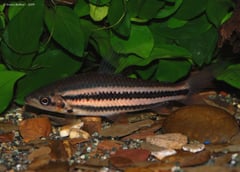
Leporinus arcusLipstick Leporinus
Eigenmann, 1912
The lipstick leporinus, Leporinus arcus, is an anostomid from the Orinoco, Essequibo and upper Courantyne basins in Venezuela and the Guianas. It grows to 250 to 300 mm and needs an aquarium with base dimensions of at least 210 by 60 cm.
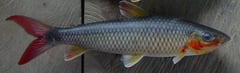
Leporinus brunneus
Myers, 1950
Leporinus brunneus is an anostomid from the rios Madeira and Negro in Brazil, the Orinoco in Venezuela and Colombia, and the Casiquiare canal. The largest officially recorded specimen measured 256 mm, and an aquarium with base dimensions of at least 210 by 60 cm is needed.
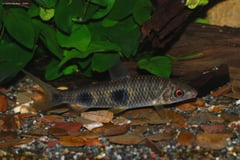
Leporinus copelandii
Steindachner, 1875
Leporinus copelandii is an anostomid from the Paraíba do Sul and Doce river systems of southeastern Brazil. It reaches at least 200 mm, and an aquarium with base dimensions of 180 by 60 cm should be the smallest considered.
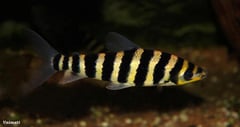
Leporinus fasciatusBanded Leporinus
Bloch, 1794
The banded leporinus, Leporinus fasciatus, is an anostomid from the Amazon and Orinoco systems and coastal Guyana, Suriname and French Guiana. Young fish are often sold without warning of their size and requirements, and it is fairly ubiquitous in public aquarium displays. It is frequently confused with L. affinis, and its dark body bars multiply with age, from five in young fish to around ten in adults.
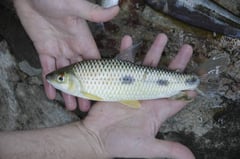
Leporinus fridericiThreespot Leporinus
Bloch, 1794
The threespot leporinus, Leporinus friderici, is an anostomid from much of the Amazon system, with further records from the Guianas and Trinidad. It grows to 350 to 400 mm and needs an aquarium with base dimensions of at least 240 by 90 cm. Across this enormous range the fish differ in morphology and, especially, colour pattern.