Genus
Luciosoma
- Species
- 4
- Photographed
- 4 of 4
- Difficulty rated
- 4 of 4
Where the name comes fromEdit
from the Latin lucius, meaning 'a fish (probably the pike)', and Ancient Greek σῶμα (sôma), meaning 'body', in reference to the elongate, pike-like body shape in members of this genus.

Luciosoma bleekeri
Steindachner, 1878
Luciosoma bleekeri is a slender, pike-like cyprinid from the Mekong in Laos, Thailand, Cambodia and Vietnam, and from central and western Thailand. Subadults are traded regularly as 'apollo shark' or 'shark minnow' and it is frequently confused with L. setigerum, which has a series of black spots on the lateral line scales that this species lacks. It needs the largest private aquaria, and feeds mainly on terrestrial insects taken at the surface.
Luciosoma pellegrinii
Popta, 1905
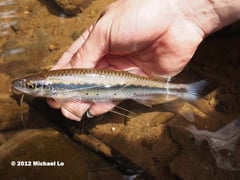
Luciosoma pellegrinii is a slender, pike-like cyprinid endemic to Borneo, ranging from the Kapuas in West Kalimantan to Sabah. It is scarcely known in the aquarium trade because it comes from an area where very few commercial collections take place, but its name is misapplied on a regular basis. It has 4 to 8 distinct dark spots on the lateral line and appears to develop longer pelvic-fin filaments than any other member of the genus.

Luciosoma setigerumApollo Shark
(Valenciennes, 1842)
The apollo shark, Luciosoma setigerum, is a slender cyprinid found across much of Southeast Asia, from the Mekong basin to Borneo, Sumatra and Java. Subadults are traded regularly and are frequently confused with L. bleekeri, which lacks the series of black spots on the lateral line scales. A similar fish of unknown origin with no stripe on the front of the body is also common in the trade, listed as L. cf. setigerum. It needs the largest private aquaria.
Luciosoma spilopleura
Bleeker, 1855
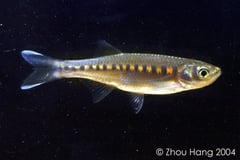
Luciosoma spilopleura is a small cyprinid known only from Sumatra and the Indonesian part of Borneo, where it prefers fast-flowing headwater streams. The species is poorly known and is not present in the ornamental trade, although its name has been widely misapplied to other Luciosoma species for decades. The largest known specimen measured 81.9 mm, so it appears to grow much smaller than its congeners.