Genus
Nannostomus
- Species
- 15
- Photographed
- 15 of 15
- Difficulty rated
- 15 of 15
Where the name comes fromEdit
from the Latin nannus, meaning 'small', and Greek stoma, meaning 'mouth', in reference to the small mouthparts of member species.
Nannostomus anduzei
Fernandez & Weitzman, 1987
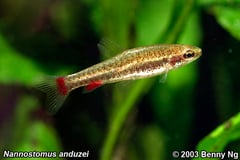
The smallest member of its genus, Nannostomus anduzei is a pencilfish from the upper Orinoco in Venezuela and the rio Negro basin in Brazil. Rarely traded in numbers, it is a relatively common contaminant among shipments of wild fishes from Manaus. Males have an intensely red caudal peduncle and anal-fin, and its size and timid nature suit a tank of its own or diminutive tankmates such as Paracheirodon simulans.
Nannostomus beckfordiGolden Pencilfish
Günther, 1872
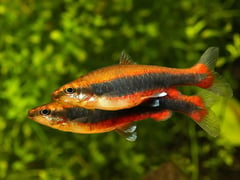
The golden pencilfish, Nannostomus beckfordi, is a lebiasinid widely distributed across Guyana, Suriname, French Guiana, Brazil and Venezuela. The type species of the genus and fairly ubiquitous in the trade, it is less demanding than most congeners and a good choice for a newcomer. Many fish on sale are farmed, and wild populations vary in colour pattern, several having been described as species now considered synonyms of N. beckfordi.
Nannostomus digrammusTwostripe Pencilfish
(Fowler, 1913)
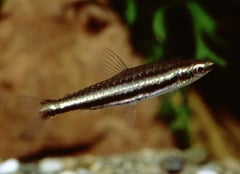
The twostripe pencilfish, Nannostomus digrammus, is a lebiasinid from the central Amazon basin in Brazil and the Rupununi basin in Guyana. Rare in the hobby, it usually arrives as bycatch among shipments of other fishes. It is most similar to N. bifasciatus but has an adipose-fin, and its small size and timid nature make it a poor community fish.
Nannostomus equesHockeystick Pencilfish
Steindachner, 1876
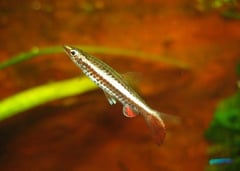
The hockeystick pencilfish, Nannostomus eques, is a lebiasinid from the central and upper Amazon, the Orinoco drainage and rivers of Guyana. It swims at an oblique angle, a trait shared only with N. unifasciatus among congeners, and is also known as the 'rocket', 'diptail' or 'tubemouth' pencilfish. Genetic research on rio Negro populations raises the possibility that the species may be a complex of cryptic taxa.
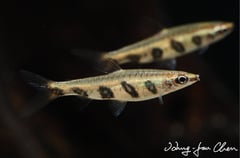
Nannostomus espeiBarred Pencilfish
(Meinken, 1956)
The barred pencilfish, Nannostomus espei, is a lebiasinid considered endemic to the Mazaruni River system in Guyana. The only member of the genus to show a vertically-barred pattern permanently, it has five dark bar-like markings on each flank where congeners have horizontal stripes. It inhabits sluggish blackwater habitats where pH can be as low as 4.0, and its small size and timid nature suit a tank of its own or diminutive tankmates.
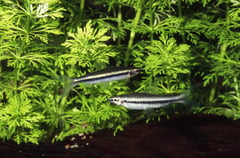
Nannostomus grandis
Zarske, 2011
The largest member of its genus at up to 46 mm, Nannostomus grandis is a pencilfish known only from commercial exports from Belém, Pará state, Brazil. Poorly known in the hobby, it arrives as bycatch, especially among N. beckfordi, which it closely resembles. The simplest difference is that N. grandis lacks pale white or bluish tips to the ventral fins, and it appears to have been traded as N. anomalus in the 1920s and 1930s.
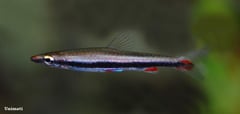
Nannostomus harrisoniBlackstripe Pencilfish
(Eigenmann, 1909)
The blackstripe pencilfish, Nannostomus harrisoni, is a lebiasinid that appears endemic to the Demerara River basin in eastern Guyana. Quite rare in the hobby, it is more often exported as bycatch among shipments of N. eques than in numbers. It inhabits sluggish tributaries, swamps and flooded forest, and mature males show red in the pelvic, anal and caudal fins.
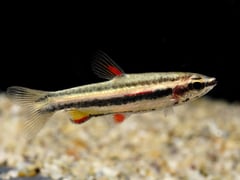
Nannostomus marginatusDwarf Pencilfish
Eigenmann, 1909
The dwarf pencilfish, Nannostomus marginatus, is a lebiasinid of Guyana, Suriname and the middle-to-lower Amazon in Peru, Colombia and Brazil. Enduringly popular, it lacks the red body colour of males of the related N. mortenthaleri and N. rubrocaudatus, showing three dark lateral stripes with no red or purple between them. Colour varies between populations, and its small size and timid nature make it a poor community fish.
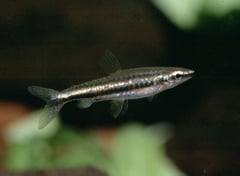
Nannostomus marilynaeGreenstripe Pencilfish
Weitzman & Cobb, 1975
The greenstripe pencilfish, Nannostomus marilynae, occurs in the rio Negro in Brazil and the Río Vichada in the upper Orinoco basin, Colombia. Also known as 'Marilyn's pencilfish', it is rarely traded in numbers and more often seen as bycatch among shipments of Paracheirodon axelrodi. It most resembles N. minimus, but males lack the highly modified anal-fin of that species.
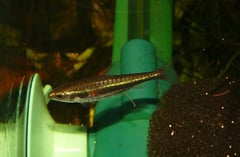
Nannostomus minimusLeast Pencilfish
Eigenmann, 1909
The least pencilfish, Nannostomus minimus, is a tiny lebiasinid from the Potaro and Mazaruni systems of the Essequibo basin in Guyana. The second-smallest member of the genus after N. anduzei, it is poorly known in the hobby and has been exported under the name N. marilynae. In the Mazaruni it occurs with N. espei in sluggish blackwater habitats but tends to keep to marginal zones with abundant cover.
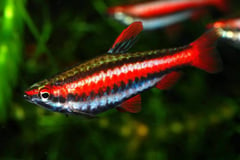
Nannostomus mortenthaleriCoral Red Pencilfish
Paepke & Arendt, 2001
The coral red pencilfish, Nannostomus mortenthaleri, is a lebiasinid that appears endemic to the Nanay basin and Río Tigre system in Loreto, Peru. Originally described as a subspecies of N. marginatus, it is traded under names including 'red arc' and 'Peruvian red' pencilfish, and males carry bright red between the upper two dark lateral stripes. More aggressive than most congeners, it needs a spacious tank with plenty of broken lines of sight.
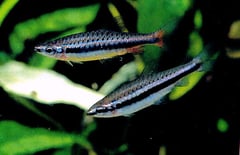
Nannostomus nitidusShining Pencilfish
Weitzman, 1978
The shining pencilfish, Nannostomus nitidus, was described from the Rio Capim, a short river draining into the rio Pará near Belém, Brazil. Poorly known in the hobby, it is rarely traded in numbers and is more often seen as bycatch. Males have a brightly coloured stripe above the primary dark lateral stripe, and some captive-raised fry lacking an adipose-fin have raised questions about the validity of the similar N. limatus.
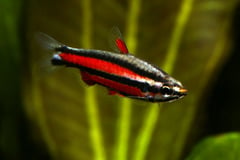
Nannostomus rubrocaudatusPurple Pencilfish
Zarske, 2009
The purple pencilfish, Nannostomus rubrocaudatus, is reportedly collected along the Marañón in Peru, between the Morona and Santiago rivers. Before description it was traded as Nannostomus sp. 'purple' or N. sp. 'coral red II'. Males have red-purple pigmentation between all three dark lateral stripes, and it is more aggressive than most congeners, so it needs a spacious tank with plenty of broken lines of sight.
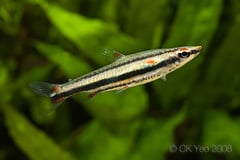
Nannostomus trifasciatusThree-lined Pencilfish
Steindachner, 1876
The three-lined pencilfish, Nannostomus trifasciatus, is a lebiasinid widespread in the western Amazon basin in Brazil, Peru, Colombia and Bolivia. Fairly ubiquitous in the trade, it is less demanding than many congeners and a good choice for a newcomer to pencilfishes. Many fish on sale are farmed, and wild populations vary in colour pattern, one being marketed as 'super red' for its unusually long red stripe.
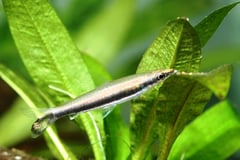
Nannostomus unifasciatusOne-lined Pencilfish
Steindachner, 1876
The one-lined pencilfish, Nannostomus unifasciatus, occurs in the upper Amazon and upper Orinoco basins in Brazil, Bolivia, Colombia and Venezuela. A popular aquarium fish, it swims at an oblique angle, a trait shared only with N. eques. It differs from that species in lacking dark brown spots on the body scales and normally having an ocellus in the upper caudal-fin lobe.