Genus
Nemacheilus
- Species
- 12
- Photographed
- 12 of 12
- Difficulty rated
- 12 of 12
Where the name comes fromEdit
from the Greek nēma, meaning 'thread' or 'filament' and cheilos, meaning 'lip' in reference to the furrowed lip in members of this genus.
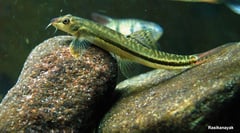
'Nemacheilus' anguilla
Annandale, 1919
Nemacheilus anguilla is a loach endemic to the Western Ghats of southwestern India, recorded from rivers in Maharashtra, Karnataka and Kerala. Dark flank markings merged into a lateral stripe separate it from other Indian congeners, and its generic placement requires further study. It inhabits well-oxygenated, moderate to fast-flowing rivers over gravel and boulders, and is peaceful with its own kind, best kept in a group of four or more.
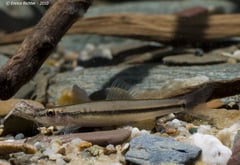
Nemacheilus binotatus
Smith, 1933
Nemacheilus binotatus is a loach known only from the Mae Klong and Chao Phraya river systems of western and central Thailand. Its colour pattern is simply two dark stripes, one along the back and one from the snout through the eye along the flank, which separates it from N. longistriatus and N. ornatus. It lives in shallow, flowing stretches of streams over sand, gravel and leaf litter.
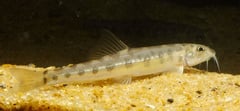
'Nemacheilus' corica
Hamilton, 1822
Nemacheilus corica is a loach from Himalayan foothill rivers of the Ganges and Brahmaputra systems in Nepal, northern India and Bangladesh. Usually referred to Schistura in the hobby, it has been placed in Nemacheilus by most authors since the late 1970s, though its generic placement requires further study. A row of variably sized dark spots runs along the back and another along each flank, both ending in a dark blotch at the caudal-fin base.
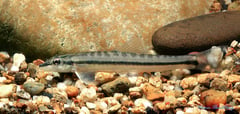
Nemacheilus longistriatusLaos Blackline Torpedo Loach
Kottelat, 1990
The Laos blackline torpedo loach, Nemacheilus longistriatus, is a nemacheilid loach from the Mekong in Thailand and Laos. It has been collected from the main river channel and from backwaters over bedrock or sand. It is occasionally exported for the aquarium hobby and is told apart from the similar N. binotatus by the dark saddles along its back. A naturally reclusive loach, it becomes more confident alongside schools of peaceful, open water-dwelling cyprinids.
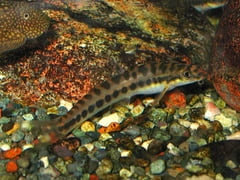
Nemacheilus masyaeArrow Loach
Smith, 1933
Nemacheilus masyae is a nemacheilid loach from Thailand and Peninsular Malaysia. Its flanks carry 14-18 short dark bars and its back 12-17 saddles. It occurs in both small blackwater forest streams and turbid main river channels. It is very similar to N. pallidus but has a more slender body, and its dark bars and saddles are wider than the light interspaces between them.
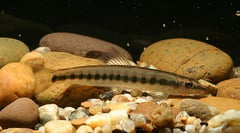
Nemacheilus ornatus
Kottelat, 1990
Nemacheilus ornatus is a small nemacheilid loach known only from the Tapi river drainage in Surat Thani province, southern Thailand. It is said to occur in shallow riffles with clear, moderately-flowing water over small pebbles. Its colour pattern is a black lateral stripe with 9-16 vertical blotches extending above and below it, and the first of these blotches is ringed with lighter pigment to form an ocellus.

Nemacheilus pallidus
Kottelat, 1990
Nemacheilus pallidus is a nemacheilid loach from the Mae Klong, Chao Phraya and Mekong systems in Thailand, Laos, Cambodia and Vietnam. It inhabits streams and small rivers with clear to turbid water and substrates of mud, sand or small rocks. The similar-looking N. masyae is sometimes traded under this name, but N. pallidus has a deeper body and dark bars and saddles thinner than the light interspaces between them.
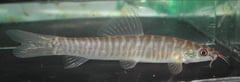
Nemacheilus platiceps
Kottelat, 1990
Nemacheilus platiceps is a nemacheilid loach native to the Mekong basin in Laos, Thailand, Cambodia and Vietnam, and the Dong Nai system. It has been collected from shallow, slow-moving hill stream pools where leaf litter collects, and from faster-flowing stretches over gravel. It is only occasionally available in the aquarium trade and has 12-16 dark, irregular body bars, usually split vertically.
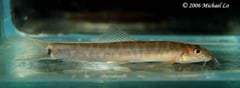
Nemacheilus saravacensis
Boulenger, 1894
Nemacheilus saravacensis is a nemacheilid loach from Borneo, recorded from drainages in Sarawak (Malaysia) and West Kalimantan (Indonesia). It inhabits clear, tea-coloured forest streams with low mineral hardness and pH. Rare in the aquarium hobby, it may only have appeared as bycatch, and it carries 13-17 irregular dark blotches along the lateral line with a similar number of saddles across the back.
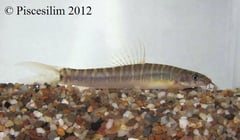
Nemacheilus selangoricus
Duncker, 1904
Nemacheilus selangoricus is a nemacheilid loach ranging from southern Thailand through Peninsular Malaysia and Singapore to western Borneo and Sumatra. It is most common in shallow, flowing forest streams over sand, gravel and detritus. It belongs to the N. selangoricus group and is most similar to N. spiniferus, from which it differs in its 8-12 very regular dark bars on the flanks.
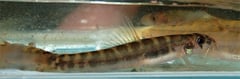
Nemacheilus spiniferus
Kottelat, 1984
Nemacheilus spiniferus is a nemacheilid loach from Borneo, recorded from Sarawak, Brunei and Kalimantan, plus the Natuna and Anambas islands. It is most common in shallow, flowing forest streams with clear to slightly tannin-stained water. A member of the N. selangoricus group, it is rare in the aquarium hobby and differs from N. selangoricus in its 10-13 irregularly-shaped dark bars.
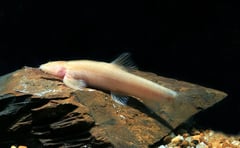
Nemacheilus troglocataractus
Kottelat & Géry, 1989
Nemacheilus troglocataractus is a blind cave loach known only from the Tham Sai Yok Noi cave system in Kanchanaburi Province, Thailand. Most specimens have no externally visible eyes and all are entirely depigmented. It is protected by Thai law and illegal to remove from its habitat, so the profile includes it for interest only.