Genus
Pachypanchax
- Species
- 4
- Photographed
- 4 of 4
- Difficulty rated
- 4 of 4
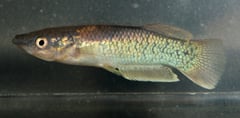
Pachypanchax arnoulti
Loiselle, 2006
Pachypanchax arnoulti is a killifish endemic to western Madagascar, where it occurs in the Mahavavy du Sud and Betsiboka river systems. It was in the hobby for many years as the congener P. omalonotus and appears under that name in most older aquarium literature, so a degree of hybridisation has undoubtedly occurred. The absence of metallic gold spots on the flanks separates it from that species. Its populations have declined dramatically since the 1950s.
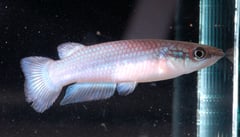
Pachypanchax omalonotusPowder-blue Panchax
Duméril, 1861
The powder-blue panchax, Pachypanchax omalonotus, is a killifish from Nosy Be and the adjacent Sambirano River system in northwestern Madagascar. Many fish in the hobby identified as P. omalonotus are in fact P. arnoulti, as are those in much older aquarium literature, and a degree of hybridisation has undoubtedly occurred. Metallic gold spots on the flanks separate it from that species, and males are polymorphic, with yellow, red and blue morphs in different populations.
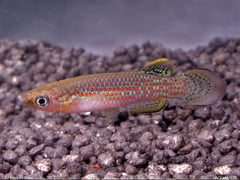
Pachypanchax playfairiiPlayfair's Panchax
Günther, 1866
Playfair's panchax, Pachypanchax playfairii, is a killifish from forest streams in the granitic Seychelles, and has been translocated to Zanzibar. The only purely freshwater fish native to the Seychelles, it is known there from Mahé, Praslin, Silhouette and La Digue. Raised scales on the back of most adult males and a black ocellus in the dorsal-fin of females tell it apart from all congeners.
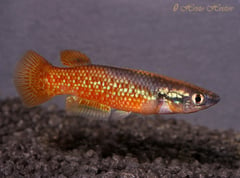
Pachypanchax sakaramyiMadagascar Panchax
Holly, 1928
The Madagascar panchax, Pachypanchax sakaramyi, is a killifish from high-gradient forest streams around the Ambohitra Massif in northern Madagascar. The only remaining riverine populations are in a short stretch of the Sakaramy River and the upper Antongombato River, most of the original populations having been lost to invasive species, deforestation and the diversion of the Sakaramy's source. Despite its conservation status it is relatively well-established in the aquarium hobby.