Genus
Paracanthocobitis
- Species
- 4
- Photographed
- 4 of 4
- Difficulty rated
- 4 of 4
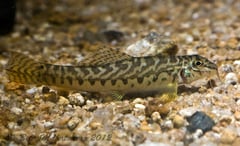
Paracanthocobitis botiaZipper Loach
Hamilton, 1822
The zipper loach, Paracanthocobitis botia, is a nemacheilid loach from the Brahmaputra River in Assam, northeastern India. It was long thought to range from Pakistan to western Thailand, and several populations once included under the name are now treated as separate species. Relatively hardy and peaceful, it is one of the better choices for those new to nemacheilids, and its dark, eye-like ocellus at the top of the caudal peduncle is normally more intense in younger fish.
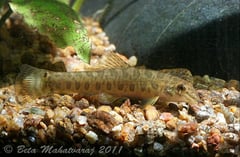
Paracanthocobitis mooreh
Sykes, 1839
Paracanthocobitis mooreh is a nemacheilid loach known only from the Godavari, Krishna and Kaveri (Cauvery) systems in western and southern India. An incomplete lateral line ending near the pelvic-fin origin, with small, mostly vertical blotches along it connected to the dorsal saddles, separates it from congeners. It favours stretches of streams and small rivers where leaf litter collects over sand, cobbles and boulders, and is generally non-aggressive.
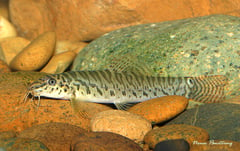
Paracanthocobitis pictilisCherry-fin Loach
Kottelat, 2012
The cherry-fin loach, Paracanthocobitis pictilis, is a nemacheilid loach from the Ataran River, a Salween tributary on the Thailand-Myanmar border. Before its description it was traded as P. rubidipinnis, a species apparently endemic to the lower Irrawaddy. Bolder and less peaceful than other members of the genus, it inhabits shady, fast-flowing riffles, and some males become aggressive unless kept in a mixed-sex group of at least six.
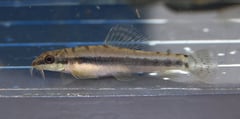
Paracanthocobitis zonalternans
Blyth, 1860
Paracanthocobitis zonalternans is a nemacheilid loach ranging from Manipur in India through Myanmar into western and peninsular Thailand. Several species are thought to be confused under the name, and Singer and Page (2015) consider it likely to be a species complex. Among the more peaceful members of the genus, it does best in a mixed-sex group of at least half a dozen, and it has been bred in aquaria, first by UK aquarist Mick Wright.