Genus
Polypterus
- Species
- 9
- Photographed
- 5 of 9
- Difficulty rated
- 8 of 9
Polypterus bichir bichirNile Bichir
authority not recorded
The Nile bichir, Polypterus bichir bichir, is a large bichir recorded from Egypt, Kenya, Ethiopia and Chad west to Nigeria, Ghana and Guinea-Bissau. It grows to 72 cm, though rarely that large in aquaria, and belongs to the 'lower-jawed' group of Polypterus. It is one of the subspecies of the P. bichir complex, will eat any tankmate it can fit in its mouth, and needs a tight-fitting cover as an excellent escape artist.
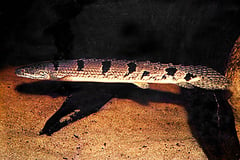
Polypterus delheziArmoured Bichir
authority not recorded
The armoured bichir, Polypterus delhezi, is a bichir from the Democratic Republic of Congo, found in lakes, streams and flooded areas. Also known as the banded bichir, it is hardy and nocturnal with very poor vision, and relies on its sense of smell to find food. Like other bichirs it can drown if denied access to atmospheric air, and it will eat any tankmate small enough to fit in its mouth.
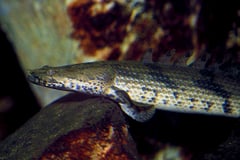
Polypterus endlicheri endlicheriSaddled Bichir
authority not recorded
The saddled bichir, Polypterus endlicheri endlicheri, is a nocturnal bichir recorded from ten African countries including Cameroon, Nigeria and Sudan. It lives in rivers and marshy areas and is occasionally found in brackish water around mangroves. One of the 'lower-jawed' tribe of Polypterus, it can reach 75 cm, though rarely in captivity, and a fully grown fish needs a very large aquarium. Like other bichirs it breathes atmospheric air and can drown if denied access to it.
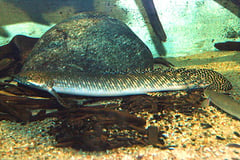
Polypterus ornatapinnisOrnate Bichir
authority not recorded
The ornate bichir, Polypterus ornatapinnis, is a nocturnal bichir from Cameroon, the Democratic Republic of Congo, Burundi, Angola and Tanzania. It is found in rivers, ponds, marshes and lakes, including Tanganyika. The largest of the 'upper-jawed' polypterids, it reaches 60 cm, though usually less in aquaria, and will eat any tankmate small enough to fit in its mouth.
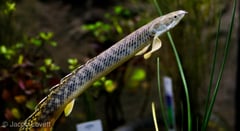
Polypterus palmas palmasMarbled Bichir
authority not recorded
The marbled bichir, Polypterus palmas palmas, is a small bichir from Ghana, Cameroon, the Democratic Republic of Congo and four other countries. One of the more peaceful and active Polypterus, it reaches 32.5 cm and is recommended as a beginner's bichir. Three subspecies make up the P. palmas complex, and most fish sold as P. palmas are in fact P. palmas polli, though aquarium care for all of them is identical.
Polypterus retropinnisWest African Bichir
authority not recorded
The West African bichir, Polypterus retropinnis, is a nocturnal bichir widely distributed throughout Western Africa. It inhabits marshes, swamps, flooded areas and small rivers, and is also known as the speckled bichir. Imported infrequently, it has an unsettled classification: its former subspecies P. retropinnis lowei is now a synonym of P. palmas palmas, and there is some discussion as to whether P. retropinnis belongs in the P. palmas complex too.
Polypterus senegalus senegalusSenegal Bichir
authority not recorded
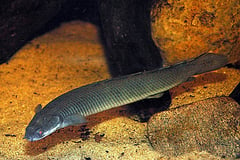
The Senegal bichir, Polypterus senegalus senegalus, is the most widespread bichir, found in 26 African countries including Egypt and Senegal. It is usually found in shallow, slow-moving swamps, marshes and freshwater lagoons. One of the more peaceful and active Polypterus, it reaches 50 cm, is recommended for beginners with these fish, and has lived for over 30 years in aquaria.
Polypterus teugelsi
Britz, 2004
Polypterus teugelsi is a bichir probably endemic to the River Cross drainage in Cameroon, where it lives in shady, slow-moving rainforest streams. Its colour pattern differs from every other member of the genus: a network of black marks over the upper half of the body, an orange belly and jet black pectoral fins. It is also more slender than other Polypterus. Discovered in 1988 and described in 2004, it stands apart from every other known bichir, all described before 1911.
Polypterus weeksiiMottled Bichir
authority not recorded
The mottled bichir, Polypterus weeksii, is a nocturnal bichir from the Congo basin in the Republic of Congo and Democratic Republic of Congo. One of the 'upper-jawed' polypterids and one of the rarer bichirs in the hobby, it reaches 55 cm. Like its congeners it finds food by smell, breathes atmospheric air, and will eat any tankmate it can fit in its mouth.