Genus
Potamotrygon
- Species
- 11
- Photographed
- 4 of 11
- Difficulty rated
- 11 of 11
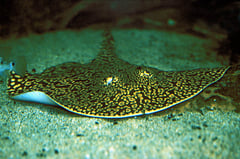
Potamotrygon falkneriLarge Spot Stingray
authority not recorded
The large spot stingray (P53), Potamotrygon falkneri, is a freshwater stingray from the Paraná and Paraguay basins in Brazil, Paraguay and Argentina. A large female can reach about 52 cm across the disc. It is imported irregularly and is usually expensive when available. Like all rays it carries a venomous sting on the tail, and the venom causes intense pain and tissue necrosis.
Potamotrygon henleiBlack Stingray
authority not recorded
The black stingray (P12), Potamotrygon henlei, is a freshwater stingray probably endemic to the Rio Tocantins basin in Brazil. It reaches 60 cm across the disc and occurs in several colour forms, with white or yellow spots on a black to dark brown background. It is often confused with P. leopoldi and P14, and is told apart by spots on the underside of the disc, although some P. leopoldi have shown this patterning too.
Potamotrygon hystrixPorcupine Stingray
authority not recorded
The porcupine stingray (P06), Potamotrygon hystrix, is a freshwater stingray from the Rio Paraná and Rio Paraguay basins in Argentina and Brazil. Usually around 35 cm across the disc, it is recommended as a good beginners' ray. Fish sold as hystrix are almost always Peruvian and mislabelled: P. humerosa, P. yepezi and a P. motoro variant known as P. sp. 'Peru' have all been sold under the name, and all grow considerably larger.
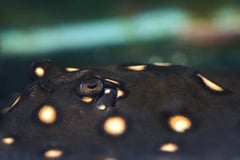
Potamotrygon leopoldiPolka Dot Stingray
Castex & Castello, 1970
The polka dot stingray, Potamotrygon leopoldi, is a freshwater stingray known only from the Rio Xingu basin and Rio Fresco in central Brazil. A large female reaches 70 cm across the disc, and males tend to be smaller. A rare form with ring-shaped spots is known as 'eclipse'. P. henlei is very similar and is told apart by spots on the underside of the disc that P. leopoldi is supposed to lack.
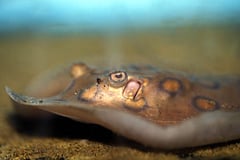
Potamotrygon motoroMotoro Stingray
authority not recorded
The motoro stingray, Potamotrygon motoro, is a freshwater stingray ranging across Colombia, Peru, Bolivia, Brazil, Paraguay, Uruguay and Argentina. It reaches about 50 cm across the disc. The patterning is highly variable, with some variants given P-numbers and others sold as 'blue', 'orange', 'black' or 'marbled'. Males are among the most violent when spawning and can seriously injure females.
Potamotrygon orbignyiSmooth-back Stingray
authority not recorded
The smooth-back stingray (P11), Potamotrygon orbignyi, is a freshwater stingray from Venezuela, Guyana, Suriname, French Guiana, Brazil and Bolivia. Often labelled 'teacup ray' by dealers, it is tricky to identify when young and most resembles P. humerosa. The skin tells them apart: rough in P. humerosa and noticeably smooth in P. orbignyi. Most reach 35 to 37.5 cm across the disc, but females from the Amazon basin grow larger and do not mature until about 44 cm.
Potamotrygon schroederiFlower Ray
authority not recorded
The flower ray, Potamotrygon schroederi, is a freshwater stingray from the Orinoco (Rio Apure) and Amazon (Rio Negro) basins in Brazil and Venezuela. A large female can exceed 50 cm across the disc, and the long caudal fin takes it well over 90 cm nose to tail. Another fish sold as 'flower ray' is a potentially undescribed species from Peru, known to ray enthusiasts as 'Peru flower' or P40.
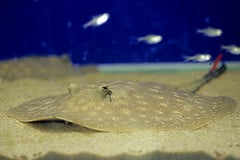
Potamotrygon scobinaMosaic Stingray
authority not recorded
The mosaic stingray, Potamotrygon scobina, is a freshwater stingray found only in the middle and lower Amazon drainage in Brazil. Most captive fish stay below 35 cm across the disc, and it is usually recommended as a good beginners' ray. Other rays, almost always Peruvian, are often mislabelled as scobina. Apparently only the real P. scobina has five rows of spines on the tail.
Potamotrygon sp. "itaituba"P14
authority not recorded
P14, Potamotrygon sp. 'Itaituba', is a freshwater stingray collected from the Rio Tapajos in Brazil. It is unclear whether it is a geographical variant of P. leopoldi or a distinct species. It is smaller, at around 40 cm across the disc, and its light spots are smaller, denser around the edge of the disc and extend to the underside. The name comes from Itaituba, the city the rays are sent to before being shipped on to Santarém.
Potamotrygon sp. "pearl"Pearl Ray
authority not recorded
The pearl ray, Potamotrygon sp. 'Pearl', is an undescribed freshwater stingray from the Rio Tapajos in Brazil. It can exceed 60 cm across the disc, and its patterning is highly variable: some fish have golden markings, others almost white, and the darker pigmentation varies in both shade and coverage. Under the newer R-number system it is known as R080.
Potamotrygon yepeziMaracaibo River Stingray
authority not recorded
The Maracaibo River stingray, Potamotrygon yepezi, is a freshwater stingray from the waters surrounding and feeding Lake Maracaibo in Venezuela. Strictly a freshwater species, it is absent from the brackish lake itself and apparently favours soft mud or sand substrates. Not large for a Potamotrygon at around 40 cm across the disc, it is often confused with P. reticulata, P. humerosa and P. scobina, and the Peruvian P. sp. 'Nazca' is unlikely to be this species.