Genus
Pseudomugil
- Species
- 6
- Photographed
- 6 of 6
- Difficulty rated
- 6 of 6
Where the name comes fromEdit
from the Ancient Greek ψευδής (pseudes), meaning 'false, lying, untrue', used here as a prefix, and the generic name Mugil.
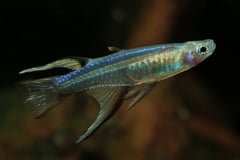
Pseudomugil cyanodorsalisNeon Blue-eye
Allen & Sarti, 1983
The neon blue-eye, Pseudomugil cyanodorsalis, is a euryhaline blue-eye from coastal northern Australia and possibly southern New Guinea. Males are told apart from the rest of the genus by the bright metallic blue upper portion of the body, the source of the alternative name 'blueback blue-eye'. It has been recorded from full marine conditions to pure fresh water, and is generally considered to do better in brackish water. Timid and easily outcompeted, it is unsuitable for the general community.
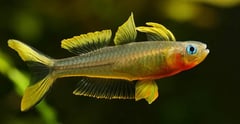
Pseudomugil furcatusForktail Blue-eye
Nichols, 1955
The forktail blue-eye, Pseudomugil furcatus, is a small pseudomugilid endemic to the Northern and Milne Bay provinces of eastern Papua New Guinea. Aquarium stock is bred commercially and apparently derives from a single collection in 1981, so inbreeding can bring reduced fertility and a high rate of deformity in fry. It inhabits heavily-vegetated, clear forest streams and suits a densely-planted, well-chosen community aquarium.
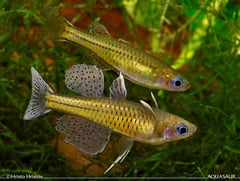
Pseudomugil gertrudaeSpotted Blue-eye
Weber, 1911
The spotted blue-eye, Pseudomugil gertrudae, is a pseudomugilid from northern Australia, Papua New Guinea and the Aru Islands, eastern Indonesia. Wild populations are isolated from one another and differ in colour pattern, body size and fin morphology, but the fish on sale are of a single, commercially produced ornamental strain. Dark spots in the dorsal, anal and caudal fins separate it from other members of the genus except P. paskai and Pseudomugil sp. 'red neon'.
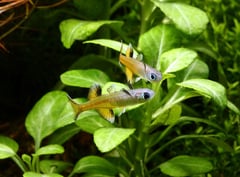
Pseudomugil signiferPacific Blue-eye
Kner, 1866
The Pacific blue-eye, Pseudomugil signifer, is the most widely-distributed blue-eye in Australia, found along most of the eastern coastline. Its habitats range from full marine conditions to pure fresh water, and northern populations often grow considerably larger than southern ones. Recent unpublished analyses apparently suggest it may comprise two or more distinct taxa, and wild fish from the northern and southern ends of its range would not hybridise in captive experiments.
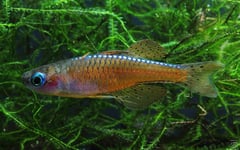
Pseudomugil sp. 'red neon'
authority not recorded
Pseudomugil sp. 'red neon' is an undescribed blue-eye, possibly collected near Timika in Papua province, Indonesia. It first appeared in the hobby in 2011 under names including P. sp. cf. paskai and P. 'iriani'. Initially suspected to be a hybrid or selectively-bred form of P. paskai, it has been shown by DNA sequencing to be an undescribed species close to P. gertrudae and P. paskai. Peaceful but easily outcompeted, it suits a densely-planted aquarium.
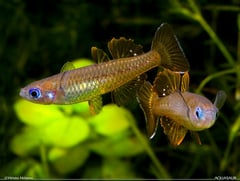
Pseudomugil tenellusDelicate Blue-eye
Taylor, 1964
The delicate blue-eye, Pseudomugil tenellus, is a euryhaline blue-eye with a patchy but wide range in coastal northern Australia. Sometimes called the 'Arnhem Land blue-eye', it is most easily identified by the midlateral scale row, a series of pale spots with darker spaces between that become more conspicuous with age. It is particularly common in densely-vegetated swamps, billabongs and slow-moving streams, and also occurs on the Aru Islands and in southern Papua New Guinea.