Genus
Scleropages
- Species
- 4
- Photographed
- 3 of 4
- Difficulty rated
- 4 of 4
Where the name comes fromEdit
from the Ancient Greek σκληρός (skleros), meaning 'hard', and pages (Latin derivation?), meaning 'leaves', perhaps in reference to the large body scales.

Scleropages formosusAsian Arowana
Müller & Schlegel, 1840
The Asian arowana, Scleropages formosus, is an osteoglossid from the Mekong system, eastern Thailand, Peninsular Malaysia, Sumatra and Borneo. Highly valued in the aquarium trade since the 1970s and listed on Appendix I of CITES since 1975, it is now extirpated across much of its range. It occurs in several colour forms, such as the 'super red' of the upper Kapuas, and three were described as species in 2003, though the majority view treats all of them as S. formosus pending review.

Scleropages inscriptus
Roberts, 2012
Scleropages inscriptus is an osteoglossid said to come from the Tenasserim river basin in Tananthayi Region, southern Myanmar. Its distribution is unclear, and the type specimens were obtained dead from an aquarium fish vendor. Distinctive angulated linear markings on the head and flanks separate it from other members of the genus. The largest of the type series measured 385 mm, but it can apparently attain about 600 mm.
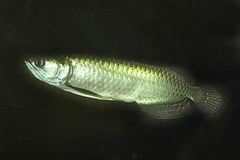
Scleropages jardiniiAustralian Arowana
authority not recorded
The Australian arowana, Scleropages jardinii, is an osteoglossid from still and slow-moving waters in Australia, Papua New Guinea and Indonesia. Known in Australia as the gulf saratoga or northern-spotted barramundi, it has smaller scales, a bronze base colour and duller patterning than the Asian species. It is widely considered the most aggressive arowana in aquaria, and some individuals will not tolerate any tankmates.
Scleropages leichardtiSpotted Australian Arowana
authority not recorded
The spotted Australian arowana, Scleropages leichardti, is an osteoglossid endemic to the Fitzroy River system of north-eastern Queensland, Australia. Known there as the spotted or southern saratoga, it differs from S. jardinii in its spotted scales, forward-pointing barbels, unpatterned gill covers and silver base colour. Indonesia classes it as protected even though it has never been recorded there, probably through misidentified S. jardinii. The species is rare in the hobby.