Genus
Sewellia
- Species
- 8
- Photographed
- 8 of 8
- Difficulty rated
- 8 of 8
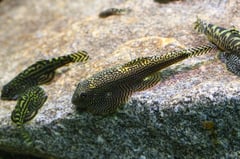
Sewellia albisuera
Freyhof, 2003
Sewellia albisuera is a hillstream loach known only from a handful of localities in the Thu Bon river system, Quang Nam province, central Vietnam. It is very rarely traded but resembles S. sp. 'SEW01', from which it differs in its network of irregular dark reticulations (many small light spots in SEW01). It inhabits shallow, fast-flowing, highly-oxygenated headwaters and tributaries, and the type locality is apparently suffering from pollution.
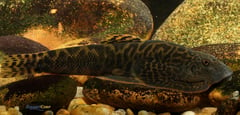
Sewellia elongata
Roberts, 1998
Sewellia elongata is a hillstream loach from the Bolovens plateau in southern Laos, also recorded in the upper Se Kong drainage in central Vietnam. The largest described Sewellia, growing to at least 73 mm SL, it is most similar to S. diardi but has a relatively slender, elongate body. It appeared in the aquarium trade during 2010 and inhabits shallow, fast-flowing, highly-oxygenated headwaters with riffles and runs.
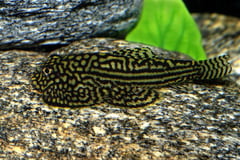
Sewellia lineolataTiger Hillstream Loach
Valenciennes, 1846
The tiger hillstream loach, Sewellia lineolata, is a gastromyzontid loach from fast-flowing headwaters in Vietnam and on the Mekong in Laos. Three to five dark stripes on the body make it difficult to confuse with any other member of the genus. The water must be clean, fast-flowing and well-oxygenated, and Sewellia species are arguably the easiest of all loaches to breed in aquaria.
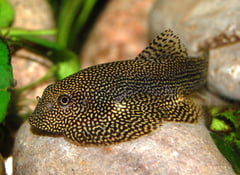
Sewellia sp. 'SEW01'Spotted Butterfly Loach
authority not recorded
The spotted butterfly loach, Sewellia sp. 'SEW01', is a hillstream loach from Quang Nam province in central Vietnam. One of the more readily available members of the genus, it is also called S. sp. 'spotted' or S. sp. 'special' and has many small, light spots on a dark background. It resembles S. albisuera, and it has been suggested the two are the same species, but this does not appear to be the case.
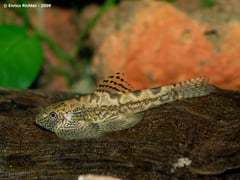
Sewellia sp. 'SEW02'
authority not recorded
Sewellia sp. 'SEW02' is an undescribed hillstream loach whose trade specimens are thought to originate in Hue province, central Vietnam. It first became available in early 2009 and was initially identified as S. breviventralis, but it does not fully match that species or S. elongata and remains in need of identification. It is sometimes sold as 'butterfly loach', a generic name used for several balitorids.
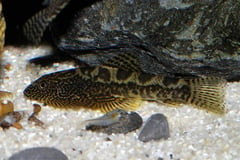
Sewellia sp. 'SEW03'
authority not recorded
Sewellia sp. 'SEW03' is an unidentified hillstream loach thought to originate in Hue province, central Vietnam. First available in early 2009 as S. breviventralis, it cannot be that species because there is no discernible gap between the pelvic and anal fins. It is often imported in mixed batches with S. sp. 'SEW02', which it resembles closely, and needs shallow, fast-flowing, highly-oxygenated water.
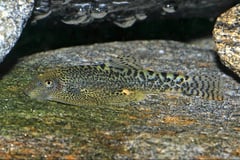
Sewellia sp. 'SEW04'
authority not recorded
Sewellia sp. 'SEW04' is a hillstream loach thought to originate in Hue province, central Vietnam, and may be undescribed. It has been imported among shipments of S. sp. 'SEW02' and S. sp. 'SEW03' and does not appear to correspond to any known member of the genus.
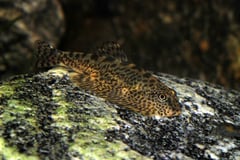
Sewellia speciosa
Roberts, 1998
Sewellia speciosa is a hillstream loach that appears endemic to the Xe Kong river drainage in central Vietnam and southern Laos. It first became available in early 2010 and sometimes appears on trade lists as 'Laos sucker' or 'Laos Sakura sucker'. The spotted body without stripes separates it from the morphologically similar S. lineolata, which is striped, and it inhabits shallow, fast-flowing, highly-oxygenated headwaters.