Genus
Sinibotia
- Species
- 4
- Photographed
- 4 of 4
- Difficulty rated
- 4 of 4
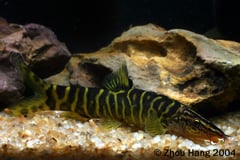
Sinibotia pulchraGolden Zebra Loach
(Wu, 1939)
The golden zebra loach, Sinibotia pulchra, is a botiid loach from the Zhu Jiang (Pearl River) system in southern China. It is also sold as the 'golden Chinese loach' or '12-banded Chinese loach' and, with S. robusta, is the most commonly traded Sinibotia, the two often imported in mixed batches. It is reclusive but very peaceful, and the gregarious nature of the genus means 3-4 should be the minimum purchase.
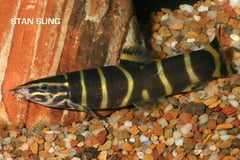
Sinibotia reevesae
(Chang, 1944)
Sinibotia reevesae is a botiid loach described from the middle Yangtze in Luxian County, Sichuan Province, and still known only from that area. It is apparently rare in nature and seldom seen in the trade, arriving occasionally as bycatch in shipments of S. pulchra or S. robusta. It has 7-8 dark vertical bars, and the head lacks the brown vermiform markings of S. pulchra.
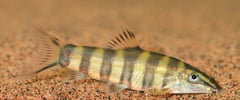
Sinibotia robustaKansu Loach
(Wu, 1939)
The Kansu loach, Sinibotia robusta, is a botiid loach from the Zhu Jiang (Pearl River) system in Guangxi, southern China. Its deeper, stockier body separates it from other Sinibotia. With S. pulchra it is the most commonly traded member of the genus, and the two are often imported in mixed batches. Young fish have around 6 dark bars that usually bifurcate as they mature.
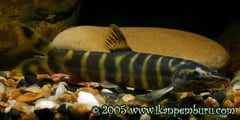
Sinibotia superciliaris
(Günther, 1892)
Sinibotia superciliaris is a botiid loach from the middle Yangtze River drainage in Sichuan and Guizhou provinces, western China. It is rarely seen in the trade, with exports sporadic. It looks very similar to S. pulchra but lacks the brownish markings and spots on the side of the head, and in the wild it was collected from swiftly-flowing stretches with rocky substrates.