Genus
Stiphodon
- Species
- 11
- Photographed
- 11 of 11
- Difficulty rated
- 11 of 11
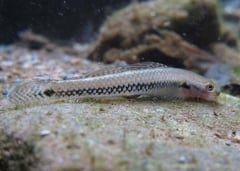
Stiphodon alcedo
Maeda, Mukai & Tachihara, 2011
Stiphodon alcedo is a small stream-dwelling goby known only from the Ryukyu Islands, Japan, in streams on Okinawa and Iriomote. Nuptial males are blackish or sometimes orange with metallic turquoise on the head, and the male's first dorsal fin is pointed but not filamentous. Like other Stiphodon it is a specialised algal grazer with an amphidromous life cycle.
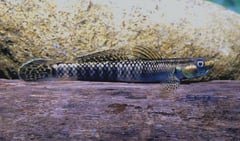
Stiphodon atratus
Watson, 1996
Stiphodon atratus is a stream-dwelling goby from Indonesia, northern New Guinea and islands east to Vanuatu and New Caledonia. Males are blackish, especially on the unpaired fins, and large males appear entirely black between the second dorsal and anal fins. It has been maintained by a few private collectors. Like other Stiphodon it is a specialised algal grazer with an amphidromous life cycle.
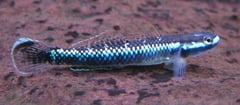
Stiphodon atropurpureusBlue Neon Goby
(Herre, 1927)
The blue neon goby, Stiphodon atropurpureus, is a stream-dwelling goby from southern Japan, Taiwan, southern China, the Philippines and Malaysia. It is available occasionally but often under the wrong name, including S. elegans and 'Sumatran blue neon goby', though it is not found on Sumatra. In males the bright blue-green lateral stripe combined with a reddish outer edge to the first dorsal fin is unique within the genus.
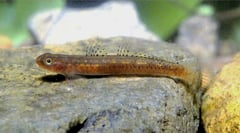
Stiphodon birdsong
Watson, 1996
Stiphodon birdsong is a tiny stream-dwelling goby from Halmahera Island east along the northern coast of Papua New Guinea to Fergusson Island. The largest officially recorded specimen measured just 22.9 mm. It is most similar to S. surrufus and S. mele and differs from them only in meristics, such as tooth and scale counts. Like other Stiphodon it is a specialised algal grazer with an amphidromous life cycle.
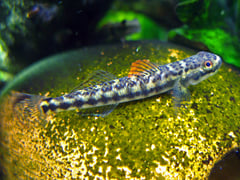
Stiphodon maculidorsalisOrange-fin Stiphodon
Maeda & Tan, 2013
The orange-fin stiphodon, Stiphodon maculidorsalis, is a stream-dwelling goby known only from western Sumatra, Indonesia. Formerly referred to as S. sp. 'orange fin' or 'ST01', it is one of the more commonly traded members of the genus, often in single-sex batches, mixed with other species or misidentified as S. zebrinus. Small black spots on the top of the head and trunk, present in both sexes, are unique within the genus.
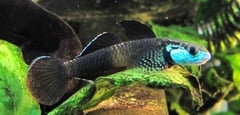
Stiphodon ornatusRainbow Stiphodon
Meinken, 1974
The rainbow stiphodon, Stiphodon ornatus, is a stream-dwelling goby known only from Aceh and West Sumatra provinces, Sumatra, Indonesia. Traded as S. sp. 'rainbow', 'gold fin' or 'gold cheek', it is among the more widely available members of the genus. More than one species may be sold under these names, and males vary a great deal in colour with mood, so identification can be tricky. All Stiphodon in the trade are wild-collected.
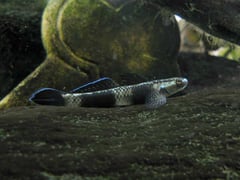
Stiphodon pelewensis
Herre, 1936
Stiphodon pelewensis is a stream-dwelling goby described from Palau and thought to occur through the Mariana Islands and as far as Pohnpei. Its range needs confirmation, since a number of similarly patterned fishes occur across much of Micronesia. It resembles S. weberi, and the two are most easily told apart by the belly, fully scaled in S. pelewensis and unscaled in S. weberi.
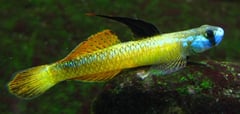
Stiphodon percnopterygionus
Watson & Chen, 1998
Stiphodon percnopterygionus is a small stream-dwelling goby ranging from southern Taiwan through the Ryukyu and Bonin islands to Guam and Palau. Rare in the aquarium trade, it is among the most easily identified in the genus. Males have highly extended fourth and fifth spines in the first dorsal fin, and adults reach only 30-35 mm SL. Like other Stiphodon it is a specialised algal grazer with an amphidromous life cycle.
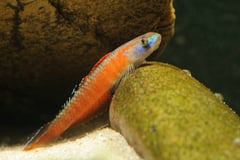
Stiphodon rutilaureus
Watson, 1996
Stiphodon rutilaureus is a small rock-climbing goby from fast island streams, from northern Papua New Guinea east to Vanuatu and Fiji. Males are bright orange-red with 9 to 11 vertical bars and a blue upper lip, cheek and opercle. An algal grazer, it needs clean, well-oxygenated, flowing water.
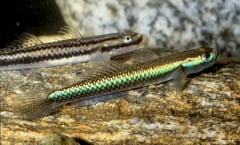
Stiphodon semoniCobalt Blue Goby
Weber, 1895
The cobalt blue goby, Stiphodon semoni, is a stream-dwelling goby ranging from western Sumatra east to northern New Guinea and the Solomon Islands. It has been traded for a number of years but often under the wrong name, including S. elegans and S. atropurpureus. Males have a bright blue metallic stripe from snout to caudal peduncle and rounded, almost hyaline dorsal fins, while those of S. atropurpureus are dusky to black.
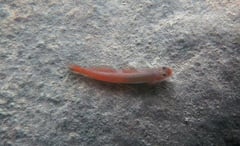
Stiphodon surrufus
Watson & Kottelat, 1995
Stiphodon surrufus is a small stream-dwelling goby described from Leyte in the Philippines and also reported from Okinawa and Yakushima, Japan. Males are reddish in life and lack elongate spines in the first dorsal fin. It was possibly carried north by the Kuroshio Current, and is less abundant there than congeners such as S. percnopterygionus. Like other Stiphodon it is a specialised algal grazer with an amphidromous life cycle.